


Lunar eclipse 2021: Super blood moon will occur today; when and where to watch it in India
Total Lunar Eclipse (Blood Moon) 2021 will start at 2:16 pm IST and will be at its peak at around 4:49 pm IST.

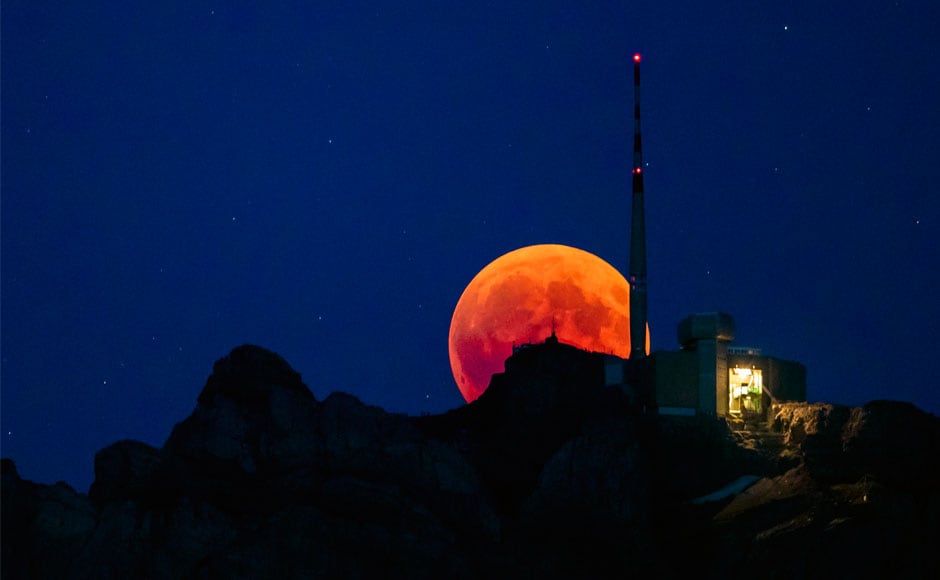
A total lunar eclipse or a Chandra Grahan is also called the Blood moon because of the reddish tinge that appears on the moon during a eclipse.[/caption]The total eclipse will last about 15 minutes as Earth passes directly between the moon and the sun. But the entire show will last five hours, as Earth’s shadow gradually covers the moon, then starts to ebb. The eclipse will be at its peak at around 4:49 pm IST. It will start at 2:16 pm IST and between 4:41 pm IST to 4:56 pm IST, the surface of the moon will be completely covered by Earth’s umbra. This is the time when it will be visible.Unlike a solar eclipse, there’s no harm in looking at an eclipsed moon. The Super Blood Moon will be visible to people in South America, North America, Asia, Australia, Antarctica, the Pacific Ocean and the Indian Ocean. From India, for a small period of time, the eclipse will be visible from the northeastern parts of India (except Sikkim), some parts of West Bengal, some coastal parts of Odisha and Andaman and the Nicobar Islands.There will be two lunar and two solar eclipses this year.A partial lunar eclipse will take place on 19 November. The ending of the partial phase of which will be visible for a very short span of time just after moonrise from extreme northeastern parts of Arunachal Pradesh and Assam. The next total lunar eclipse will be May 2022.When the moon gets in between the sun and the Earth, it causes a solar eclipse. The solar eclipses will occur on 10 June and 4 December in 2021.

Careless Whispers: Scientists discover that plants can 'talk' to each other using smells
Life on Mars? European Space Agency’s Orbiter discovers ice water deposits at equator
Microsoft briefly overtakes Apple as the most valuable company, Apple back on top again
Even NASA is facing a tough time, starts layoffs following major budget cuts
ISRO, NASA's NISAR satellite to get ready by Jan-end, will monitor Earth's snow-covered regions