
Advertisement


Sections
Lab-grown meat to hit markets at $10 patties six years after $280,000 burger introduced
Dutch start-up Mosa Meat's co-founder Mark Post created the first "cultured" beef hamburger in 2013.

Lab-grown meat, first introduced to the world six years ago in the form of a $280,000 hamburger, could hit supermarket shelves at $10 a patty within two years, European start-ups told Reuters.Consumers concerned about climate change, animal welfare and their own health are fueling interest in so-called clean meat, with the number of associated business start-ups climbing from four at the end of 2016 to more than two dozen two years later, according to the Good Food Institute market researcher.Plant-based meat alternatives are also booming. Shares in Beyond Meat have more than tripled in price since its initial public offering in May. Beyond Meat and Impossible Foods each sell 100% plant-based meat alternatives to retailers and fast-food chains across the United States.[caption id="attachment_5570601" align="alignnone" width="1280"]![Representational Image.]() Representational Image.[/caption]And cultured meat grown from animal cells could be next on the mainstream menu, with producers eyeing regulatory approval as they improve the technology and reduce costs.It was Dutch start-up Mosa Meat's co-founder Mark Post who created the first "cultured" beef hamburger in 2013 at a cost of 250,000 euros ($280,400), funded by Google co-founder Sergey Brin, but Mosa Meat and Spain's Biotech Meats say that production costs have fallen dramatically since then."The burger was this expensive in 2013 because back then it was novel science and we were producing at very small scale. Once production is scaled up, we project the cost of producing a hamburger will be around 9 euros," a Mosa Meat spokeswoman told Reuters, adding that it could ultimately become even cheaper than a conventional hamburger.
Representational Image.[/caption]And cultured meat grown from animal cells could be next on the mainstream menu, with producers eyeing regulatory approval as they improve the technology and reduce costs.It was Dutch start-up Mosa Meat's co-founder Mark Post who created the first "cultured" beef hamburger in 2013 at a cost of 250,000 euros ($280,400), funded by Google co-founder Sergey Brin, but Mosa Meat and Spain's Biotech Meats say that production costs have fallen dramatically since then."The burger was this expensive in 2013 because back then it was novel science and we were producing at very small scale. Once production is scaled up, we project the cost of producing a hamburger will be around 9 euros," a Mosa Meat spokeswoman told Reuters, adding that it could ultimately become even cheaper than a conventional hamburger.![First cultured hamburger. Image credit: Wikimedia Commons]() First cultured hamburger. Image credit: Wikimedia Commons[/caption]To make cultured meat, stem cells from the muscle of an animal are placed in a culture medium that is then put in a bioreactor - similar to those used for fermentation of beer and yoghurt - to support growth of new strands of muscle tissue.Liz Specht, associate director at the Good Food Institute market research firm that focuses on meat alternatives, said in a white paper this year that it was likely that cell-based meat would achieve price parity with conventional meat once production is on an industrial scale.Specht identified the cell culture medium as the most significant cost driver and said it was possible to produce it without animal-derived components and at much lower prices.Interest in the category has ensured start-ups have had ample access to funding.Biotech Foods' Vila said the company had sufficient funds up to 2021, the year it hopes to generate its first revenue, thanks to a capital injection from an unidentified investor.Mosa Meat has meat processors Bell Food Group and Merck KGaA's venture capital arm M Ventures among its investors.In May food and agriculture group, Cargill announced it had invested in cultured meat company Aleph Farms.
First cultured hamburger. Image credit: Wikimedia Commons[/caption]To make cultured meat, stem cells from the muscle of an animal are placed in a culture medium that is then put in a bioreactor - similar to those used for fermentation of beer and yoghurt - to support growth of new strands of muscle tissue.Liz Specht, associate director at the Good Food Institute market research firm that focuses on meat alternatives, said in a white paper this year that it was likely that cell-based meat would achieve price parity with conventional meat once production is on an industrial scale.Specht identified the cell culture medium as the most significant cost driver and said it was possible to produce it without animal-derived components and at much lower prices.Interest in the category has ensured start-ups have had ample access to funding.Biotech Foods' Vila said the company had sufficient funds up to 2021, the year it hopes to generate its first revenue, thanks to a capital injection from an unidentified investor.Mosa Meat has meat processors Bell Food Group and Merck KGaA's venture capital arm M Ventures among its investors.In May food and agriculture group, Cargill announced it had invested in cultured meat company Aleph Farms.
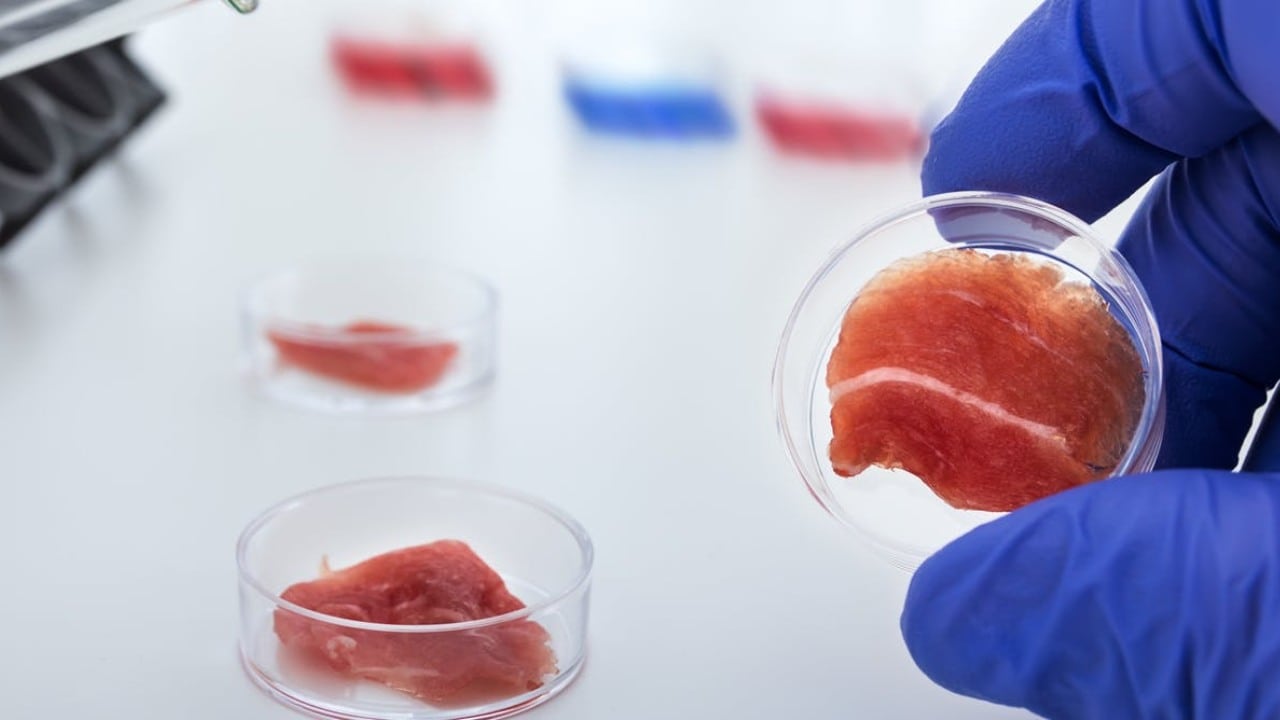 Representational Image.[/caption]And cultured meat grown from animal cells could be next on the mainstream menu, with producers eyeing regulatory approval as they improve the technology and reduce costs.It was Dutch start-up Mosa Meat's co-founder Mark Post who created the first "cultured" beef hamburger in 2013 at a cost of 250,000 euros ($280,400), funded by Google co-founder Sergey Brin, but Mosa Meat and Spain's Biotech Meats say that production costs have fallen dramatically since then."The burger was this expensive in 2013 because back then it was novel science and we were producing at very small scale. Once production is scaled up, we project the cost of producing a hamburger will be around 9 euros," a Mosa Meat spokeswoman told Reuters, adding that it could ultimately become even cheaper than a conventional hamburger.
PRICE PARITY
Biotech Foods co-founder Mercedes Vila also highlighted the importance of moving from lab to factory. "Our goal is to reach production scale and have regulatory approval by 2021," Vila said.She said the average cost of producing a kilogram of cultured meat is now about 100 euros, significantly below the $800 cited a year ago by Future Meat Technologies, an Israeli biotech company that has received funding from U.S. meat processor Tyson Foods.Biotech Foods, Mosa Meat and Higher Steaks, a London-based competitor also contacted by Reuters, have yet to file applications for EU approval because they are still working to improve their growth serum.[caption id="attachment_6981141" align="alignnone" width="1280"] First cultured hamburger. Image credit: Wikimedia Commons[/caption]To make cultured meat, stem cells from the muscle of an animal are placed in a culture medium that is then put in a bioreactor - similar to those used for fermentation of beer and yoghurt - to support growth of new strands of muscle tissue.Liz Specht, associate director at the Good Food Institute market research firm that focuses on meat alternatives, said in a white paper this year that it was likely that cell-based meat would achieve price parity with conventional meat once production is on an industrial scale.Specht identified the cell culture medium as the most significant cost driver and said it was possible to produce it without animal-derived components and at much lower prices.
ENERGY EFFICIENCY
Proponents of this new technology say it's the only environmentally sustainable way to satisfy meat demand that the United Nations' Food and Agriculture Organization expects to double between 2000 and 2050.But John Lynch, an environmental scientist at the University of Oxford, said it remains unclear whether scalable lab-grown meat production can really convert energy and nutrients into meat more efficiently than conventional meat production."Some studies have suggested that cultured meat may require less of a 'feed' source than conventional livestock production, but require more energy. If this is the case, then their impact on the climate will depend on where this energy comes from," he said.First Published:Jul 12, 2019, 12:43:25 IST
Advertisement
Advertisement

Careless Whispers: Scientists discover that plants can 'talk' to each other using smells
Japanese scientists have recorded a video that shows plants, in certain conditions, communicate with each other using mists that carry smells. The discovery, reveals that plants release a fine mist of airborne compounds, to warn nearby plants of potential dangers
Life on Mars? European Space Agency’s Orbiter discovers ice water deposits at equator
European Space Agency's Mars Express Orbiter has identified massive ice and ice water deposits beneath the surface of Mars. The Mars Express orbiter was also the first to confirmed the presence of ice on Mars in 2004
Microsoft briefly overtakes Apple as the most valuable company, Apple back on top again
At its peak during the session, Microsoft's value reached $2.903 trillion, with a 2% surge. As of writing this article, Apple closed at $2.89 trillion, whereas Microsoft closed at $2.86 trillion
Even NASA is facing a tough time, starts layoffs following major budget cuts
NASA is facing some massive budget cuts, because of which, it has been forced to postpone some upcoming missions. NASA's Jet Propulsion Laboratory has been hit hard by recent federal budget cuts, resulting in the layoff of 100 contractors last week
ISRO, NASA's NISAR satellite to get ready by Jan-end, will monitor Earth's snow-covered regions
The NISAR satellite which has been developed jointly ISRO and NASA, should be ready for launch by the end of January 2024. The collaboration between NASA and ISRO on NISAR is the first time the two agencies have cooperated on hardware development for an Earth-observing mission
Advertisement
Advertisement