


Japan scientists to study asteroid Ryugu samples for source of heat, clues of life on Earth
JAXA is continuing an initial examination of the asteroid samples ahead of fuller studies next year.

Japanese space experts said Thursday they will examine soil samples brought back from a distant asteroid in an attempt to find the source of heat that altered the celestial body, in their search for clues to the origin of the solar system and life on Earth. Scientists at the Japan Aerospace Exploration Agency said they have made a preliminary examination of 5.4 grams (0.19 ounce) of soil, far more than the minimum 0.1 gram sample they had hoped for, which the Hayabusa2 spacecraft brought back in December from the asteroid Ryugu, more than 300 million kilometers (190 million miles) from Earth.
About 3 grams (0.1 ounce) of the black granules are from Ryugu’s surface and were gathered when Hayabusa2 touched down on the asteroid in April 2019. About 2 grams of larger fragments, up to about 1 centimeter (0.4 inch), were obtained from under the surface in a crater made by Hayabusa2 when it landed a second time three months later.
 More from Science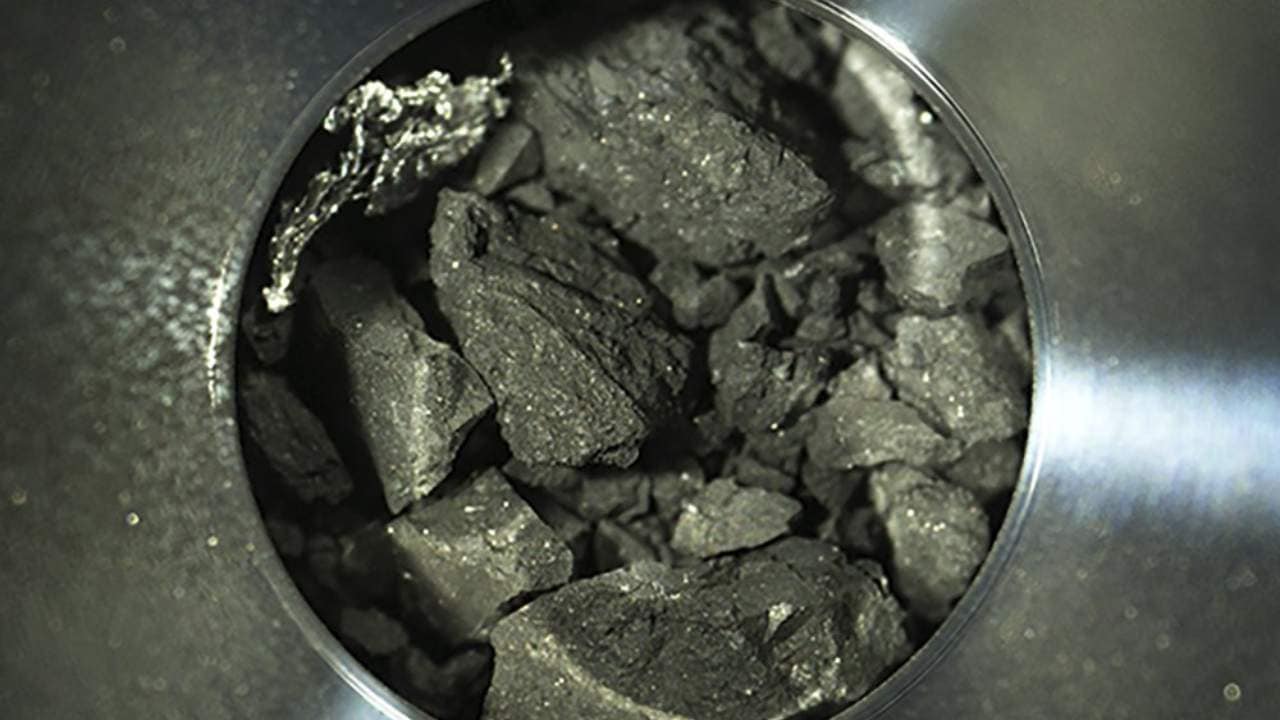
Soil samples, seen inside the A compartment of the capsule brought back by Hayabusa 2, in Sagamihara, near Tokyo. Image: JAXA via AP[/caption]Kohei Kitazato, a University of Aizu planetary scientist working with JAXA, said his team found indications of heat exceeding 300 degrees Celsius (572 degrees Fahrenheit) both on the asteroid surface and underground.He said the soil underground would not reach that temperature from the heat of the sun alone, suggesting that radiative internal heat or planetary collisions affected Ryugu when it was still part of a parent body billions of years ago, causing evaporation of its water. His earlier study, jointly conducted with Brown University scholars and more than 30 other institutions, was published in the magazine Nature Astronomy last month.JAXA is continuing an initial examination of the asteroid samples ahead of fuller studies next year. Scientists will also examine possible traces of organic matter in hopes they will provide insights into the origins of the solar system and life on Earth. Following studies in Japan, some of the samples will be shared with NASA and other international space agencies for additional research.Hayabusa2 is continuing on an 11-year expedition to another small and distant asteroid, 1998KY26, to study possible defenses against meteorites that could fly toward Earth, while conducting various tests that could be used in future Japanese space missions, including its planned 2024 MMX sample-return mission from one of the Martian moons.

Careless Whispers: Scientists discover that plants can 'talk' to each other using smells
Life on Mars? European Space Agency’s Orbiter discovers ice water deposits at equator
Microsoft briefly overtakes Apple as the most valuable company, Apple back on top again
Even NASA is facing a tough time, starts layoffs following major budget cuts
ISRO, NASA's NISAR satellite to get ready by Jan-end, will monitor Earth's snow-covered regions