


James Webb: Most powerful space telescope built, will look back at the Dark Ages of the universe
The Dark Ages ended when gravity formed the first stars and galaxies that eventually began to emit the first light and astronomers don’t know when it happened, the best guess is that it was several hundred million years after the Big Bang.

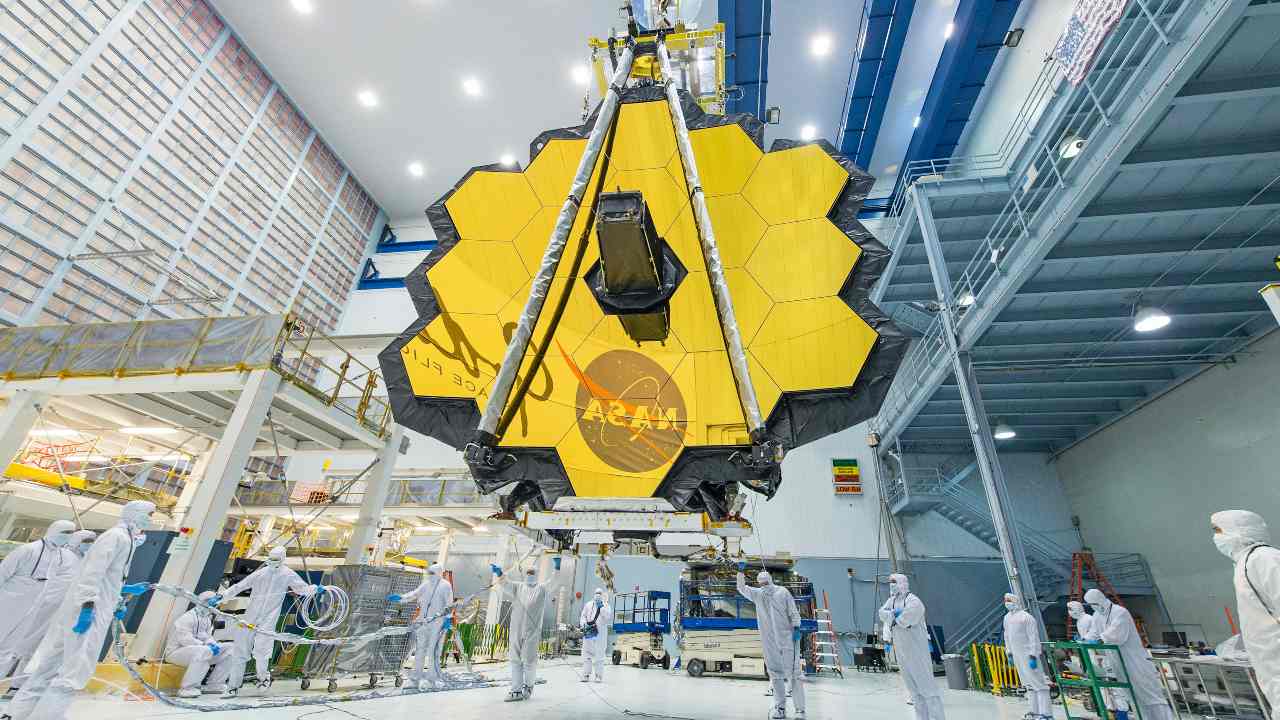
he James Webb Space Telescope is the biggest orbital telescope ever built and is scheduled to be launched into space on Dec. 18, 2021. NASA/Desiree Stover,[/caption]
The ‘Dark Ages’ of the universe
Excellent evidence shows that the universe started with an event called the Big Bang 13.8 billion years ago, which left it in an ultra-hot, ultra-dense state. The universe immediately began expanding after the Big Bang, cooling as it did so. One second after the Big Bang, the universe was a hundred trillion miles across with an average temperature of an incredible 18 billion F (10 billion C). Around 400,000 years after the Big Bang, the universe was 10 million light years across and the temperature had cooled to 5,500 F (3,000 C). If anyone had been there to see it at this point, the universe would have been glowing dull red like a giant heat lamp.Throughout this time, space was filled with a smooth soup of high energy particles, radiation, hydrogen and helium. There was no structure. As the expanding universe became bigger and colder, the soup thinned out and everything faded to black. This was the start of what astronomers call the Dark Ages of the universe.The soup of the Dark Ages was not perfectly uniform and due to gravity, tiny areas of gas began to clump together and become more dense. The smooth universe became lumpy and these small clumps of denser gas were seeds for the eventual formation of stars, galaxies and everything else in the universe.Although there was nothing to see, the Dark Ages were an important phase in the evolution of the universe.
Looking for the first light
Telescope as a time machine
Enter the James Webb Space Telescope.Telescopes are like time machines. If an object is 10,000 light-years away, that means the light takes 10,000 years to reach Earth. So the further out in space astronomers look, the further back in time we are looking.Engineers optimized James Webb for specifically detecting the faint infrared light of the earliest stars or galaxies. Compared to the Hubble Space Telescope, James Webb has a 15 times wider field of view on its camera, collects six times more light and its sensors are tuned to be most sensitive to infrared light.The strategy will be to stare deeply at one patch of sky for a long time, collecting as much light and information from the most distant and oldest galaxies as possible. With this data, it may be possible to answer when and how the Dark Ages ended, but there are many other important discoveries to be made. For example, unravelling this story may also help explain the nature of dark matter, the mysterious form of matter that makes up about 80 percent of the mass of the universe.James Webb is the most technically difficult mission NASA has ever attempted. But I think the scientific questions it may help answer will be worth every ounce of effort. I and other astronomers are waiting excitedly for the data to start coming back sometime in 2022. Chris Impey, University Distinguished Professor of Astronomy, University of ArizonaThis article is republished from The Conversation under a Creative Commons license. Read the original article.

Careless Whispers: Scientists discover that plants can 'talk' to each other using smells
Life on Mars? European Space Agency’s Orbiter discovers ice water deposits at equator
Microsoft briefly overtakes Apple as the most valuable company, Apple back on top again
Even NASA is facing a tough time, starts layoffs following major budget cuts
ISRO, NASA's NISAR satellite to get ready by Jan-end, will monitor Earth's snow-covered regions