


ISS astronauts complete third spacewalk in three weeks to fix cosmic ray detector
The spectrometer was never meant for hands-on repairs like this and was designed to last just three years.

Spacewalking astronauts installed new pumps on a cosmic ray detector outside the International Space Station on Monday in a bid to extend its scientific life.
It was the third spacewalk in nearly three weeks for Italy’s Luca Parmitano and NASA’s Andrew Morgan. One more spacewalk remains before NASA can declare the Alpha Magnetic Spectrometer successfully repaired.
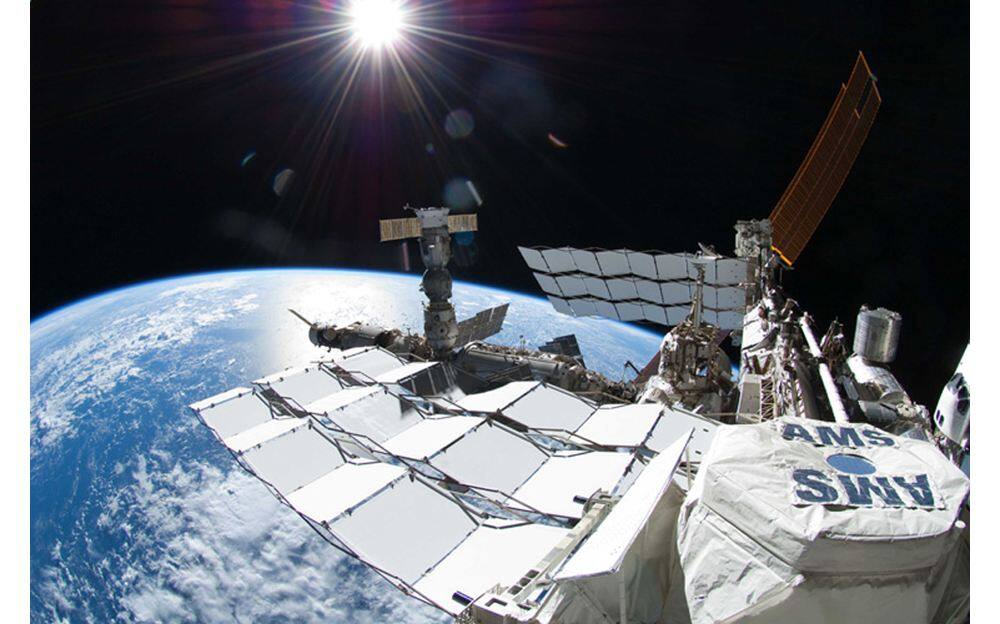
The Alpha Magnetic Spectrometer has been hunting for antimatter and dark matter for 8 ½ years.[/caption]NASA compared the series of four spacewalks — the most complex since the Hubble Space Telescope missions — with heart bypass surgery because they are designed to bypass the old, degraded pumps.
The $2 billion spectrometer was never meant for hands-on repairs like this and was designed to last just three years. If the new plumbing holds, the instrument should last the entire life of the space station, or another five to 10 years.
Given the high stakes, Mission Control urged the spacewalkers to “take good care” of the pumps. Parmitano clutched the 159-kilogram box of pumps, a bulky 107 centimetres by 82 centimetres, with both hands as he headed toward the spectrometer.
 More from Science
Astronauts Luca Parmitano and Andrew Morgan work on the cosmic ray detector. Image credit: Twitter[/caption]“Good news. We show that we can tear things apart and build them back up,” said Morgan.
Mission Control cautioned, “We’ve got a little way to go yet, but we agree.”
Next was the spacewalkers’ toughest job: splicing eight stainless steel tubes that were cut on the 22 November spacewalk, into the new pumps. The astronauts hustled through the plumbing work and even squeezed in an extra chore, wrapping a thermal blanket onto the spectrometer. They completed the spacewalk in six hours, quicker than planned.

Careless Whispers: Scientists discover that plants can 'talk' to each other using smells
Life on Mars? European Space Agency’s Orbiter discovers ice water deposits at equator
Microsoft briefly overtakes Apple as the most valuable company, Apple back on top again
Even NASA is facing a tough time, starts layoffs following major budget cuts
ISRO, NASA's NISAR satellite to get ready by Jan-end, will monitor Earth's snow-covered regions