
Advertisement


Sections
ISRO's Space Shuttle-like Reusable Launch Vehicle will attempt its first landing in Karnataka
India's RLV includes a Space Shuttle-like craft that could feature an air-breathing ramjet engine.

The Indian Space Research Organisation (ISRO) is finally following in the footsteps of NASA and SpaceX by developing a space program for Reusable Launch Vehicles (RLV) which it has been testing since 2016.The RLV program aims to cut down on launch costs by, well, reusing the spacecraft. ISRO's current project appears to be using a hybrid design that sits somewhere between NASA's now-shuttered Space Shuttle program and SpaceX's reusable rockets.India's RLV includes a Space Shuttle-like craft that could feature an air-breathing ramjet engine. This craft will take a payload to space and then glide back to Earth, landing like a normal aircraft, much like the Space Shuttle. The rocket that will take this shuttle to orbit will return to Earth much like Musk's Falcon 9 rockets. It will return under its own power and make a landing on a floating platform out at sea.So far, the RLV shuttle has been tested over water. Now, it will be tested over land and make an attempt at an actual landing.[caption id="attachment_7506331" align="alignnone" width="1280"]![An artist illustration of the RLV-TD concept. Image: ISRO]() An artist illustration of the RLV-TD concept. Image: ISRO[/caption]The scientists at ISRO will be tracking the flight and landing of the RLV at the Aeronautical Test Range (ATR) at Challakere in Chitradurga district, Karnataka.The ATR has 2.2 km runway and the RLV will be dropped from a helicopter at an altitude of three km. According to a report in the Deccan Chronicle, an onboard computer will help the RLV glide for some distance before touching down on the runway like an aircraft.The launch vehicle is critical to unleashing ISRO’s dreams of human space flight, Gaganyaan. It will also help to further cut the cost of launches.The first demonstration of the rocket's concept was tested on 23 May 2016, when ISRO carried out its 'Hypersonic Flight Experiment' of a two-stage-to-orbit (TSTO), fully-reusable rocket.[caption id="attachment_7506351" align="alignnone" width="700"]
An artist illustration of the RLV-TD concept. Image: ISRO[/caption]The scientists at ISRO will be tracking the flight and landing of the RLV at the Aeronautical Test Range (ATR) at Challakere in Chitradurga district, Karnataka.The ATR has 2.2 km runway and the RLV will be dropped from a helicopter at an altitude of three km. According to a report in the Deccan Chronicle, an onboard computer will help the RLV glide for some distance before touching down on the runway like an aircraft.The launch vehicle is critical to unleashing ISRO’s dreams of human space flight, Gaganyaan. It will also help to further cut the cost of launches.The first demonstration of the rocket's concept was tested on 23 May 2016, when ISRO carried out its 'Hypersonic Flight Experiment' of a two-stage-to-orbit (TSTO), fully-reusable rocket.[caption id="attachment_7506351" align="alignnone" width="700"]![An illustration showing the different stages in the RLV technology demonstration, from launch to landing of both stages. Image: ISRO]() An illustration showing the different stages in the RLV technology demonstration, from launch to landing of both stages. Image: ISRO[/caption]Four aspects of the vehicle are to be tested:
An illustration showing the different stages in the RLV technology demonstration, from launch to landing of both stages. Image: ISRO[/caption]Four aspects of the vehicle are to be tested:
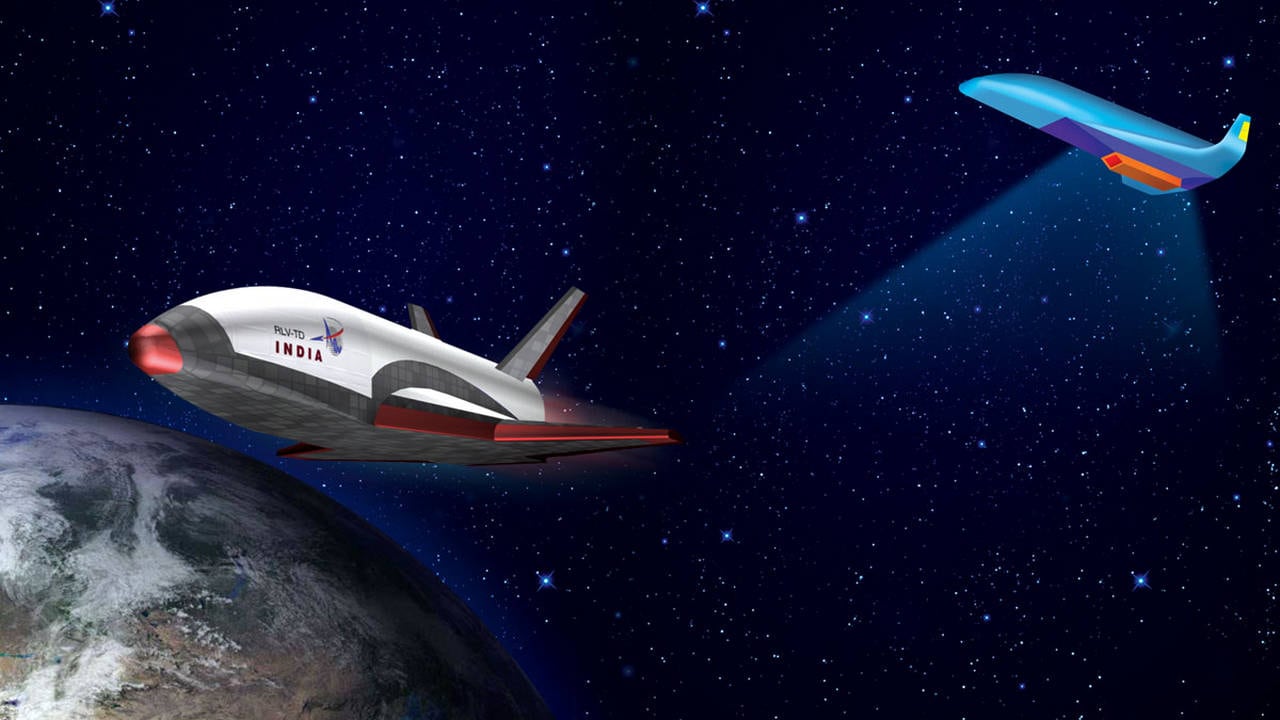 An artist illustration of the RLV-TD concept. Image: ISRO[/caption]The scientists at ISRO will be tracking the flight and landing of the RLV at the Aeronautical Test Range (ATR) at Challakere in Chitradurga district, Karnataka.The ATR has 2.2 km runway and the RLV will be dropped from a helicopter at an altitude of three km. According to a report in the Deccan Chronicle, an onboard computer will help the RLV glide for some distance before touching down on the runway like an aircraft.The launch vehicle is critical to unleashing ISRO’s dreams of human space flight, Gaganyaan. It will also help to further cut the cost of launches.The first demonstration of the rocket's concept was tested on 23 May 2016, when ISRO carried out its 'Hypersonic Flight Experiment' of a two-stage-to-orbit (TSTO), fully-reusable rocket.[caption id="attachment_7506351" align="alignnone" width="700"]
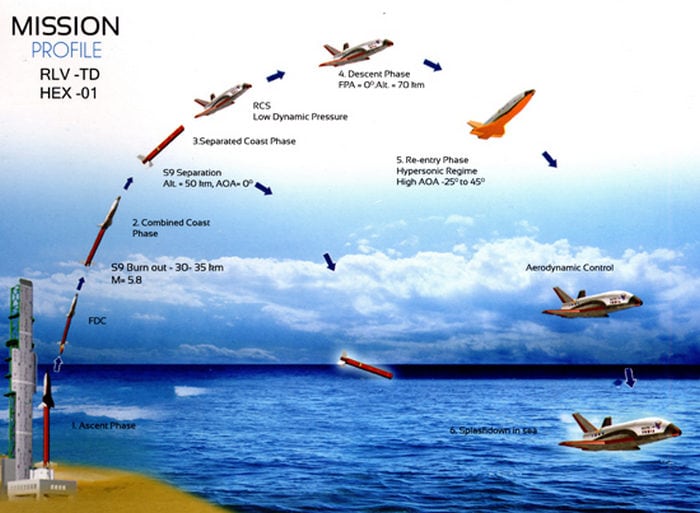 An illustration showing the different stages in the RLV technology demonstration, from launch to landing of both stages. Image: ISRO[/caption]Four aspects of the vehicle are to be tested:
- hypersonic flight, tested in the hypersonic flight experiment (HEX)
- autonomous landing, to be tested in the landing experiment (LEX)
- powered cruise flight
- hypersonic flight with air-breathing propulsion, to be tested in the scramjet propulsion experiment (SPEX)
First Published:Oct 16, 2019, 13:04:58 IST
Advertisement
Advertisement

Careless Whispers: Scientists discover that plants can 'talk' to each other using smells
Japanese scientists have recorded a video that shows plants, in certain conditions, communicate with each other using mists that carry smells. The discovery, reveals that plants release a fine mist of airborne compounds, to warn nearby plants of potential dangers
Life on Mars? European Space Agency’s Orbiter discovers ice water deposits at equator
European Space Agency's Mars Express Orbiter has identified massive ice and ice water deposits beneath the surface of Mars. The Mars Express orbiter was also the first to confirmed the presence of ice on Mars in 2004
Microsoft briefly overtakes Apple as the most valuable company, Apple back on top again
At its peak during the session, Microsoft's value reached $2.903 trillion, with a 2% surge. As of writing this article, Apple closed at $2.89 trillion, whereas Microsoft closed at $2.86 trillion
Even NASA is facing a tough time, starts layoffs following major budget cuts
NASA is facing some massive budget cuts, because of which, it has been forced to postpone some upcoming missions. NASA's Jet Propulsion Laboratory has been hit hard by recent federal budget cuts, resulting in the layoff of 100 contractors last week
ISRO, NASA's NISAR satellite to get ready by Jan-end, will monitor Earth's snow-covered regions
The NISAR satellite which has been developed jointly ISRO and NASA, should be ready for launch by the end of January 2024. The collaboration between NASA and ISRO on NISAR is the first time the two agencies have cooperated on hardware development for an Earth-observing mission
Advertisement
Advertisement