
Advertisement


Sections
ISRO reveals plans for Gaganyaan's unmanned missions in 2020 aboard GSLV MkIII D2 rocket
We will follow all the parameters & if it doesn't work, we will fly a second unmanned mission: Sivan.

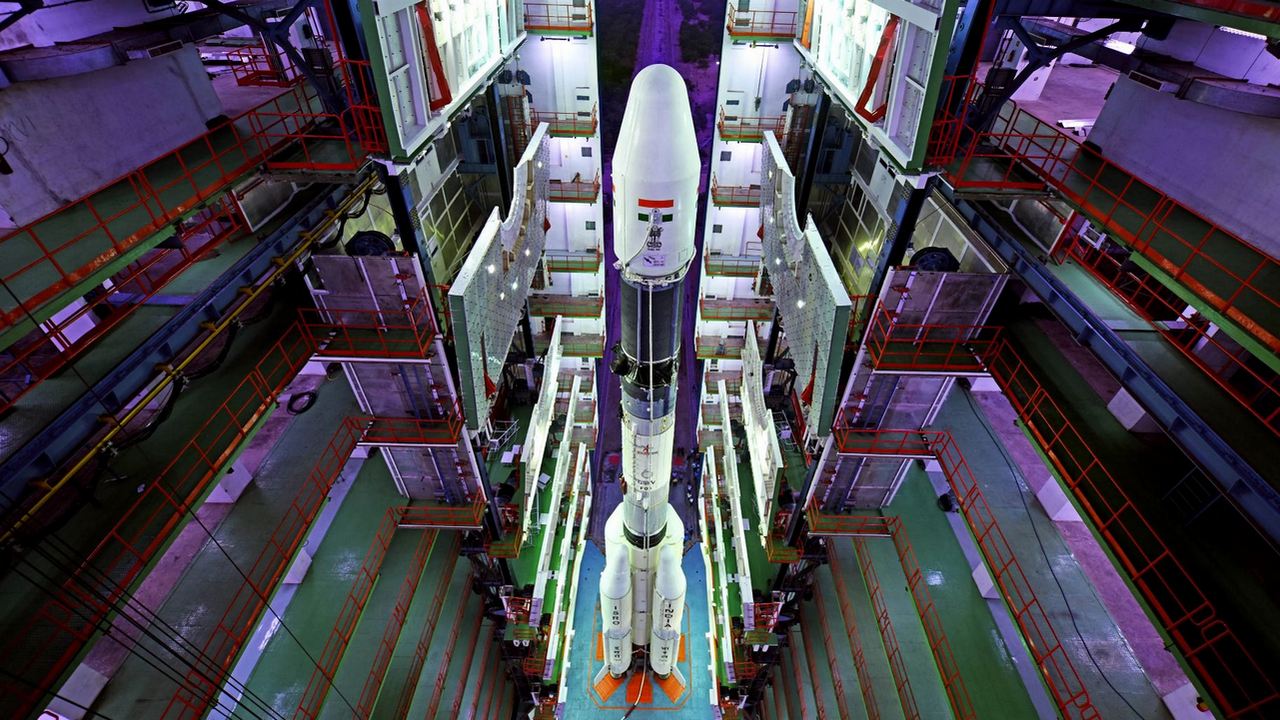 A fully-integrated GSLV stands inside the Vehicle Assembly Building at the Satish Dhawan Space Centre in Sriharikota. Image: ISRO[/caption]Sivan also announced that ISRO will have two such unmanned missions with the GSLV-MkIII rocket before it carries Indian astronauts to low-Earth orbit.
"(The) third one will be (a) manned mission. First, we will follow all the parameters and if it does not work, we will fly the second unmanned mission. Once it gets confirmed, we will go for (a) human mission," Sivan said.The unmanned mission will test India’s capabilities to launch humans into space, sustain them for 5-7 days as they carry out experiments, and bring them back safely, the ISRO chief explained.Gaganyaan’s crew module to house astronauts, its life support systems to keep them alive in space, and the spacecraft's environmental-control systems have already been developed according to earlier reports.[caption id="attachment_5554321" align="alignnone" width="1280"]
 ISRO Chairman K Shivan addressing the press in New Delhi on 28 August 2018. Image courtesy: Department of Space[/caption]The GSLV-MkIII-D2, which will be used to carry the astronauts to space is "excellent, reliable, simple," in Sivan's view.The 43.4-metre tall GSLV-MkIII rocket weighs roughly 640 tonnes and equipped to carry satellites as heavy as four tonnes into space.The successful launch of GSAT-29 adds to a series of test flights ISRO is carrying out to develop the agency’s heaviest rocket for the manned space mission.ISRO had flown a similar rocket on 5 June 2017 when it launched GSAT-19, another communication satellite developed by the agency, in the rocket's historic first developmental launch.When asked about launch plans for Gaganyaan, Sivan said, "It will be happening from Sriharikota… and for that launch, we have to modify the launch pad."
First Published:Nov 15, 2018, 13:49:44 IST
Advertisement
Advertisement

Careless Whispers: Scientists discover that plants can 'talk' to each other using smells
Japanese scientists have recorded a video that shows plants, in certain conditions, communicate with each other using mists that carry smells. The discovery, reveals that plants release a fine mist of airborne compounds, to warn nearby plants of potential dangers
Life on Mars? European Space Agency’s Orbiter discovers ice water deposits at equator
European Space Agency's Mars Express Orbiter has identified massive ice and ice water deposits beneath the surface of Mars. The Mars Express orbiter was also the first to confirmed the presence of ice on Mars in 2004
Microsoft briefly overtakes Apple as the most valuable company, Apple back on top again
At its peak during the session, Microsoft's value reached $2.903 trillion, with a 2% surge. As of writing this article, Apple closed at $2.89 trillion, whereas Microsoft closed at $2.86 trillion
Even NASA is facing a tough time, starts layoffs following major budget cuts
NASA is facing some massive budget cuts, because of which, it has been forced to postpone some upcoming missions. NASA's Jet Propulsion Laboratory has been hit hard by recent federal budget cuts, resulting in the layoff of 100 contractors last week
ISRO, NASA's NISAR satellite to get ready by Jan-end, will monitor Earth's snow-covered regions
The NISAR satellite which has been developed jointly ISRO and NASA, should be ready for launch by the end of January 2024. The collaboration between NASA and ISRO on NISAR is the first time the two agencies have cooperated on hardware development for an Earth-observing mission
Advertisement
Advertisement