


Infrared images of Saturn's moon Enceladus shows fresh ice churning, landscape surfacing
While it is known that the moon's South Pole is relatively young, new images show fresh ice churning in the North Pole as well.

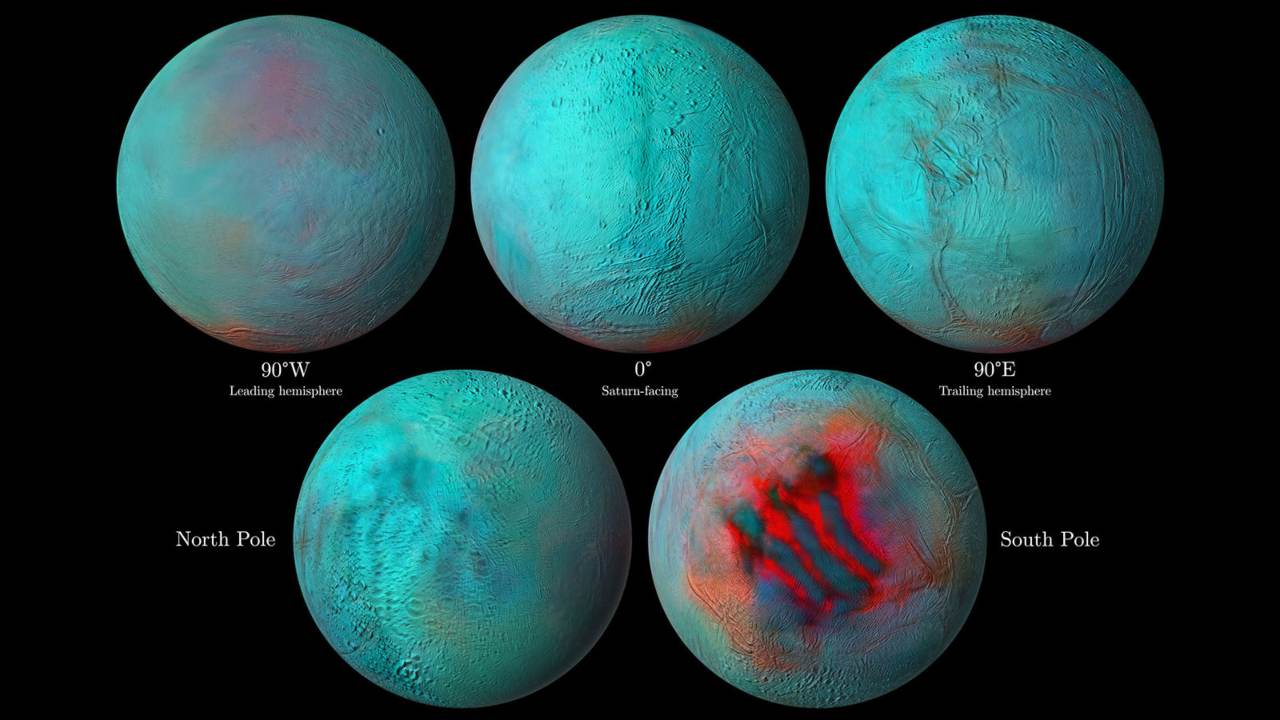
Detailed infrared images of Saturn's icy moon Enceladus, with reddish areas indicating fresh ice that has been deposited on the surface. Image Credit: NASA/JPL-Caltech/University of Arizona/LPG/CNRS/University of Nantes/Space Science Institute[/caption]The craft had a Visible and Infrared Mapping Spectrometer (VIMS) that collected light reflected off the surface of Saturn, its rings and its ten major icy moons. As the instrument captured lights in different wavelengths, it then separated them to give more information about the material that was reflecting the light.Thereafter, in a bid to map the moon, data from the VIMS was combined with detailed images captured by Cassini’s Imaging Science Subsystem (ISS) to make composite images.The recent images reveal that a geologic activity like resurfacing of the landscape has occurred in both the hemispheres of Enceladus. While it was known that the South Pole is young, some fresh ice has been churning out in the North Pole as well.Gabriel Tobie, VIMS scientist with the University of Nantes in France and co-author of the latest study said, “The infrared shows us that the surface of the South Pole is young, which is not a surprise because we knew about the jets that blast icy material there”.Further, the infrared images prove that “one large region in the Northern Hemisphere” was also apparently young and “probably active not that long ago, in geologic timelines”.The study is accessible from the journal Icarus.

Careless Whispers: Scientists discover that plants can 'talk' to each other using smells
Life on Mars? European Space Agency’s Orbiter discovers ice water deposits at equator
Microsoft briefly overtakes Apple as the most valuable company, Apple back on top again
Even NASA is facing a tough time, starts layoffs following major budget cuts
ISRO, NASA's NISAR satellite to get ready by Jan-end, will monitor Earth's snow-covered regions