


Hyperion, the largest galaxy supercluster recorded of the early cosmos unvieled
A million billion times the sun's mass, Hyperion looks to Earth as it did billions of years ago.

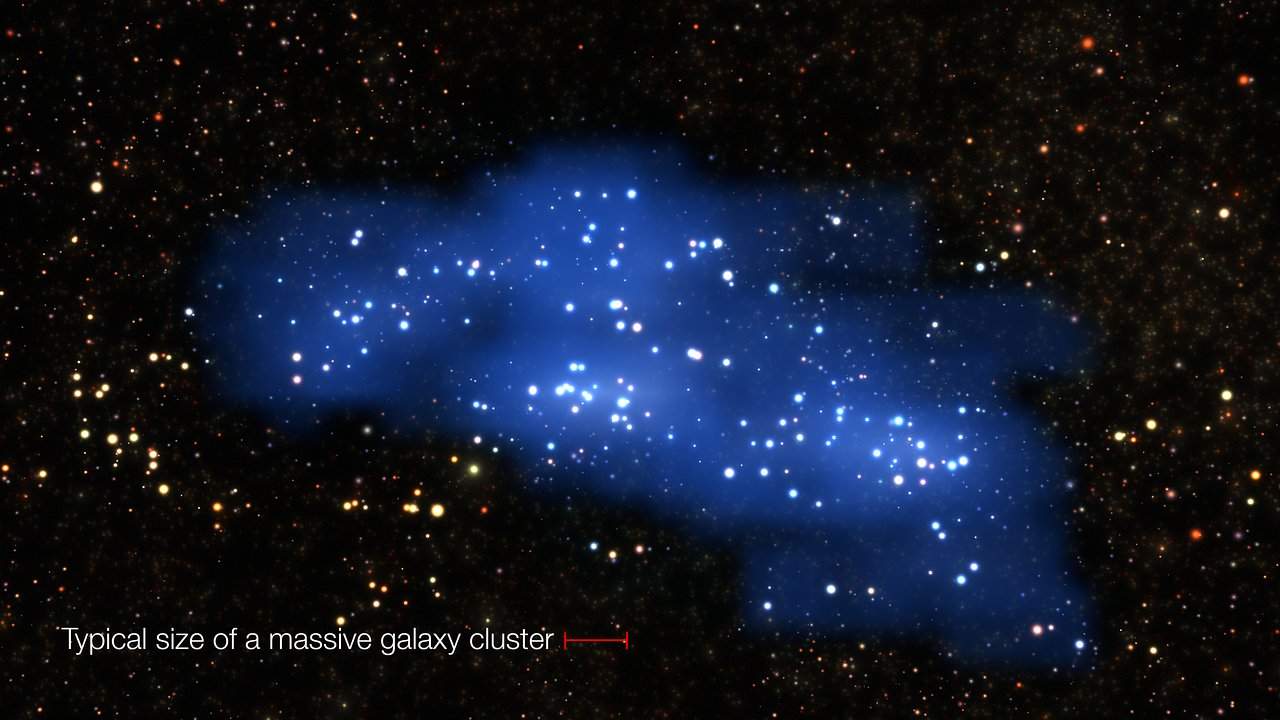
This visualisation shows the extent of Hyperion compared to the size of a typical massive galaxy cluster in the local universe. Image courtesy: ESO[/caption]Hyperion is an adolescent in astronomy terms. Its distance from earth means astronomers are viewing it as it was created just over 2 billion years after the Big Bang, which gave rise to the universe about 13.8 billion years ago.“These are galaxies very far from us, almost at the beginning of the universe, and allow us to understand better how the universe evolved from the Big Bang until the present day,” Miefke said.“Hyperion is a sixth of the age of the universe. It’s as though we were able to look at the adolescence of an 80-year-old human being.”The Milky Way galaxy, which hosts our Solar System, is about 13.6 billion years old.Hyperion was detected using the Visible Multi-Object Spectrograph, which according to its handlers acts as a “time machine in the middle of desert, showing us how the universe looked when it was just a third of its current age.”

Careless Whispers: Scientists discover that plants can 'talk' to each other using smells
Life on Mars? European Space Agency’s Orbiter discovers ice water deposits at equator
Microsoft briefly overtakes Apple as the most valuable company, Apple back on top again
Even NASA is facing a tough time, starts layoffs following major budget cuts
ISRO, NASA's NISAR satellite to get ready by Jan-end, will monitor Earth's snow-covered regions