


Hubble telescope captures close-up shot of ‘celebrity’ comet NEOWISE as it passes by the Sun
NASA’s Hubble telescope captured close-up shots of the coma of the comet which is the cloud of gas and dust that surrounds the icy nucleus of the comet.

Comet Neowise, or C/20202 F3, proved to be one of the brightest comet ever seen from the Earth’s surface when it was fully visible in the northern hemisphere in mid-July.
The rare comet is about five kilometres across and its nucleus is covered with sooty material dating back to the origin of our solar system 4.6 billion years ago. Now NASA’s Hubble telescope captured close-up shots of the coma of the comet, and the results are illuminating. The coma is a cloud formed of gas and dust that surrounds the icy nucleus of the comet.
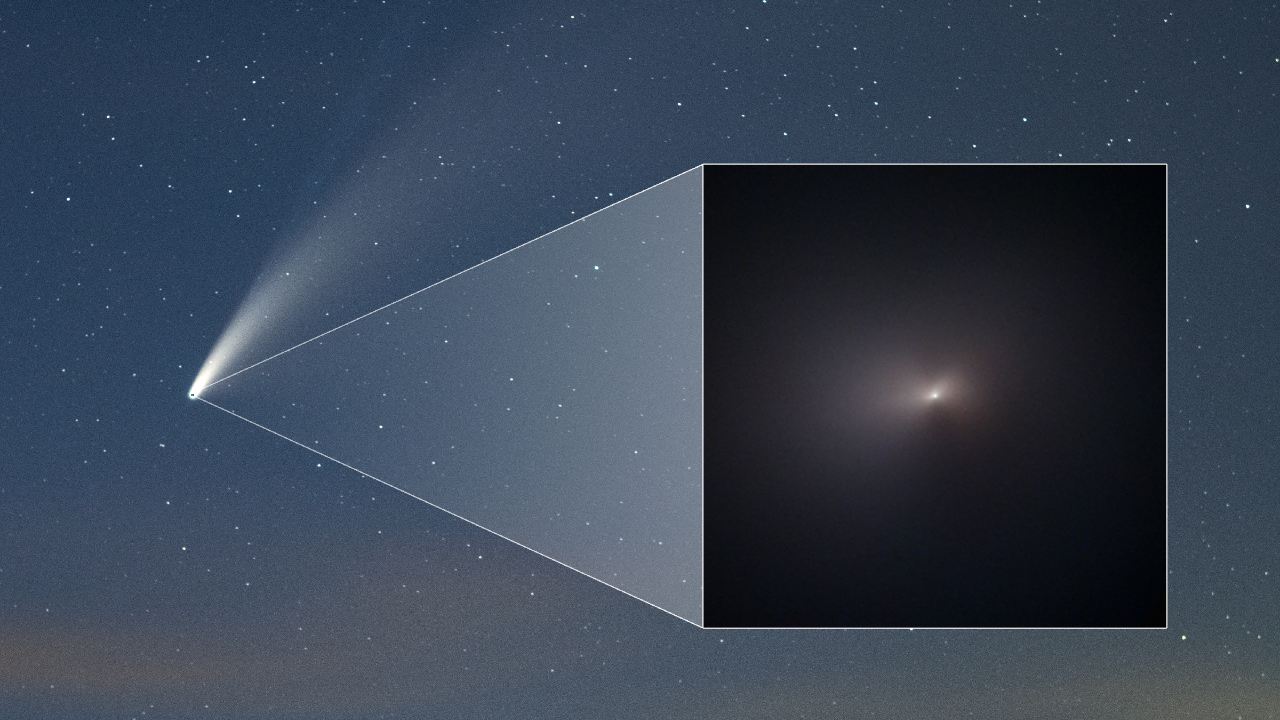
This ground-based image of comet C/2020 F3 (NEOWISE) was taken from the Northern Hemisphere on July 16, 2020. The inset image, taken by the Hubble Space Telescope on Aug. 8, 2020, reveals a close-up of the comet after its pass by the Sun. Image credit: NASA[/caption]This happened after Neowise came as close as 43 million kilometres to the star on 3 July. Where other comets are likely to break apart due to the enhanced “thermal and gravitational stresses at such close encounters”, Hubble’s picture shows that Neowise and its nucleus have managed to stay intact.
While the nucleus is too tiny to be seen by Hubble, lead researcher Qicheng Zhang of Caltech, California, said that this telescope had “far better resolution” than any other telescope to capture Neowise. Zhang added that the resolution allowed the see details very close to the nucleus. As per the researcher, it allowed them to see changes in the dust right after it’s stripped from that nucleus due to solar heat.
 More from Science
These images could help scientists learn more about dust in the early solar system, reported Space.com. Researchers are trying to see how the colour of the comet changes as it rockets away from the sun and towards the outer solar system. This will show how the composition and structure of dust in the coma changes with the Sun's heat.

Careless Whispers: Scientists discover that plants can 'talk' to each other using smells
Life on Mars? European Space Agency’s Orbiter discovers ice water deposits at equator
Microsoft briefly overtakes Apple as the most valuable company, Apple back on top again
Even NASA is facing a tough time, starts layoffs following major budget cuts
ISRO, NASA's NISAR satellite to get ready by Jan-end, will monitor Earth's snow-covered regions