


Hubble scans $10,000 quadrillion 16 Psyche asteroid ahead of NASA 2022 mission
The spacecraft is slated to launch in August 2022, perform a Mars-assisted gravity boost in 2023, and arrive at 16 Psyche in 2026.

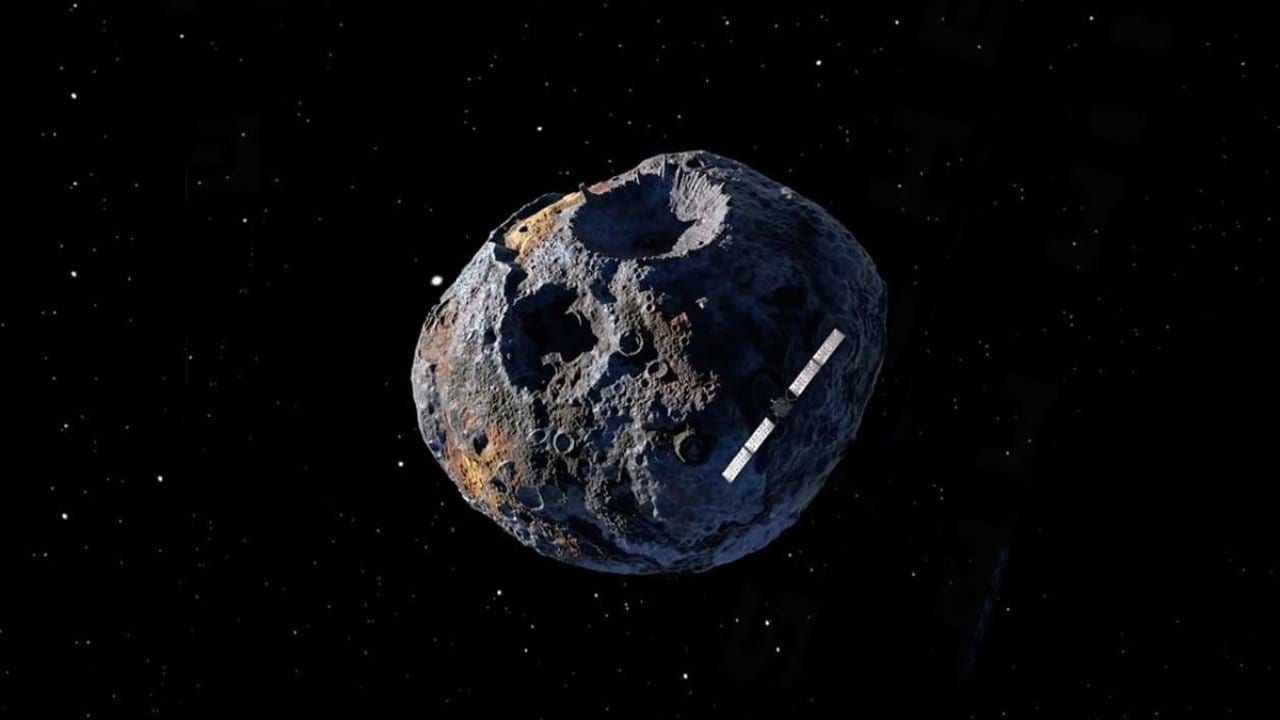
An illustration of the spacecraft and 16 psyche. Image: NASA[/caption]The Hubble Space Telescope has now spent some time examining the planetary body. Researchers have examined Psyche in the ultraviolet and have found that it has a high iron composition. However, they noted that a relatively small amount of iron mixed into rocky materials like olivine.Scientists have a number of theories for how Psyche could have formed, but the ultraviolet analyses do not confirm if Psyche is an iron-rich core remnant. The asteroid is the only known metallic core-like body from any planet currently floating around.According to researchers one of the reasons the asteroid belt failed to reunite into a planet is that Jupiter kept gravitational energies high to support planetary accretion. And so, the material in the belt was either ejected, pounded, flung inwards, or swallowed by Jupiter itself.The goal of the NASA mission to study 16 Psyche is to determine if the space rock represents a planetary core or a mass of previously unmelted material. It will also, attempt to see the compositional differences between the minerals in Psyche’s core and the expected contents of Earth’s and conditions under which it formed among others.The results of the study have been published in The Planetary Science Journal.Keywords: 16 Psyche, Jupiter, Venus, Earth, protoplanet, asteroid

Careless Whispers: Scientists discover that plants can 'talk' to each other using smells
Life on Mars? European Space Agency’s Orbiter discovers ice water deposits at equator
Microsoft briefly overtakes Apple as the most valuable company, Apple back on top again
Even NASA is facing a tough time, starts layoffs following major budget cuts
ISRO, NASA's NISAR satellite to get ready by Jan-end, will monitor Earth's snow-covered regions