


Family time: ESO's Very Large Telescope captures image of two giant exoplanets orbiting a small sun
The star, located in the Fly constellation, is barely 17 million years old and by contrast, our sun is 4.5 billion years old.

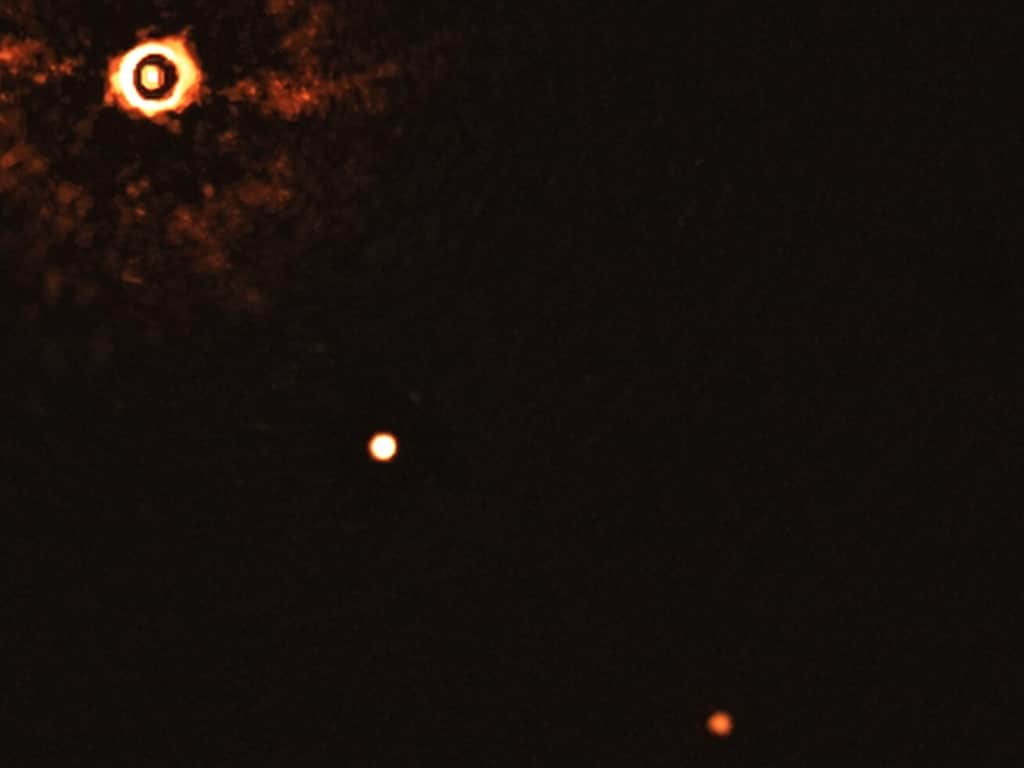
This image, captured by the SPHERE instrument on ESO’s Very Large Telescope, shows the star TYC 8998-760-1 accompanied by two giant exoplanets. The bright and dark rings we see on the star’s image are optical artefacts. The two planets are visible as two bright dots in the centre and bottom right of the frame. Image credit: ESO[/caption]What makes this group shot so appealing is it’s a “very young version of our own sun,” said Alexander Bohn of the Netherlands’ Leiden University, who led the study.Bohn said he was “extremely excited” about the discovery. “This is the first time astronomers were able to capture such a shot,” he said in an email.The observations can help scientists better understand the evolution of our own solar system.Astronomers typically confirm worlds around other stars by observing brief but periodic dimming of the starlight, indicating an orbiting planet. Such indirect observations have identified thousands of planets in our Milky Way galaxy.It’s much harder and less common for a telescope to directly observe these so-called exoplanets. To directly spot two of them around the same star is even rarer. Only two multi-planet solar systems have been spotted using the direct method, both with stars quite different than our sun, according to the observatory.Of the 4,183 exoplanets confirmed to date, only 48 of them have been directly imaged — just one percent, according to NASA statistics.Direct imaging provides humanity’s best chance to detect life outside our solar system, if it exists, Bohn said. By observing light from the planets themselves, the atmospheres can be analyzed for molecules and elements that might suggest life.

Careless Whispers: Scientists discover that plants can 'talk' to each other using smells
Life on Mars? European Space Agency’s Orbiter discovers ice water deposits at equator
Microsoft briefly overtakes Apple as the most valuable company, Apple back on top again
Even NASA is facing a tough time, starts layoffs following major budget cuts
ISRO, NASA's NISAR satellite to get ready by Jan-end, will monitor Earth's snow-covered regions