


Excavated skeleton of long-necked plant-eater sheds light on dinosaur evolution
Scientists found fossils Mnyamawamtuka moyowamkia dinosaur that measured roughly 26 feet long.

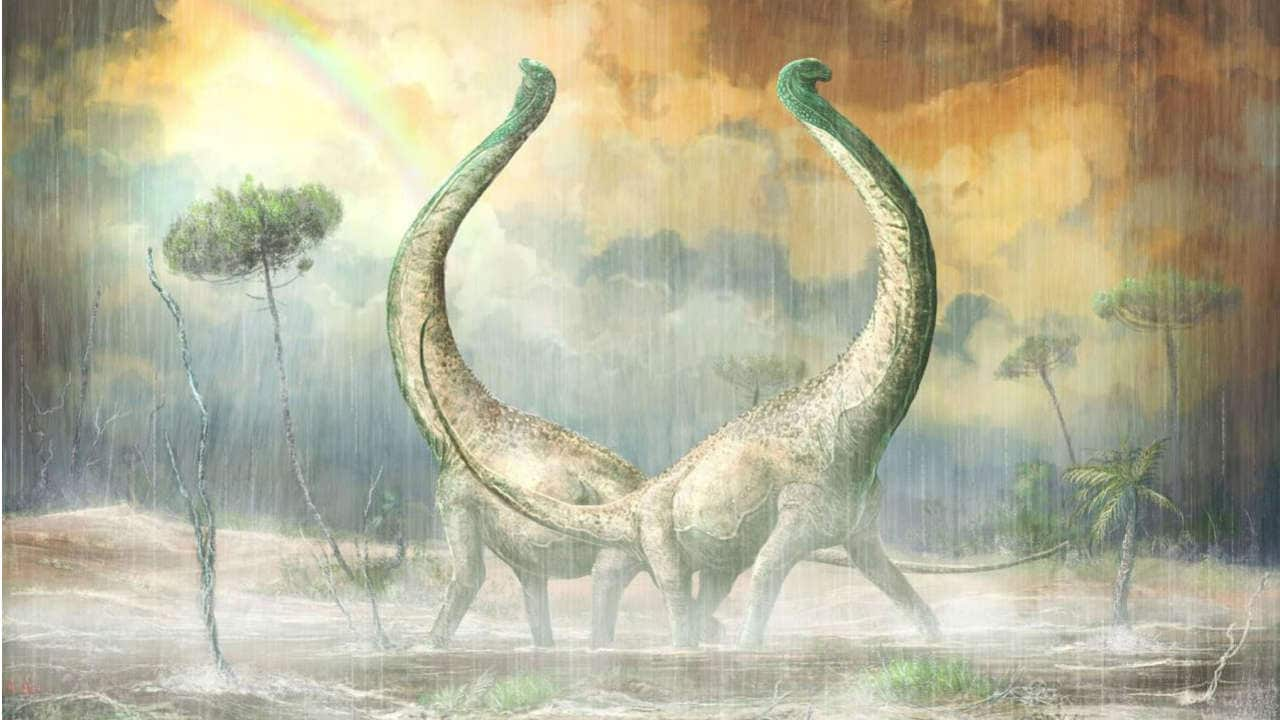
The Cretaceous Period dinosaur Mnyamawamtuka in its environmental setting is seen in this illustration. Image: Reuters[/caption]“Mnyamawamtuka is important as it is a relatively complete animal from the early part of the titanosaurian diversification. Thus, it provides a critical look at the group before the widespread diversification around the planet,” Ohio University anatomy professor Patrick O’Connor said.Mnyamawamtuka means “beast of the Mtuka” because it was unearthed near the Mtuka River bed in southwestern Tanzania.“This excavation was fairly involved, as the fossils were discovered eroding out of a vertical cliff surface about 20 feet (6 meters) above the dry river bed,” O’Connor said.“At first, we worked merely to stabilize the falling rock and fossils, with later efforts involving climbing ropes and teams of skilled excavators. It is a fantastic setting, with monkeys, a variety of hornbills and other birds, every type of insect under the sun, complete with a very cool dinosaur skeleton,” O’Connor added.

Careless Whispers: Scientists discover that plants can 'talk' to each other using smells
Life on Mars? European Space Agency’s Orbiter discovers ice water deposits at equator
Microsoft briefly overtakes Apple as the most valuable company, Apple back on top again
Even NASA is facing a tough time, starts layoffs following major budget cuts
ISRO, NASA's NISAR satellite to get ready by Jan-end, will monitor Earth's snow-covered regions