
Advertisement


Sections
Earth's magnetic field anomaly over the Atlantic has split in two, now expanding westward: NASA
The anomaly’s 'valley' – the area that had the weakest magnetic field strength – has split into two lobes, the agency has said.

The South Atlantic Anomaly (or SAA) has kept scientists hooked for quite some time now. Now as NASA researchers study the anomaly in detail, they have found that the region is in fact splitting.The anomaly’s "valley" or the area that had the "minimum field strength", has split into two lobes, said NASA’s Goddard Space Flight Center in a recent post. This split is likely to generate "additional challenges" for the planning and execution of satellites. They also found that the SAA is expanding westward and slowly weakening in intensity.“Even though the SAA is slow-moving, it is going through some change in morphology, so it's also important that we keep observing it,” said Terry Sabaka, a geophysicist at Goddard in Maryland.[caption id="attachment_8734121" align="alignnone" width="1280"]![An illustration of the South Atlantic Anomaly. Image: NASA/YouTube]() An illustration of the South Atlantic Anomaly. Image: NASA/YouTube[/caption]The South Atlantic anomaly is a wide area ranging on Earth (from Southwest Africa to regions of South America) that acts like a ‘dent’ in the magnetic field of the planet. The charged particles trapped in Earth’s magnetic field “dip closer to the surface than normal” and their radiation adversely affects the working of satellites passing by the region and computers.According to the space agency, if a satellite is hit by a high-energy proton, it can “short-circuit and cause an event called single event upset or SEU”. This means that a satellite can suffer a momentary glitch or permanent damage. Hence, scientists shut down certain components or instruments while passing through the area.As NASA explained in a video, the Solar Anomalous and Magnetospheric Particle Explorer or SAMPEX, ESA’s Swarm Earth Explorer and NASA's Ionospheric Connection Explorer monitor the SAA's position and track its evolution.Along with the mission, geomagnetic, geophysics and heliophysics research groups of the agency have also created theoretical models of the SAA, to look over the region and predict how it can affect the near earth environment in the future.
An illustration of the South Atlantic Anomaly. Image: NASA/YouTube[/caption]The South Atlantic anomaly is a wide area ranging on Earth (from Southwest Africa to regions of South America) that acts like a ‘dent’ in the magnetic field of the planet. The charged particles trapped in Earth’s magnetic field “dip closer to the surface than normal” and their radiation adversely affects the working of satellites passing by the region and computers.According to the space agency, if a satellite is hit by a high-energy proton, it can “short-circuit and cause an event called single event upset or SEU”. This means that a satellite can suffer a momentary glitch or permanent damage. Hence, scientists shut down certain components or instruments while passing through the area.As NASA explained in a video, the Solar Anomalous and Magnetospheric Particle Explorer or SAMPEX, ESA’s Swarm Earth Explorer and NASA's Ionospheric Connection Explorer monitor the SAA's position and track its evolution.Along with the mission, geomagnetic, geophysics and heliophysics research groups of the agency have also created theoretical models of the SAA, to look over the region and predict how it can affect the near earth environment in the future.
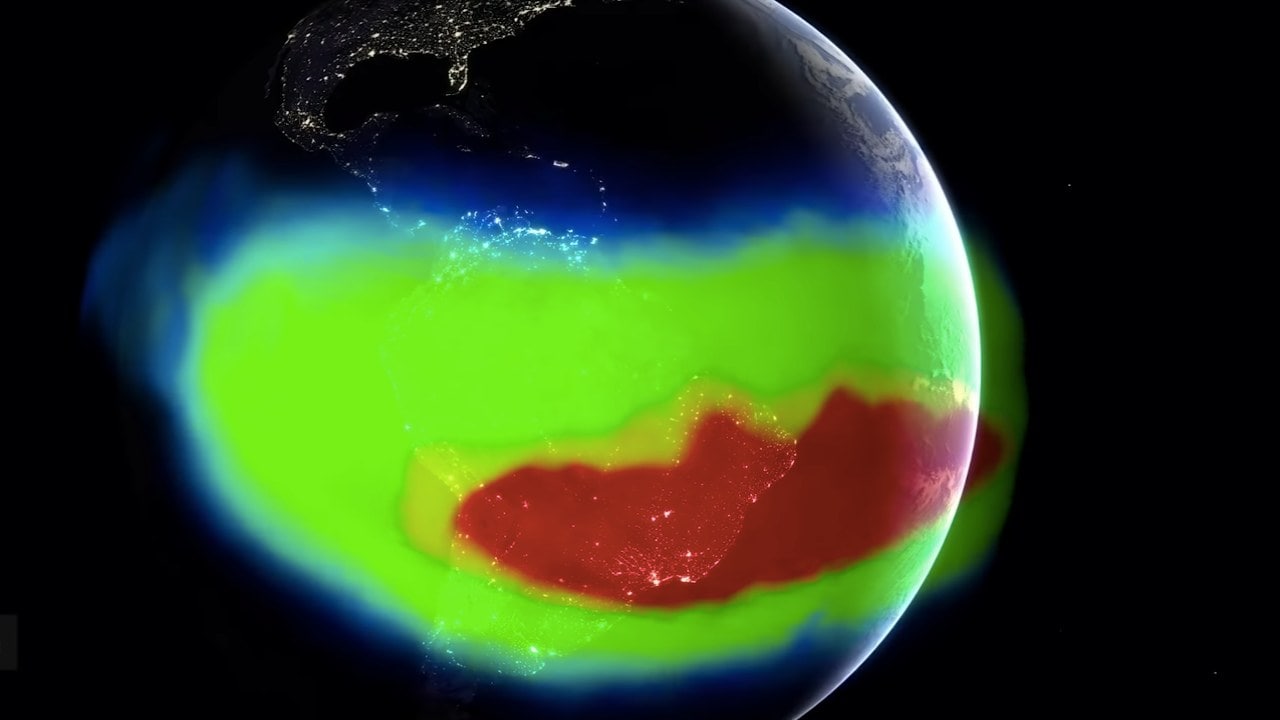 An illustration of the South Atlantic Anomaly. Image: NASA/YouTube[/caption]The South Atlantic anomaly is a wide area ranging on Earth (from Southwest Africa to regions of South America) that acts like a ‘dent’ in the magnetic field of the planet. The charged particles trapped in Earth’s magnetic field “dip closer to the surface than normal” and their radiation adversely affects the working of satellites passing by the region and computers.According to the space agency, if a satellite is hit by a high-energy proton, it can “short-circuit and cause an event called single event upset or SEU”. This means that a satellite can suffer a momentary glitch or permanent damage. Hence, scientists shut down certain components or instruments while passing through the area.
First Published:Aug 20, 2020, 15:53:22 IST
Advertisement
Advertisement

Careless Whispers: Scientists discover that plants can 'talk' to each other using smells
Japanese scientists have recorded a video that shows plants, in certain conditions, communicate with each other using mists that carry smells. The discovery, reveals that plants release a fine mist of airborne compounds, to warn nearby plants of potential dangers
Life on Mars? European Space Agency’s Orbiter discovers ice water deposits at equator
European Space Agency's Mars Express Orbiter has identified massive ice and ice water deposits beneath the surface of Mars. The Mars Express orbiter was also the first to confirmed the presence of ice on Mars in 2004
Microsoft briefly overtakes Apple as the most valuable company, Apple back on top again
At its peak during the session, Microsoft's value reached $2.903 trillion, with a 2% surge. As of writing this article, Apple closed at $2.89 trillion, whereas Microsoft closed at $2.86 trillion
Even NASA is facing a tough time, starts layoffs following major budget cuts
NASA is facing some massive budget cuts, because of which, it has been forced to postpone some upcoming missions. NASA's Jet Propulsion Laboratory has been hit hard by recent federal budget cuts, resulting in the layoff of 100 contractors last week
ISRO, NASA's NISAR satellite to get ready by Jan-end, will monitor Earth's snow-covered regions
The NISAR satellite which has been developed jointly ISRO and NASA, should be ready for launch by the end of January 2024. The collaboration between NASA and ISRO on NISAR is the first time the two agencies have cooperated on hardware development for an Earth-observing mission
Advertisement
Advertisement