
Advertisement


Sections
Deep sea microbes helps scientists unlock mystery of transitioning from simple cells to complex life
Evolutionary shift from simple bacteria-like cells to first fungi, plants and animals, 2 billion years ago has left us stumped.

A microorganism scooped up in deep-sea mud off Japan’s coast has helped scientists unlock the mystery of one of the watershed evolutionary events for life on Earth: the transition from the simple cells that first colonized the planet to complex cellular life - fungi, plants and animals including people.Researchers said on Wednesday they were able to study the biology of the microorganism, retrieved from depths of about 2.5 km, after coaxing it to grow in the laboratory. They named it Prometheoarchaeum syntrophicum, referring to the Greek mythological figure Prometheus who created humankind from clay and stole fire from the gods.[caption id="attachment_7919381" align="alignnone" width="1280"]![Explaining the transiting from simple cells to complex life forms. Image credit: Youtube]() Explaining the transiting from simple cells to complex life forms, around two billion years ago. Image credit: Youtube[/caption]Prometheoarchaeum’s spherical cell - with a diameter of roughly 500 nanometers, or one-20,000th of a centimeter - boasts long, often branching tentacle-like appendages on its outer surface.It is part of a group called Archaea, relatively simple single-cell organisms lacking internal structures such as a nucleus. Scientists have long puzzled over the evolutionary shift from such simple bacteria-like cells to the first rudimentary fungi, plants and animals - a group called eukaryotes - perhaps two billion years ago.Based on a painstaking laboratory study of Prometheoarchaeum and observations of its symbiotic - mutually beneficial - relationship with a companion bacterium, the researchers offered an explanation.They proposed that appendages like those of Prometheoarchaeum entangled a passing bacterium, which was then engulfed and eventually evolved into an organelle - internal structure - called a mitochondrion that is the powerhouse of a cell and crucial for respiration and energy production.The solar system including Earth formed 4.5 billion years ago. The first life on Earth, simple marine microbes, appeared roughly four billion years ago. The later advent of eukaryotes set in motion evolutionary paths that led to a riotous assemblage of organisms over the eons like palm trees, blue whales, T. rex, hummingbirds, clownfish, shiitake mushrooms, lobsters, daisies, woolly mammoths and Marilyn Monroe.“How we - as eukaryotes - originated is a fundamental question related to how we - as humans - came to be,” said microbiologist Masaru Nobu of Japan’s National Institute of Advanced Industrial Science and Technology, one of the leaders of the study published in the journal Nature.Prometheoarchaeum is a member of a subgroup called Asgard archaea - named for the dwelling place of the gods in Norse mythology. Other members of this subgroup were retrieved from the frigid seabed near a hydrothermal vent system called Loki’s Castle, named after a Norse mythological figure, between Greenland and Norway.The research on Prometheoarchaeum, Nobu said, indicates that the Asgard archaea are the closest living relatives to the first eukaryotes.The researchers used a submersible research vessel to collect mud containing Prometheoarchaeum from the Omine Ridge off Japan in 2006. They studied it in the laboratory in a years-long process and watched it slowly proliferate after incubating the samples in a vessel infused with methane gas to simulate the deep-sea marine sediment environment in which it resides.[caption id="attachment_7919351" align="alignnone" width="1000"]
Explaining the transiting from simple cells to complex life forms, around two billion years ago. Image credit: Youtube[/caption]Prometheoarchaeum’s spherical cell - with a diameter of roughly 500 nanometers, or one-20,000th of a centimeter - boasts long, often branching tentacle-like appendages on its outer surface.It is part of a group called Archaea, relatively simple single-cell organisms lacking internal structures such as a nucleus. Scientists have long puzzled over the evolutionary shift from such simple bacteria-like cells to the first rudimentary fungi, plants and animals - a group called eukaryotes - perhaps two billion years ago.Based on a painstaking laboratory study of Prometheoarchaeum and observations of its symbiotic - mutually beneficial - relationship with a companion bacterium, the researchers offered an explanation.They proposed that appendages like those of Prometheoarchaeum entangled a passing bacterium, which was then engulfed and eventually evolved into an organelle - internal structure - called a mitochondrion that is the powerhouse of a cell and crucial for respiration and energy production.The solar system including Earth formed 4.5 billion years ago. The first life on Earth, simple marine microbes, appeared roughly four billion years ago. The later advent of eukaryotes set in motion evolutionary paths that led to a riotous assemblage of organisms over the eons like palm trees, blue whales, T. rex, hummingbirds, clownfish, shiitake mushrooms, lobsters, daisies, woolly mammoths and Marilyn Monroe.“How we - as eukaryotes - originated is a fundamental question related to how we - as humans - came to be,” said microbiologist Masaru Nobu of Japan’s National Institute of Advanced Industrial Science and Technology, one of the leaders of the study published in the journal Nature.Prometheoarchaeum is a member of a subgroup called Asgard archaea - named for the dwelling place of the gods in Norse mythology. Other members of this subgroup were retrieved from the frigid seabed near a hydrothermal vent system called Loki’s Castle, named after a Norse mythological figure, between Greenland and Norway.The research on Prometheoarchaeum, Nobu said, indicates that the Asgard archaea are the closest living relatives to the first eukaryotes.The researchers used a submersible research vessel to collect mud containing Prometheoarchaeum from the Omine Ridge off Japan in 2006. They studied it in the laboratory in a years-long process and watched it slowly proliferate after incubating the samples in a vessel infused with methane gas to simulate the deep-sea marine sediment environment in which it resides.[caption id="attachment_7919351" align="alignnone" width="1000"]![A scanning electron microscopy image of the single-celled organism Prometheoarchaeum syntrophicum strain MK-D1 showing the cell with tentacle-like branching protrusions. Image credit: JAMSTEC]() A scanning electron microscopy image of the single-celled organism Prometheoarchaeum syntrophicum strain MK-D1 showing the cell with tentacle-like branching protrusions. Image credit: JAMSTEC[/caption]“We were able to obtain the first complete genome of this group of archaea and conclusively show that these archaea possess many genes that had been thought to be only found in eukaryotes,” Nobu said.Prometheoarchaeum was found to be reliant on its companion bacterium.“The organism ‘eats’ amino acids through symbiosis with a partner,” Nobu said. “This is because the organism can neither fully digest amino acids by itself, gain energy if any byproducts have accumulated, nor build its own cell without external help.”
A scanning electron microscopy image of the single-celled organism Prometheoarchaeum syntrophicum strain MK-D1 showing the cell with tentacle-like branching protrusions. Image credit: JAMSTEC[/caption]“We were able to obtain the first complete genome of this group of archaea and conclusively show that these archaea possess many genes that had been thought to be only found in eukaryotes,” Nobu said.Prometheoarchaeum was found to be reliant on its companion bacterium.“The organism ‘eats’ amino acids through symbiosis with a partner,” Nobu said. “This is because the organism can neither fully digest amino acids by itself, gain energy if any byproducts have accumulated, nor build its own cell without external help.”
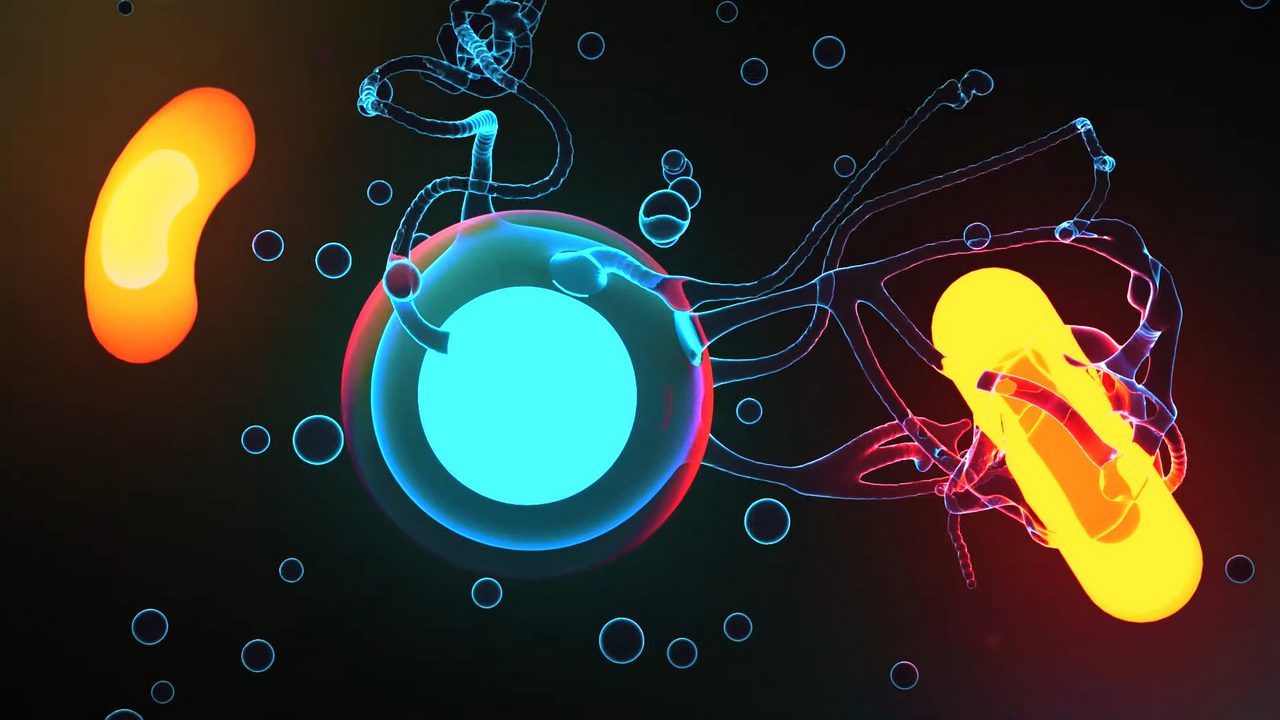 Explaining the transiting from simple cells to complex life forms, around two billion years ago. Image credit: Youtube[/caption]Prometheoarchaeum’s spherical cell - with a diameter of roughly 500 nanometers, or one-20,000th of a centimeter - boasts long, often branching tentacle-like appendages on its outer surface.It is part of a group called Archaea, relatively simple single-cell organisms lacking internal structures such as a nucleus. Scientists have long puzzled over the evolutionary shift from such simple bacteria-like cells to the first rudimentary fungi, plants and animals - a group called eukaryotes - perhaps two billion years ago.Based on a painstaking laboratory study of Prometheoarchaeum and observations of its symbiotic - mutually beneficial - relationship with a companion bacterium, the researchers offered an explanation.They proposed that appendages like those of Prometheoarchaeum entangled a passing bacterium, which was then engulfed and eventually evolved into an organelle - internal structure - called a mitochondrion that is the powerhouse of a cell and crucial for respiration and energy production.The solar system including Earth formed 4.5 billion years ago. The first life on Earth, simple marine microbes, appeared roughly four billion years ago. The later advent of eukaryotes set in motion evolutionary paths that led to a riotous assemblage of organisms over the eons like palm trees, blue whales, T. rex, hummingbirds, clownfish, shiitake mushrooms, lobsters, daisies, woolly mammoths and Marilyn Monroe.“How we - as eukaryotes - originated is a fundamental question related to how we - as humans - came to be,” said microbiologist Masaru Nobu of Japan’s National Institute of Advanced Industrial Science and Technology, one of the leaders of the study published in the journal Nature.
 A scanning electron microscopy image of the single-celled organism Prometheoarchaeum syntrophicum strain MK-D1 showing the cell with tentacle-like branching protrusions. Image credit: JAMSTEC[/caption]“We were able to obtain the first complete genome of this group of archaea and conclusively show that these archaea possess many genes that had been thought to be only found in eukaryotes,” Nobu said.Prometheoarchaeum was found to be reliant on its companion bacterium.“The organism ‘eats’ amino acids through symbiosis with a partner,” Nobu said. “This is because the organism can neither fully digest amino acids by itself, gain energy if any byproducts have accumulated, nor build its own cell without external help.”
First Published:Jan 17, 2020, 11:34:11 IST
Advertisement
Advertisement

Careless Whispers: Scientists discover that plants can 'talk' to each other using smells
Japanese scientists have recorded a video that shows plants, in certain conditions, communicate with each other using mists that carry smells. The discovery, reveals that plants release a fine mist of airborne compounds, to warn nearby plants of potential dangers
Life on Mars? European Space Agency’s Orbiter discovers ice water deposits at equator
European Space Agency's Mars Express Orbiter has identified massive ice and ice water deposits beneath the surface of Mars. The Mars Express orbiter was also the first to confirmed the presence of ice on Mars in 2004
Microsoft briefly overtakes Apple as the most valuable company, Apple back on top again
At its peak during the session, Microsoft's value reached $2.903 trillion, with a 2% surge. As of writing this article, Apple closed at $2.89 trillion, whereas Microsoft closed at $2.86 trillion
Even NASA is facing a tough time, starts layoffs following major budget cuts
NASA is facing some massive budget cuts, because of which, it has been forced to postpone some upcoming missions. NASA's Jet Propulsion Laboratory has been hit hard by recent federal budget cuts, resulting in the layoff of 100 contractors last week
ISRO, NASA's NISAR satellite to get ready by Jan-end, will monitor Earth's snow-covered regions
The NISAR satellite which has been developed jointly ISRO and NASA, should be ready for launch by the end of January 2024. The collaboration between NASA and ISRO on NISAR is the first time the two agencies have cooperated on hardware development for an Earth-observing mission
Advertisement
Advertisement