
Advertisement


Sections
Curiosity rover on Mars shares stunning panorama, selfie with the rocky Mont Mercou
Curiosity drilled a sample of the rock, nicknamed ‘Nontron’ after the Earth village near which Mont Mercou is located in France.

The National Aeronautics and Space Administration’s Curiosity rover has snapped a selfie with a majestic rock formation on Mars, known as Mont Mercou. The Mars rover also captured a pair of panoramic pictures, providing a three-dimensional view, of the stark cliff face of the landmark. The selfie, created from 60 individual images, was taken on 26 March 2021 – the 3,070th Martian day (sol) of Curiosity's mission, by two cameras on the rover. The first is the Mars Hand Lens Imager (MAHLI), located on Curiosity’s robotic arm. Eleven of the images were also contributed by the Mastcam, taken on a 16 March photo-spree.Mont Mercou is about 20 feet (6 meters) tall. Curiosity has drilled a sample of the rock, which the team has nicknamed ‘Nontron’, NASA said in a statement. The nomenclature gives the science team leeway to examine and explain the composition and origin of the rock on the Red Planet. The spot at which Curiosity snapped its selfie with Mont Mercou is at the transition between the ‘clay-bearing unit’ in the Gale Crater – from where the rover is departing, and the ‘sulfate-bearing unit’ in Mount Sharp, to where the rover is headed.[caption id="attachment_9484441" align="alignnone" width="1280"]![The Curiosity rover used two cameras to create this selfie in front of Mont Mercou, a rock outcrop that stands 20 feet (6 meters) tall on Mars. Image: NASA-JPL/Caltech]() The Curiosity rover used two cameras to create this selfie in front of Mont Mercou, a rock outcrop that stands 20 feet (6 meters) tall on Mars. Image: NASA-JPL/Caltech[/caption]Earlier in March, Curiosity had taken some more panoramas with its Mastcam instrument. Studying these images from more than one angle helps scientists understand the 3D geometry of the sedimentary layers that make up Mount Mercou.
The Curiosity rover used two cameras to create this selfie in front of Mont Mercou, a rock outcrop that stands 20 feet (6 meters) tall on Mars. Image: NASA-JPL/Caltech[/caption]Earlier in March, Curiosity had taken some more panoramas with its Mastcam instrument. Studying these images from more than one angle helps scientists understand the 3D geometry of the sedimentary layers that make up Mount Mercou.![]() NASA is parallelly gearing up to deploy the first helicopter to fly on another world. The Ingenuity Mars helicopter was carefully deployed from the belly of the Perseverance rover, the mission team at JPL shared in a recent tweet."It [the helicopter] is stowed sideways, folded up and locked in place, so there's some reverse origami to do before I can set it down. First though, I'll be off to the designated 'helipad,' a couple days' drive from here," the Perseverance rover team tweeted.The helicopter is expected to take flight on 8 April this year.
NASA is parallelly gearing up to deploy the first helicopter to fly on another world. The Ingenuity Mars helicopter was carefully deployed from the belly of the Perseverance rover, the mission team at JPL shared in a recent tweet."It [the helicopter] is stowed sideways, folded up and locked in place, so there's some reverse origami to do before I can set it down. First though, I'll be off to the designated 'helipad,' a couple days' drive from here," the Perseverance rover team tweeted.The helicopter is expected to take flight on 8 April this year.
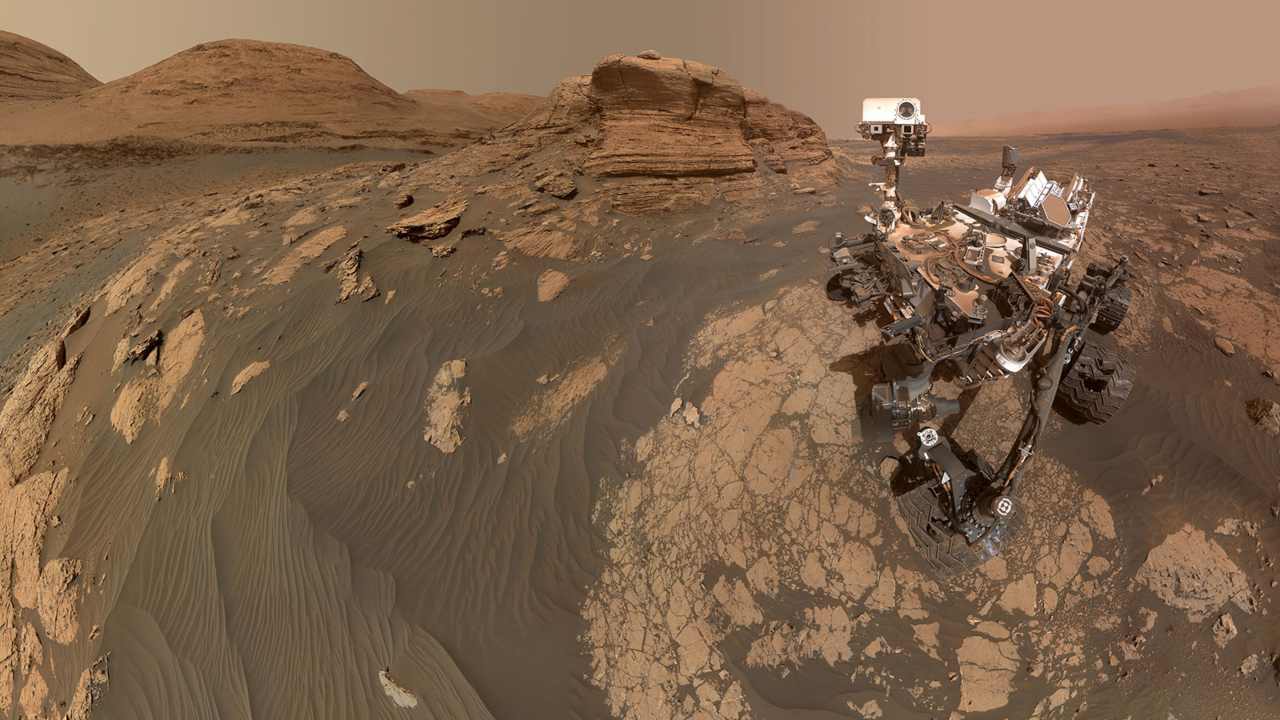 The Curiosity rover used two cameras to create this selfie in front of Mont Mercou, a rock outcrop that stands 20 feet (6 meters) tall on Mars. Image: NASA-JPL/Caltech[/caption]Earlier in March, Curiosity had taken some more panoramas with its Mastcam instrument. Studying these images from more than one angle helps scientists understand the 3D geometry of the sedimentary layers that make up Mount Mercou.
 NASA is parallelly gearing up to deploy the first helicopter to fly on another world. The Ingenuity Mars helicopter was carefully deployed from the belly of the Perseverance rover, the mission team at JPL shared in a recent tweet."It [the helicopter] is stowed sideways, folded up and locked in place, so there's some reverse origami to do before I can set it down. First though, I'll be off to the designated 'helipad,' a couple days' drive from here," the Perseverance rover team tweeted.The helicopter is expected to take flight on 8 April this year.
First Published:Mar 01, 2021, 09:00:27 IST
Advertisement
Advertisement

Careless Whispers: Scientists discover that plants can 'talk' to each other using smells
Japanese scientists have recorded a video that shows plants, in certain conditions, communicate with each other using mists that carry smells. The discovery, reveals that plants release a fine mist of airborne compounds, to warn nearby plants of potential dangers
Life on Mars? European Space Agency’s Orbiter discovers ice water deposits at equator
European Space Agency's Mars Express Orbiter has identified massive ice and ice water deposits beneath the surface of Mars. The Mars Express orbiter was also the first to confirmed the presence of ice on Mars in 2004
Microsoft briefly overtakes Apple as the most valuable company, Apple back on top again
At its peak during the session, Microsoft's value reached $2.903 trillion, with a 2% surge. As of writing this article, Apple closed at $2.89 trillion, whereas Microsoft closed at $2.86 trillion
Even NASA is facing a tough time, starts layoffs following major budget cuts
NASA is facing some massive budget cuts, because of which, it has been forced to postpone some upcoming missions. NASA's Jet Propulsion Laboratory has been hit hard by recent federal budget cuts, resulting in the layoff of 100 contractors last week
ISRO, NASA's NISAR satellite to get ready by Jan-end, will monitor Earth's snow-covered regions
The NISAR satellite which has been developed jointly ISRO and NASA, should be ready for launch by the end of January 2024. The collaboration between NASA and ISRO on NISAR is the first time the two agencies have cooperated on hardware development for an Earth-observing mission
Advertisement
Advertisement