


Cosmic 'ghost particle' found to have originated from a huge, spinning black hole
If researchers at the IceCube are right, we might know the first and only confirmed source of cosmic rays — 'blazars'.

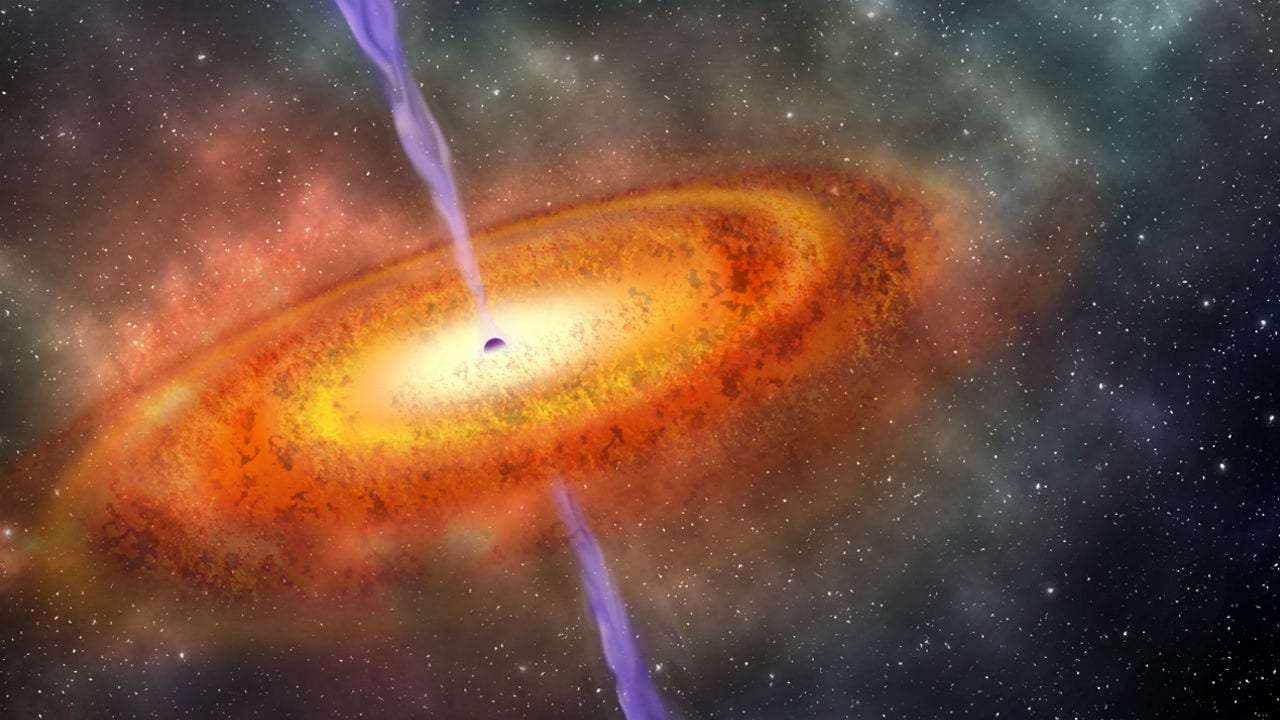
Representative illustration of a black hole. Reuters[/caption] The Fermi's Large Area Telescope identified a strong increase in gamma-ray emissions from a widely-known active galaxy around the exact time that the neutrino signal was detected. These active galaxies are in a category of systems called 'blazars', which are massive black holes with masses that could range millions to billions times that of our sun's. They blast jets of particles in its polar directions at near-light speeds, and appear particularly bright and active through a telescope pointed at it from Earth, which is thought to have been exactly the case of this neutrino jet.Fermi scientist Yasuyuki Tanaka at Hiroshima University in Japan associated the neutrino event with a blazar known as TXS 0506+056 (called TXS 0506 in short), which was observed to have been more active than in a decade at the time corresponding to the signal's arrival.“The most extreme cosmic explosions produce gravitational waves, and the most extreme cosmic accelerators produce high-energy neutrinos and cosmic rays,” said Regina Caputo, analysis coordinator for the Fermi Telescope Collaboration, according to NASA. “Through Fermi, gamma rays are providing a bridge to each of these new cosmic signals.”“Again, Fermi has helped make another giant leap in a growing field we call multimessenger astronomy,” said Paul Hertz, Director of Astrophysics at NASA to press at their Washington headquarters. “Neutrinos and gravitational waves deliver new kinds of information about the most extreme environments in the universe. But to best understand what they’re telling us, we need to connect them to the ‘messenger’ astronomers know best — light.”The discovery is the subject of two papers published on 11 July in Science.

Careless Whispers: Scientists discover that plants can 'talk' to each other using smells
Life on Mars? European Space Agency’s Orbiter discovers ice water deposits at equator
Microsoft briefly overtakes Apple as the most valuable company, Apple back on top again
Even NASA is facing a tough time, starts layoffs following major budget cuts
ISRO, NASA's NISAR satellite to get ready by Jan-end, will monitor Earth's snow-covered regions