


Computer models that calculated climate change have more or less 'gotten it right'
Results of 17 models used from 1970 and 2007 were studied to find how accurate their predictions were.

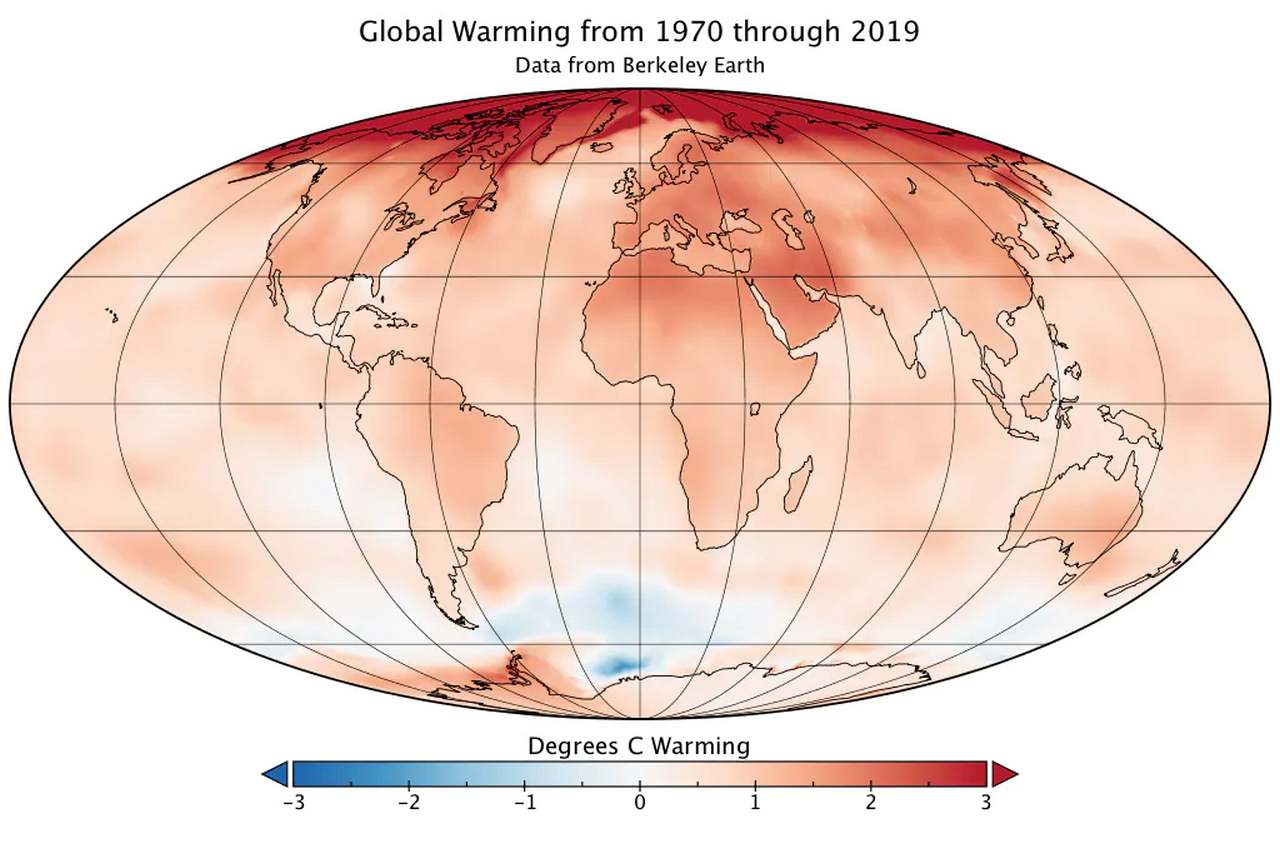
Global warming through the ages. Image credit: Berkeley Earth[/caption]Ten of the 17 were close to the temperatures that actually happened, said Hausfather, lead author of a study in Wednesday’s journal Geophysical Research Letters.
But scientists actually got the physics right even more than that, Hausfather said. That’s because they make two main assumptions when they model what will happen in the future. One is the physics of the atmosphere and how it reacts to heat-trapping gases. The other is the amount of greenhouse gases put into the air.
A few times, scientists were wrong in their predictions about the growth of carbon pollution, saying there would be more of the gases than there actually were, Hausfather said. If they got the amount of heat-trapping gases wrong, they then got the temperatures wrong.
So Hausfather and colleagues, including NASA climate scientist Gavin Schmidt, looked at how well the models did on just the pure science, taking out the emissions factor. On that count, 14 of the 17 computer models accurately predicted the future.
 More from Science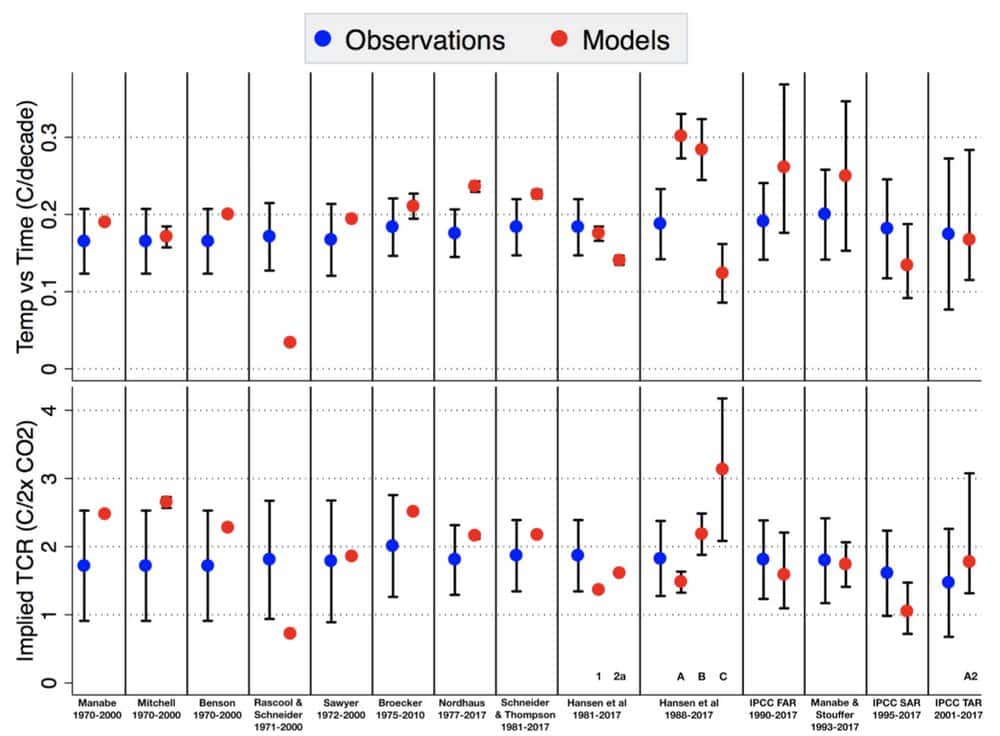
Study shows that the predictions of climate change were pretty accurate. Image credit: Zeke Hausfather[/caption]One of the earliest computer models, made in 1970, got a 91 percent. What’s so impressive about that is that at the time, climate change wasn’t noticeable in the yearly temperature records like it is now, Hausfather said.
Stanford University climate scientist Noah Diffenbaugh, who wasn’t part of the study, called the work creative and the results striking.
“Even without knowing what the current level of greenhouse gas concentrations would be, the climate models predicted the evolution of global temperature quite well,” Diffenbaugh said in an email.
It’s crucial that these models are accurate because “we have one planet Earth, so we can’t conduct controlled experiments on the actual climate system,” Diffenbaugh said.
The study was released as officials from almost 200 countries meet in Madrid for climate talks.
University of Illinois climate scientist Donald Wuebbles, who also wasn’t part of the study, said climate change “deniers do a lot of weird things to misrepresent models. None of those analyses have been valid and they should be ignored. We should no longer be debating the basic science of climate change.”

Careless Whispers: Scientists discover that plants can 'talk' to each other using smells
Life on Mars? European Space Agency’s Orbiter discovers ice water deposits at equator
Microsoft briefly overtakes Apple as the most valuable company, Apple back on top again
Even NASA is facing a tough time, starts layoffs following major budget cuts
ISRO, NASA's NISAR satellite to get ready by Jan-end, will monitor Earth's snow-covered regions