


Chandrayaan 2: Most objectives accomplished, mission will continue contributing to lunar science, ISRO said
The success criteria included a lot of proof-of-concept tech, like the variable-thrust propulsion technology used in the lander.

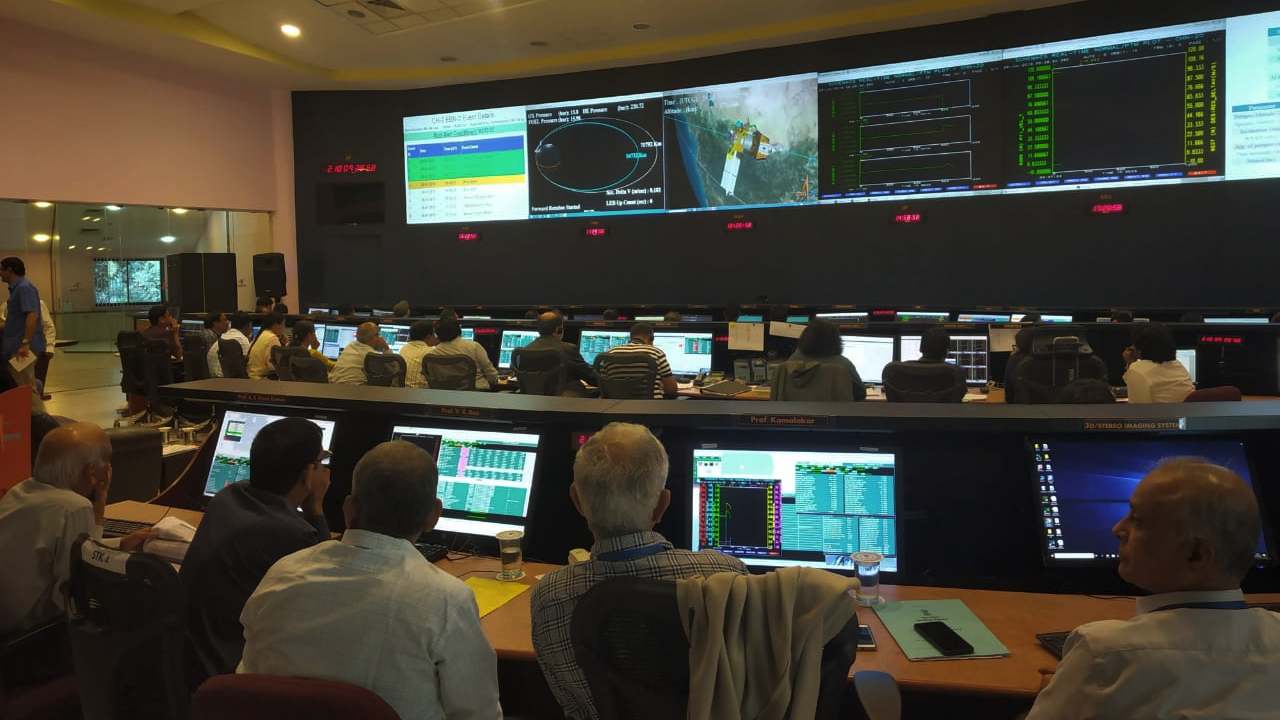
Glimpse inside ISRO's control room during landing module's first in-orbit manoeuvre on 3 September. Image: ISRO[/caption]The orbiter, which was the only tried-and-tested element in the mission (and home to the most payloads of the three components), is already in its intended orbit to carry out what it was designed to."The Orbiter...shall enrich our understanding of the moon’s evolution and mapping of the minerals and water molecules in the Polar Regions. It will use its eight state-of-the-art scientific instruments to do so," ISRO said.The results from Chandrayaan 2's orbiter could support lunar exploration for as long as seven years, instead of the planned one year."The Orbiter camera is the highest resolution camera (0.3m) in any lunar mission so far and shall provide high-resolution images that will be immensely useful to the global scientific community. The precise launch and mission management has ensured a long life of almost 7 years instead of the planned one year," the statement said.[embed]https://images.firstpost.com/wp-content/uploads/2019/09/Turbulence.mp4[/embed]The most highly-anticipated piece of news, though, about whether the lander crash-landed, as many experts are speculating, or whether the issue was only a communication failure, wasn't explicitly clarified by ISRO.Instead, the agency announced that the mission was a 90-90 percent success to date, since the success criteria included several proof-of-concept technologies like the variable-thrust propulsion technology used in the lander."The Vikram Lander followed the planned descent trajectory from its orbit of 35 km to just below 2 km above the surface. All the systems and sensors of the Lander functioned excellently until this point and proved many new technologies such as variable thrust propulsion technology used in the Lander," ISRO concludes in the statement. "The success criteria was defined for each and every phase of the mission and till date 90 to 95 percent of the mission objectives have been accomplished and will continue contribute to lunar science, notwithstanding the loss of communication with the Lander."

Careless Whispers: Scientists discover that plants can 'talk' to each other using smells
Life on Mars? European Space Agency’s Orbiter discovers ice water deposits at equator
Microsoft briefly overtakes Apple as the most valuable company, Apple back on top again
Even NASA is facing a tough time, starts layoffs following major budget cuts
ISRO, NASA's NISAR satellite to get ready by Jan-end, will monitor Earth's snow-covered regions