
Advertisement


Sections
Chandrayaan 2: Vikram lander's impact site, 'extensive' debris field found by NASA's LRO with help from Chennai engineer
Also marked in the images is a piece of debris identified by an amateur space enthusiast, computer programmer and mechanical engineer.

On 11 November, the American space agency's Lunar Reconnaissance Orbiter flew over the planned landing site of the Chandrayaan 2 Vikram lander near the moon's South Pole. Over the course of this pass, the LRO captured an image of the impact site and the debris nearby from the Vikram lander's crash-landing on 7 September. This is the first time a publicly-released image has identified the lander's impact site and debris field.The image shows the Vikram lander's impact (confirmed or likely debris, in green dots), as well as places where the surface was disturbed – where small flyaway bits of the lander might have moved some of the regolith (soil-like material covering the moon's surface).[caption id="attachment_7730521" align="alignnone" width="1100"]![Vikram's ejecta as seen be LRO's camera. Image: NASA]() Vikram lander's ejecta as seen by LRO's camera. Image: NASA[/caption]Also marked in the image is a piece of debris identified by Shanmuga Subramanian, an Indian computer programmer and mechanical engineer, marked as "S". This was the first piece of the lander's debris discovered, roughly 750 meters northwest of the main impact site."The crash landing of Vikram rekindled an interest in the moon not only for me and others also," Subramanian wrote in an email to the New York Times. "I think even if Vikram had landed and sent some images, we would have never had such interest. For the first few days, I was scanning the images randomly and there were a lot of false positives."The single bright pixel that Subramanian located in the LRO's mosaic taken on 11 November led NASA's Lunar Reconnaissance Orbiter Camera (LROC) team to the rest of the debris field and the impact site. This image also best shows the impact crater, and the lander's "extensive debris field", NASA said in a press release. Subramanian received an email from John Keller, the deputy project scientist of the LRO mission at NASA congratulating him "for what I am sure was a lot of time and effort on your part", a picture of which he shared on Twitter. The largest chunks of debris are a pair of green dots, each around 2x2 pixels in size, which cast a one-pixel shadow on the moon's surface, NASA added.The Indian Space Research Organisation (ISRO) is yet to share their comments on the image publicly. The Vikram lander was aiming for a smooth plain, some 600 kilometers from the south pole. ISRO lost contact with the lander moments before the scheduled touchdown. Despite the failed soft-landing, getting as close to the surface as Vikram did was an amazing achievement, the agency said.[caption id="" align="alignnone" width="1100"]
Vikram lander's ejecta as seen by LRO's camera. Image: NASA[/caption]Also marked in the image is a piece of debris identified by Shanmuga Subramanian, an Indian computer programmer and mechanical engineer, marked as "S". This was the first piece of the lander's debris discovered, roughly 750 meters northwest of the main impact site."The crash landing of Vikram rekindled an interest in the moon not only for me and others also," Subramanian wrote in an email to the New York Times. "I think even if Vikram had landed and sent some images, we would have never had such interest. For the first few days, I was scanning the images randomly and there were a lot of false positives."The single bright pixel that Subramanian located in the LRO's mosaic taken on 11 November led NASA's Lunar Reconnaissance Orbiter Camera (LROC) team to the rest of the debris field and the impact site. This image also best shows the impact crater, and the lander's "extensive debris field", NASA said in a press release. Subramanian received an email from John Keller, the deputy project scientist of the LRO mission at NASA congratulating him "for what I am sure was a lot of time and effort on your part", a picture of which he shared on Twitter. The largest chunks of debris are a pair of green dots, each around 2x2 pixels in size, which cast a one-pixel shadow on the moon's surface, NASA added.The Indian Space Research Organisation (ISRO) is yet to share their comments on the image publicly. The Vikram lander was aiming for a smooth plain, some 600 kilometers from the south pole. ISRO lost contact with the lander moments before the scheduled touchdown. Despite the failed soft-landing, getting as close to the surface as Vikram did was an amazing achievement, the agency said.[caption id="" align="alignnone" width="1100"]![Before and after images show the Vikram impact point. Changes to the surface are subtle and are more easily seen in these images than earlier ones. Image: NASA/LRO]() Before and after images show the Vikram impact point. Changes to the surface are subtle and are more easily seen in these images than earlier ones. Image: NASA/LRO[/caption]The LROC team released the first mosaic (taken on 17 September) of the site, after which many people downloaded the mosaic, looking for signs of Vikram. Subramanian supposedly contacted the LRO project team after positively identifying the debris. The LROC team confirmed the identification by comparing before and after images.The images for the first mosaic were acquired the impact point was poorly illuminated and thus not easily identifiable. Two subsequent image sequences were acquired on Oct. 14 and 15, and Nov. 11. The LROC team scoured the surrounding area in these new mosaics and found the impact site (70.8810°S, 22.7840°E, 834 m elevation) and associated debris field. As it turns out, the 11 November mosaic had the best pixel resolution (0.7 meter) and lighting conditions (72° incidence angle) for the discovery.In a Reddit comment posted on 3 December, Subramanian (u/Ramanean3) credits part of the discovery to citizen scientists u/Ohsin and u/Astro_Neel.
Before and after images show the Vikram impact point. Changes to the surface are subtle and are more easily seen in these images than earlier ones. Image: NASA/LRO[/caption]The LROC team released the first mosaic (taken on 17 September) of the site, after which many people downloaded the mosaic, looking for signs of Vikram. Subramanian supposedly contacted the LRO project team after positively identifying the debris. The LROC team confirmed the identification by comparing before and after images.The images for the first mosaic were acquired the impact point was poorly illuminated and thus not easily identifiable. Two subsequent image sequences were acquired on Oct. 14 and 15, and Nov. 11. The LROC team scoured the surrounding area in these new mosaics and found the impact site (70.8810°S, 22.7840°E, 834 m elevation) and associated debris field. As it turns out, the 11 November mosaic had the best pixel resolution (0.7 meter) and lighting conditions (72° incidence angle) for the discovery.In a Reddit comment posted on 3 December, Subramanian (u/Ramanean3) credits part of the discovery to citizen scientists u/Ohsin and u/Astro_Neel.
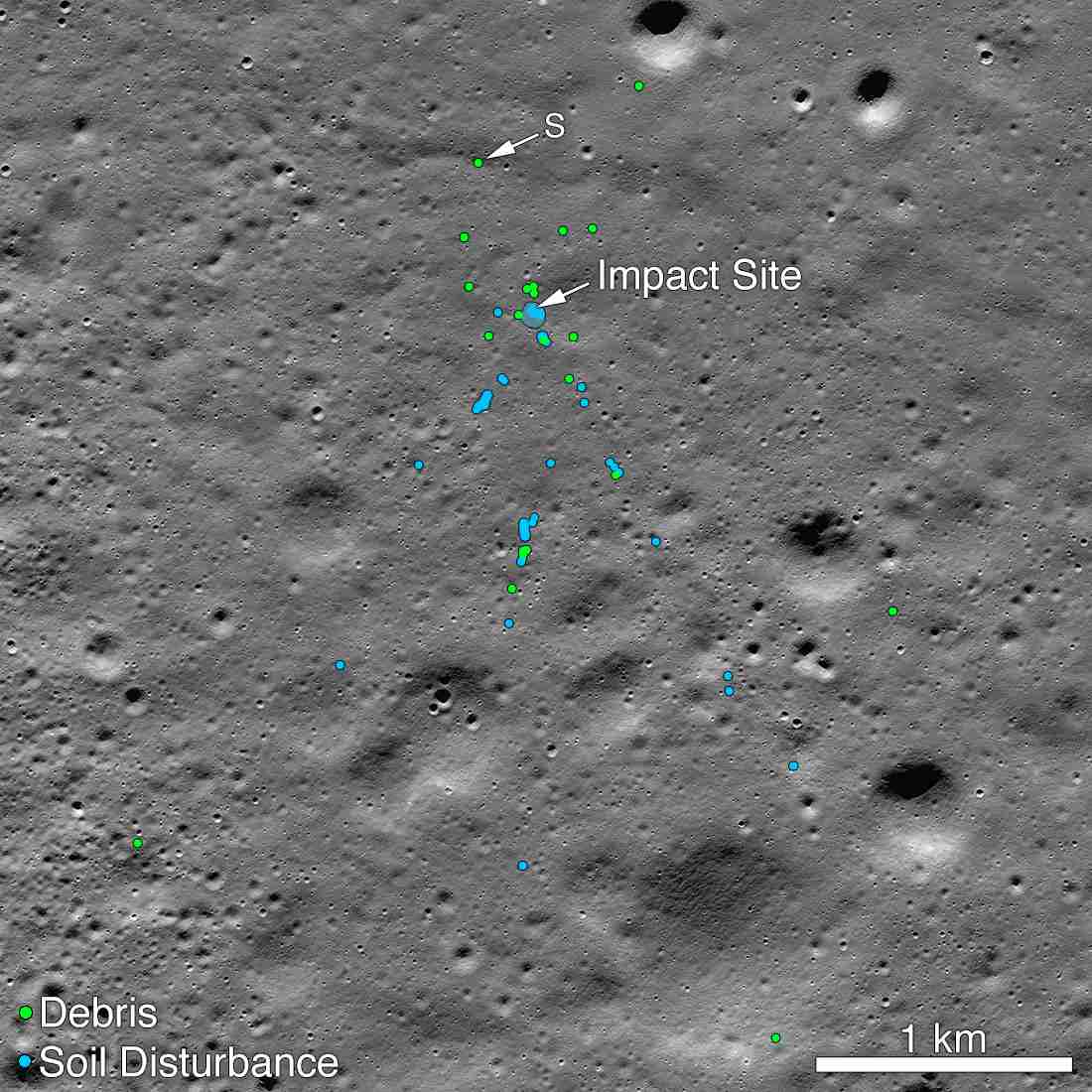 Vikram lander's ejecta as seen by LRO's camera. Image: NASA[/caption]Also marked in the image is a piece of debris identified by Shanmuga Subramanian, an Indian computer programmer and mechanical engineer, marked as "S". This was the first piece of the lander's debris discovered, roughly 750 meters northwest of the main impact site."The crash landing of Vikram rekindled an interest in the moon not only for me and others also," Subramanian wrote in an email to the New York Times. "I think even if Vikram had landed and sent some images, we would have never had such interest. For the first few days, I was scanning the images randomly and there were a lot of false positives."The single bright pixel that Subramanian located in the LRO's mosaic taken on 11 November led NASA's Lunar Reconnaissance Orbiter Camera (LROC) team to the rest of the debris field and the impact site. This image also best shows the impact crater, and the lander's "extensive debris field", NASA said in a press release. Subramanian received an email from John Keller, the deputy project scientist of the LRO mission at NASA congratulating him "for what I am sure was a lot of time and effort on your part", a picture of which he shared on Twitter. The largest chunks of debris are a pair of green dots, each around 2x2 pixels in size, which cast a one-pixel shadow on the moon's surface, NASA added.The Indian Space Research Organisation (ISRO) is yet to share their comments on the image publicly. The Vikram lander was aiming for a smooth plain, some 600 kilometers from the south pole. ISRO lost contact with the lander moments before the scheduled touchdown. Despite the failed soft-landing, getting as close to the surface as Vikram did was an amazing achievement, the agency said.[caption id="" align="alignnone" width="1100"]
 Before and after images show the Vikram impact point. Changes to the surface are subtle and are more easily seen in these images than earlier ones. Image: NASA/LRO[/caption]The LROC team released the first mosaic (taken on 17 September) of the site, after which many people downloaded the mosaic, looking for signs of Vikram. Subramanian supposedly contacted the LRO project team after positively identifying the debris. The LROC team confirmed the identification by comparing before and after images.The images for the first mosaic were acquired the impact point was poorly illuminated and thus not easily identifiable. Two subsequent image sequences were acquired on Oct. 14 and 15, and Nov. 11. The LROC team scoured the surrounding area in these new mosaics and found the impact site (70.8810°S, 22.7840°E, 834 m elevation) and associated debris field. As it turns out, the 11 November mosaic had the best pixel resolution (0.7 meter) and lighting conditions (72° incidence angle) for the discovery.In a Reddit comment posted on 3 December, Subramanian (u/Ramanean3) credits part of the discovery to citizen scientists u/Ohsin and u/Astro_Neel.
Vikram Lander Found | Lunar Reconnaissance Orbiter Camera from r/ISROAround two months ago, u/Ohsin had shared superimposed images obtained from the LRO and Chandrayaan 2's Orbiter High-Resolution Camera (OHRC), finding that the Vikram lander didn't land where it was meant to. ISRO is yet to share their comments on these new developments, but is likely to do so later this week, according to a report in the Wire.
First Published:Dec 03, 2019, 07:49:14 IST
Advertisement
Advertisement

Careless Whispers: Scientists discover that plants can 'talk' to each other using smells
Japanese scientists have recorded a video that shows plants, in certain conditions, communicate with each other using mists that carry smells. The discovery, reveals that plants release a fine mist of airborne compounds, to warn nearby plants of potential dangers
Life on Mars? European Space Agency’s Orbiter discovers ice water deposits at equator
European Space Agency's Mars Express Orbiter has identified massive ice and ice water deposits beneath the surface of Mars. The Mars Express orbiter was also the first to confirmed the presence of ice on Mars in 2004
Microsoft briefly overtakes Apple as the most valuable company, Apple back on top again
At its peak during the session, Microsoft's value reached $2.903 trillion, with a 2% surge. As of writing this article, Apple closed at $2.89 trillion, whereas Microsoft closed at $2.86 trillion
Even NASA is facing a tough time, starts layoffs following major budget cuts
NASA is facing some massive budget cuts, because of which, it has been forced to postpone some upcoming missions. NASA's Jet Propulsion Laboratory has been hit hard by recent federal budget cuts, resulting in the layoff of 100 contractors last week
ISRO, NASA's NISAR satellite to get ready by Jan-end, will monitor Earth's snow-covered regions
The NISAR satellite which has been developed jointly ISRO and NASA, should be ready for launch by the end of January 2024. The collaboration between NASA and ISRO on NISAR is the first time the two agencies have cooperated on hardware development for an Earth-observing mission
Advertisement
Advertisement