
Advertisement


Sections
Captured in photos: Second interstellar object ever observed in our solar system
The image shows details about C/2019 Q4 — a fuzzy coma and tail, both of which are features not seen in 'Oumuamua.

An unknown object was spotted entering the solar system in August, likely from an alien world. It was spotted by an amateur astronomer in Ukraine on 30 August. The Minor Planet Centre, part of the Smithsonian Astrophysical Observatory released a statement claiming the object, called C/2019 Q4, has an orbit in the shape of a hyperbola, and was moving at high speeds unaffected by the sun’s gravity, suggesting it hails from outside our solar system.Now, astronomers have taken the first photograph of the space rock. The first time an interstellar object entered our solar system, astronomers and scientists caught it too late. The asteroid, Oumuamua, was leaving and this left them with very little time to study it. C/2019 Q4 could offer an opportunity for astronomers to compare notes with 'Oumuamua, the first interstellar object spotted leaving our solar system in 2017.[caption id="attachment_7352711" align="alignnone" width="1280"]![The interstellar comet C/2019 Q4 in action.]() The interstellar comet C/2019 Q4 in action. Image: Gemini Observatory/NSF/AURA[/caption]"This image was possible because of Gemini’s ability to rapidly adjust observations and observe objects like this, which have very short windows of visibility," Andrew Stephens, coordinator of the observations by Gemini, said in a statement.The image captured by the Gemini Observatory shows details about C/2019 Q4 — a fuzzy coma and tail, both of which are features of comets not seen in 'Oumuamua. The pronounced tail in the image is indicative of outgassing, which is a characteristical comet thing to do. This is also the first time an interstellar visitor has shown an evident tail due to outgassing. 'Oumuamua, on the other hand, was a highly elongated asteroid-like rock with no evident outgassing.[caption id="attachment_6915661" align="alignnone" width="1280"]
The interstellar comet C/2019 Q4 in action. Image: Gemini Observatory/NSF/AURA[/caption]"This image was possible because of Gemini’s ability to rapidly adjust observations and observe objects like this, which have very short windows of visibility," Andrew Stephens, coordinator of the observations by Gemini, said in a statement.The image captured by the Gemini Observatory shows details about C/2019 Q4 — a fuzzy coma and tail, both of which are features of comets not seen in 'Oumuamua. The pronounced tail in the image is indicative of outgassing, which is a characteristical comet thing to do. This is also the first time an interstellar visitor has shown an evident tail due to outgassing. 'Oumuamua, on the other hand, was a highly elongated asteroid-like rock with no evident outgassing.[caption id="attachment_6915661" align="alignnone" width="1280"]![Artist impression of the space object Oumuamua. Image credit: Wikimedia Commons]() Artist impression of the space object Oumuamua. Image credit: Wikimedia Commons[/caption]Currently, C/2019 Q4 is close to the relative position of the Sun in our sky, which is hampering observations with a glow during twilight. But better opportunities to observe it will come around over the next few months, according to the Gemini website, since the comet’s hyperbolic path will bring it to more favorable conditions for observations to be made.[caption id="" align="alignnone" width="1280"]
Artist impression of the space object Oumuamua. Image credit: Wikimedia Commons[/caption]Currently, C/2019 Q4 is close to the relative position of the Sun in our sky, which is hampering observations with a glow during twilight. But better opportunities to observe it will come around over the next few months, according to the Gemini website, since the comet’s hyperbolic path will bring it to more favorable conditions for observations to be made.[caption id="" align="alignnone" width="1280"]![]() The trajectory of the interstellar comet.[/caption]The first observation made of the comet in August was pre-published in arXiv.
The trajectory of the interstellar comet.[/caption]The first observation made of the comet in August was pre-published in arXiv.
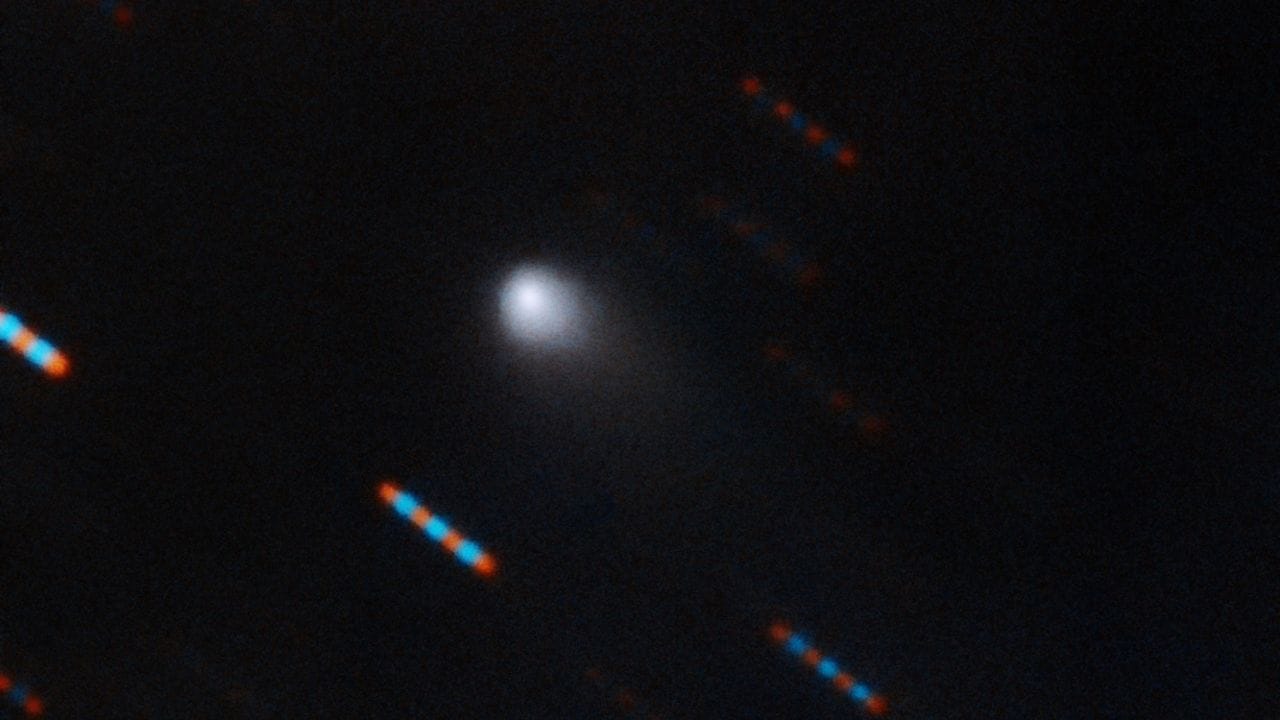 The interstellar comet C/2019 Q4 in action. Image: Gemini Observatory/NSF/AURA[/caption]"This image was possible because of Gemini’s ability to rapidly adjust observations and observe objects like this, which have very short windows of visibility," Andrew Stephens, coordinator of the observations by Gemini, said in a statement.The image captured by the Gemini Observatory shows details about C/2019 Q4 — a fuzzy coma and tail, both of which are features of comets not seen in 'Oumuamua. The pronounced tail in the image is indicative of outgassing, which is a characteristical comet thing to do. This is also the first time an interstellar visitor has shown an evident tail due to outgassing. 'Oumuamua, on the other hand, was a highly elongated asteroid-like rock with no evident outgassing.[caption id="attachment_6915661" align="alignnone" width="1280"]
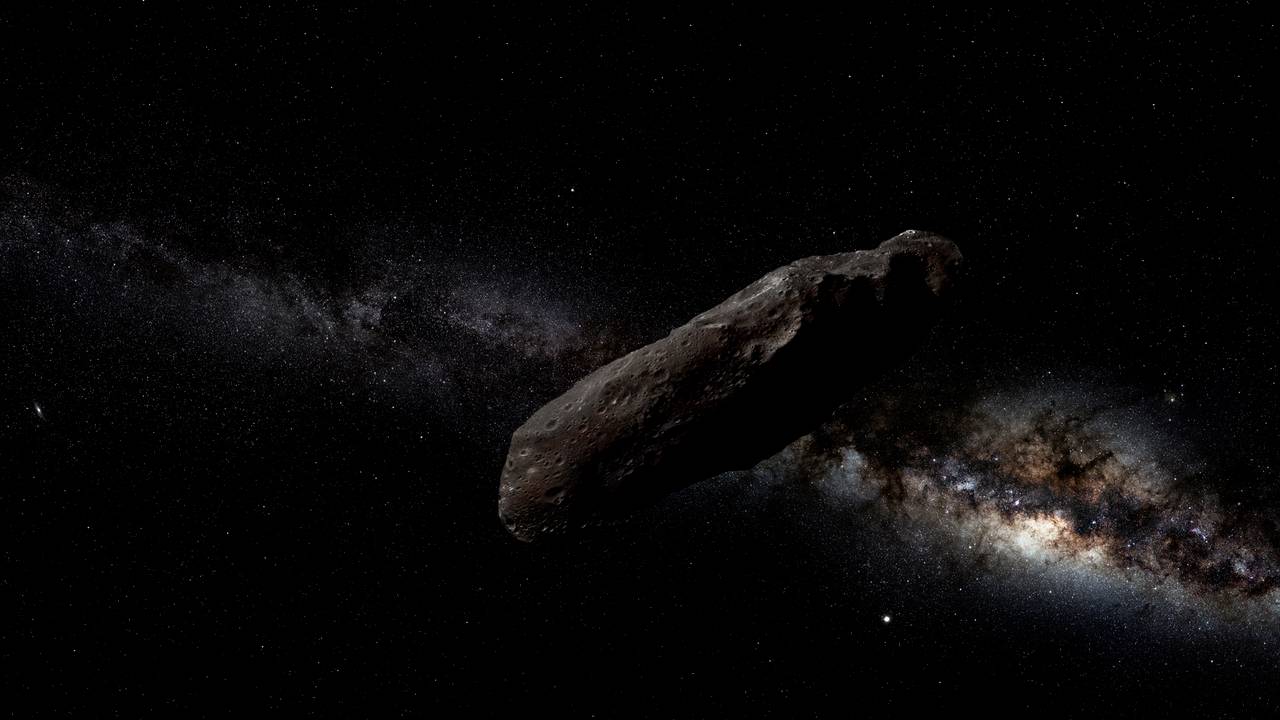 Artist impression of the space object Oumuamua. Image credit: Wikimedia Commons[/caption]Currently, C/2019 Q4 is close to the relative position of the Sun in our sky, which is hampering observations with a glow during twilight. But better opportunities to observe it will come around over the next few months, according to the Gemini website, since the comet’s hyperbolic path will bring it to more favorable conditions for observations to be made.[caption id="" align="alignnone" width="1280"]
 The trajectory of the interstellar comet.[/caption]The first observation made of the comet in August was pre-published in arXiv.
Also Read
spotted by an amateur astronomer
First Published:Sep 17, 2019, 09:34:07 IST
Advertisement
Advertisement

Careless Whispers: Scientists discover that plants can 'talk' to each other using smells
Japanese scientists have recorded a video that shows plants, in certain conditions, communicate with each other using mists that carry smells. The discovery, reveals that plants release a fine mist of airborne compounds, to warn nearby plants of potential dangers
Life on Mars? European Space Agency’s Orbiter discovers ice water deposits at equator
European Space Agency's Mars Express Orbiter has identified massive ice and ice water deposits beneath the surface of Mars. The Mars Express orbiter was also the first to confirmed the presence of ice on Mars in 2004
Microsoft briefly overtakes Apple as the most valuable company, Apple back on top again
At its peak during the session, Microsoft's value reached $2.903 trillion, with a 2% surge. As of writing this article, Apple closed at $2.89 trillion, whereas Microsoft closed at $2.86 trillion
Even NASA is facing a tough time, starts layoffs following major budget cuts
NASA is facing some massive budget cuts, because of which, it has been forced to postpone some upcoming missions. NASA's Jet Propulsion Laboratory has been hit hard by recent federal budget cuts, resulting in the layoff of 100 contractors last week
ISRO, NASA's NISAR satellite to get ready by Jan-end, will monitor Earth's snow-covered regions
The NISAR satellite which has been developed jointly ISRO and NASA, should be ready for launch by the end of January 2024. The collaboration between NASA and ISRO on NISAR is the first time the two agencies have cooperated on hardware development for an Earth-observing mission
Advertisement
Advertisement