


Can the same mask used against COVID-19, keep me safe from the wildfire smoke?
Keep your house as protected from smoke as possible by keeping the windows closed and use a portable air cleaner.

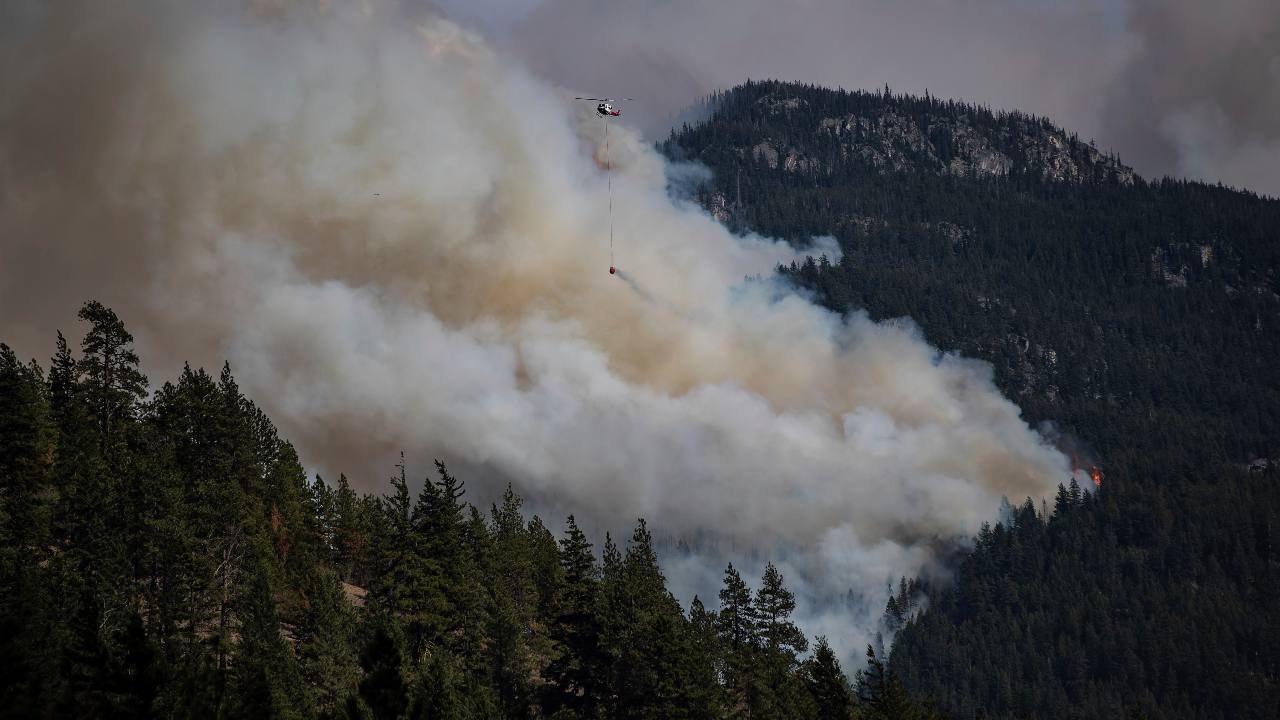
A helicopter carrying a water bucket flies past the Lytton Creek wildfire burning in the mountains near Lytton, British Columbia, on Sunday, Aug. 15, 2021. (Darryl Dyck/The Canadian Press via AP)[/caption]Although smoke exposure and the coronavirus pose similar risks, protecting yourself from each require different measures: Cloth masks used to slow the spread of the virus offer little protection against the small, harmful particles in wildfire smoke, according to the Centers for Disease Control and Prevention.With hundreds of thousands of acres burning across the West, and fire season far from over, here’s a guide to how to keep yourself safe.
What are some of the harmful effects of wildfire smoke?
The wildfire smoke currently blanketing much of the West contains a mixture of gases and particles from burning trees and plants. The smallest of these particles — 2.5 micrometers and smaller, which are called PM 2.5 — can be inhaled into the deepest part of the lungs and can cause the greatest health risks.When people are exposed to these fine particles repeatedly or for long periods of time, they can be at greater risk of health problems. With fires sparking more often, lasting longer and spreading farther, those risks grow.“We’re being exposed to more wildfires than ever,” said Mary Prunicki, an expert on the health effects of air pollution at Stanford University. “When a community is exposed to wildfire smoke, there will be an increase in respiratory disorders showing up in the emergency room and people being hospitalized with asthma and COPD. It exacerbates pneumonia, acute bronchitis.”Wildfire exposure can also heighten the risk of strokes and create complications with pregnancies.What are the best ways to protect myself from the harmful effects of wildfire smoke?Because of the small size of PM 2.5, most masks will not do much to protect you from its toxins. According to the CDC, N95 and KN95 respirators can provide protection from both wildfire smoke and the coronavirus. But because of the limited supply of N95 respirators, the CDC does not recommend their use outside of health care settings.The best protection against smoke is to limit exposure.“Don’t go by whether or not you can smell it,” said Prunicki, who also advised to limit physical activity outside. “Try not to do things that are going to cause you to breathe deeply."Keep your house as protected from smoke as possible by keeping the windows closed and use a portable air cleaner. Create a “clean room”— a dedicated room in your house where you can keep windows and doors closed, and run fans, air conditioners and portable air cleaners — and spend as much time there as possible.
How can I check the smoke conditions in my area?
Track the AQI, or Air Quality Index, to ensure the air quality is within a healthy range before spending time outside.The Air Quality Index, established by the Environmental Protection Agency, measures the density of five pollutants: ground-level ozone, particulates, carbon monoxide, nitrogen dioxide and sulfur dioxide.The index runs from 0 to 500. If it shows a number that’s less than 100, then air pollution is below the level known to cause adverse health effects. When the index registers more than 100, the outdoor air remains safe for many, but some people, like older adults, children and those with heart and lung disease, are at increased risk. A number above 200 is considered “very unhealthy.”You can find the AQI in your area on the website AirNow, which is run by the EPA and also has separate fire and smoke maps.Sophie Kasakove c.2021 The New York Times CompanyThis article originally appeared in The New York Times.
 More from Science
Careless Whispers: Scientists discover that plants can 'talk' to each other using smells
Life on Mars? European Space Agency’s Orbiter discovers ice water deposits at equator
Microsoft briefly overtakes Apple as the most valuable company, Apple back on top again
Even NASA is facing a tough time, starts layoffs following major budget cuts
ISRO, NASA's NISAR satellite to get ready by Jan-end, will monitor Earth's snow-covered regions