


Black Hole event horizon: First image of black hole helps confirm Einstein's general relativity theory
The black hole is located in the M87 galaxy that is about 53 million light years away from Earth.

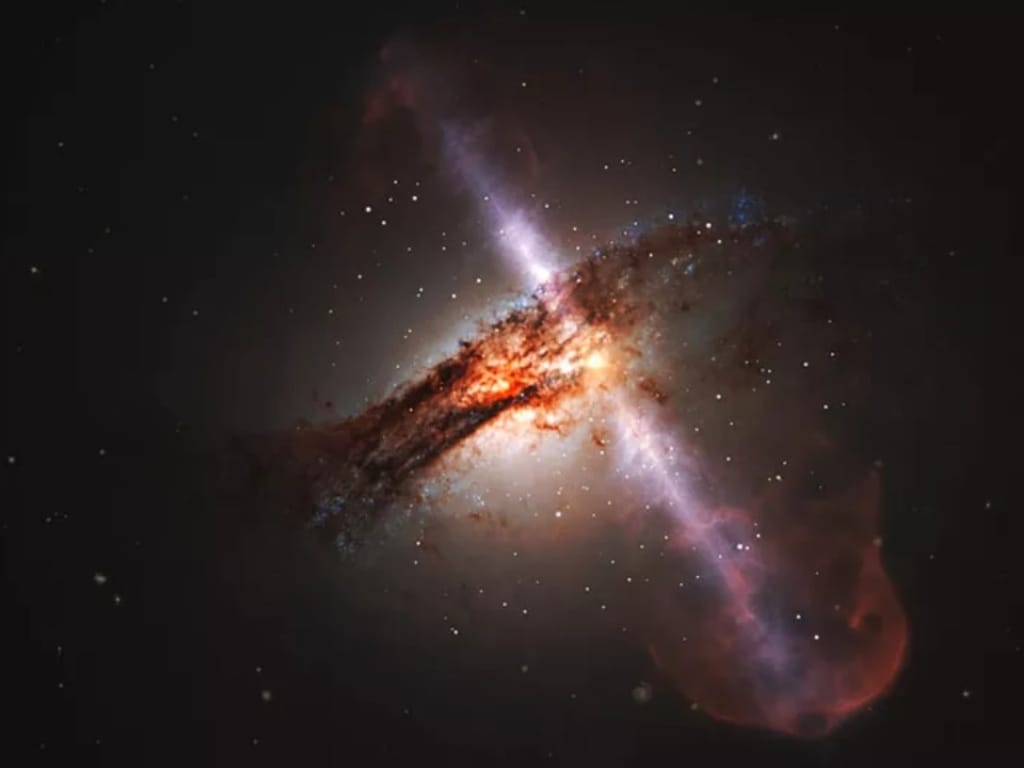
Representational image. Image: NASA/ESA/STScI[/caption]It looked like a flaming orange, yellow and black ring."We have seen what we thought was unseeable. We have seen and taken a picture of a black hole. Here it is," said Sheperd Doeleman of Harvard.Jessica Dempsey, a co-discoverer and deputy director of the East Asian Observatory in Hawaii, said it reminded her of the powerful flaming Eye of Sauron from the "Lord of the Rings" trilogy.Unlike smaller black holes that come from collapsed stars, supermassive black holes are mysterious in origin. Situated at the center of most galaxies, including ours, they are so dense that nothing, not even light, can escape their gravitational pull. This one's "event horizon" — the point of no return around it, where light and matter begin to fall inexorably into the abyss — is as big as our entire solar system.Three years ago, scientists using an extraordinarily sensitive observing system heard the sound of two much smaller black holes merging to create a gravitational wave, as Albert Einstein predicted. The new image, published in the Astrophysical Journal Letters and announced around the world in several news conferences, adds light to that sound.Outside scientists suggested the achievement could be worthy of a Nobel Prize, just like the gravitational wave discovery.While much around a black hole falls into a death spiral and is never to be seen again, the new image captures "lucky gas and dust" circling at just far enough to be safe and seen millions of years later on Earth, Dempsey said.Taken over four days when astronomers had "to have the perfect weather all across the world and literally all the stars had to align," the image helps confirm Einstein's general relativity theory, Dempsey said. Einstein a century ago even predicted the symmetrical shape that scientists just found, she said."It's circular, but on one side the light is brighter," Dempsey said. That's because that light is approaching Earth.
The measurements are taken at a wavelength the human eye cannot see, so the astronomers added color to the image. They chose "exquisite gold because this light is so hot," Dempsey said. "Making it these warm gold and oranges makes sense."What the image shows is gas heated to millions of degrees by the friction of ever-stronger gravity, scientists said. And that gravity creates a funhouse effect where you see light from both behind the black hole and behind you as the light curves and circles around the black hole itself, said astronomer Avi Loeb, director of the Black Hole Initiative at Harvard. (The lead scientists in the discovery are from Harvard, but Loeb was not involved.)The project cost $50 million to $60 million, with $26 million of that coming from the National Science Foundation.Johns Hopkins astrophysicist Ethan Vishniac, who was not part of the discovery team but edits the journal where the research was published, pronounced the image "an amazing technical achievement" that "gives us a glimpse of gravity in its most extreme manifestation."He added: "Pictures from computer simulations can be very pretty, but there's literally nothing like a picture of the real universe, however fuzzy and monochromatic.""It's just seriously cool," said John Kormendy, a University of Texas astronomer who wasn't part of the discovery team. "To see the stuff going down the tubes, so to speak, to see it firsthand. The mystique of black holes in the community is very substantial. That mystique is going to be made more real."There is a myth that says a black hole would rip you apart, but Loeb and Kormendy said the one pictured is so big, someone could fall into it and not be torn to pieces. But the person would never be seen from again.
Careless Whispers: Scientists discover that plants can 'talk' to each other using smells
Life on Mars? European Space Agency’s Orbiter discovers ice water deposits at equator
Microsoft briefly overtakes Apple as the most valuable company, Apple back on top again
Even NASA is facing a tough time, starts layoffs following major budget cuts
ISRO, NASA's NISAR satellite to get ready by Jan-end, will monitor Earth's snow-covered regions