


Astronomers find planetary maternity ward, 520 light-years from Earth and watch as a planet is born
It takes several million years for a planet to reach its final stage and it is forming around a star about 2.4 times the mass of the sun

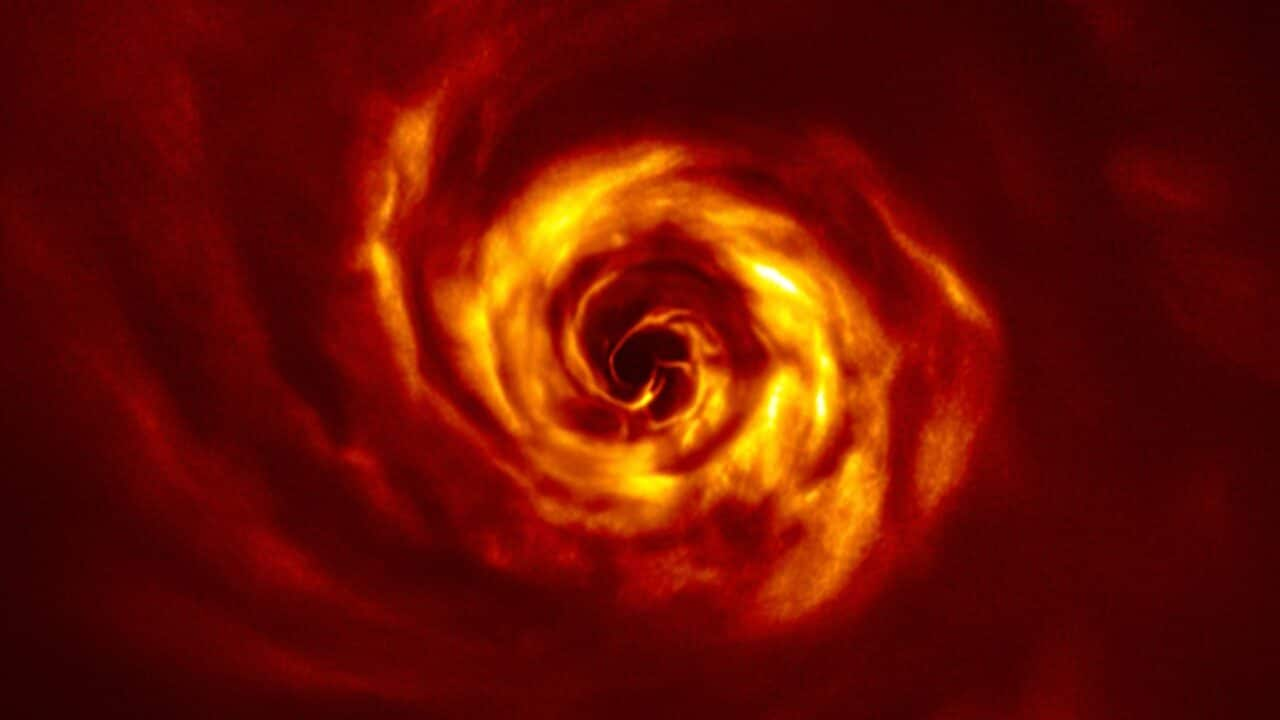
This image shows the disc around the young AB Aurigae star, where ESO’s Very Large Telescope (VLT) has spotted signs of planet birth. Close to the centre of the image, in the inner region of the disc, we see the ‘twist’ (in very bright yellow) that scientists believe marks the spot where a planet is forming. This twist lies at about the same distance from the AB Aurigae star as Neptune from the Sun. Image credit:
ESO/Boccaletti et al.[/caption]The scientists used the European Southern Observatory’s Very Large Telescope in Chile to spot a spiral structure within the swirling disk around AB Aurigae generated by the presence of a planet. They detected a “twist” pattern of gas and dust in the spiral structure marking where the planet was coalescing.“It takes several million years for a planet to be in its final stage, so birth is not well defined in time. However, we can say that we were likely able to catch a planet in the process of formation,” said Observatoire de Paris astronomer Anthony Boccaletti, who led the research published in the journal Astronomy & Astrophysics.More than 4,000 planets have been discovered orbiting stars beyond our solar system. Scientists are eager to learn more about how they are born as cold gas and dust consolidate in these disks surrounding new stars.The planet is located about 30 times further from its star than Earth’s distance from the sun - about the distance of the planet Neptune in our solar system, Boccaletti said. It appears to be a large gas planet, not a rocky planet like Earth or Mars, and maybe more massive than our solar system’s largest planet Jupiter, Boccaletti added.

Careless Whispers: Scientists discover that plants can 'talk' to each other using smells
Life on Mars? European Space Agency’s Orbiter discovers ice water deposits at equator
Microsoft briefly overtakes Apple as the most valuable company, Apple back on top again
Even NASA is facing a tough time, starts layoffs following major budget cuts
ISRO, NASA's NISAR satellite to get ready by Jan-end, will monitor Earth's snow-covered regions