
Advertisement


Sections
Asteroid's moon gets a name before NASA's DART mission crashes into it in 2022
The DART mission will target the near-Earth asteroid's moon Dimorphos when it relatively close In the second half of 2022.

By 2020, the American space agency NASA is planning to demonstrate its ability to deflect an asteroid – a strategy to ensure that Earth has the technological capability to defend itself from a potentially deadly asteroid collision in the uncertain future.The target of the mission will be the moon orbiting the near-Earth asteroid Didymos, which was recently given the name 'Dimorphos'. The mission will be both, the first full-scale demonstration of a planetary defense technology, and a first of its kind mission for NASA.Dimorphos is a near-Earth object – a class of asteroids and comets whose orbits place them within 30 million miles of Earth. This is an important classification of space rocks, and help the US government determine which asteroid threats to take seriously.[caption id="attachment_8540991" align="alignnone" width="1024"]![A mysterious blast in 1908, thought to be caused by a meteor, flattened a Siberian taiga forest. Image courtesy: Sovfot/Universal Images]() A mysterious blast in 1908, thought to be caused by a meteor, flattened a Siberian taiga forest. Image courtesy: Sovfot/Universal Images[/caption]
A mysterious blast in 1908, thought to be caused by a meteor, flattened a Siberian taiga forest. Image courtesy: Sovfot/Universal Images[/caption]![An illustration of NASA’s DART spacecraft and the Italian Space Agency’s LICIACube before impact at the Didymos binary system. Image: NASA/Johns Hopkins APL/Steve Gribben]() An illustration of NASA’s DART spacecraft and the Italian Space Agency’s LICIACube before impact at the Didymos binary system. Image: NASA/Johns Hopkins APL/Steve Gribben[/caption]
An illustration of NASA’s DART spacecraft and the Italian Space Agency’s LICIACube before impact at the Didymos binary system. Image: NASA/Johns Hopkins APL/Steve Gribben[/caption]
 A mysterious blast in 1908, thought to be caused by a meteor, flattened a Siberian taiga forest. Image courtesy: Sovfot/Universal Images[/caption]
Planetary defense is a priority
In 1908, a powerful asteroid is thought to have struck the Tunguska river in a remote Siberian forest in Russia. Millions of trees were destroyed in the forest covering an area of roughly 2000 square kilometers. The impact is said to have thrown people to the ground in a town 65 km away, as per a CNN report.As recently as 2013, an asteroid managed to survive its fiery entry through the Earth's atmosphere over the town of Chelyabinsk, Russia. In a blinding mid-air explosion, the asteroid released 20 to 30 times more energy than the first atomic bombs, briefly generating more brightness than the sun along with an enormous amount of heat. The event reportedly damaged 7,000 buildings, injuring over 1,000 people, after which shock waves from the impact broke windows 95 km away.At the time, the US had the capacity to scan the visible sky and detect potentially dangerous asteroids heading the way of our planet. The Chelyabinsk asteroid went undetected because it came from the same direction and path as the sun. This blind spot continues to exist today, which leaves room for error in predicting potential asteroid collisions with Earth.NASA's DART will crash into Dimorphos
In the second half of 2022, the near-Earth asteroid Didymos and its moon Dimorphos will be relatively close (within 1.1 crore km) of Earth. NASA has chosen this range to fire up its DART mission. DART will deliberately collide with Dimorphos to change the asteroid's motion in space, according to NASA. The advantage of hitting a target while it is still very, very far away is that even the slightest deflection from its original path will take the asteroid far enough away from Earth as it closes in distance.A companion CubeSat called LICIACube, provided by the Italian Space Agency, will accompany DART and record the collision."Astronomers will be able to compare observations from Earth-based telescopes before and after DART's kinetic impact to determine how much the orbital period of Dimorphos changed," Tom Statler, program scientist of the DART mission at NASA, said in a statement."That's the key measurement that will tell us how the asteroid responded to our deflection effort."[caption id="attachment_8544771" align="alignnone" width="1280"]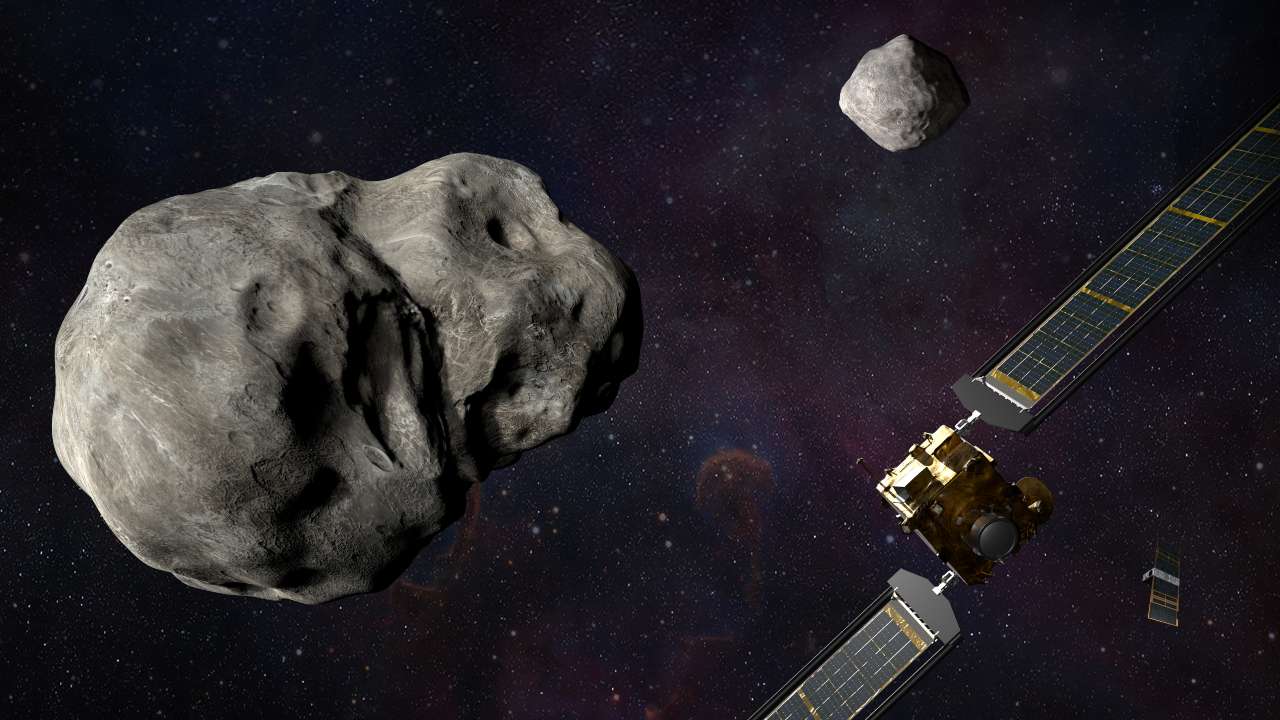 An illustration of NASA’s DART spacecraft and the Italian Space Agency’s LICIACube before impact at the Didymos binary system. Image: NASA/Johns Hopkins APL/Steve Gribben[/caption]
ESA's Hera mission – a follow-up
A few years after DART's impact, the European Space Agency plans to launch Hera, a mission to investigate Didymos and Dimorphos to collect more data.While the DART mission was developed as part of NASA's Planetary Defense missions, the team of scientists and engineers will work with ESA's Hera mission team under a larger, international collaboration called the Asteroid Impact and Deflection Assessment, or AIDA.At the moment, this might be our best defense strategy against an asteroid on a collision course with Earth – if scientists catch it early enough.Other efforts to deal with a potential collision include a biannual Planetary Defense exercise to evaluate our preparedness for a collision that is inevitable. This simulation exercise hasn't yet proven our readiness for an event. After wrecking the French Riviera in 2013, destroying Dhaka in 2015 and sparing Tokyo in 2017, an international team of scientists and disaster response experts took to New York in 2019 to gauge how well prepared the city is to deal with a killer asteroid heading their way. New York didn't survive the killer asteroid simulation.Here's hoping better strategy, more preparation and a hope for survival could come from the next Planetary Defense simulation, scheduled to take place in Vienna in 2021.First Published:Jul 01, 2020, 10:11:23 IST
Advertisement
Advertisement

Careless Whispers: Scientists discover that plants can 'talk' to each other using smells
Japanese scientists have recorded a video that shows plants, in certain conditions, communicate with each other using mists that carry smells. The discovery, reveals that plants release a fine mist of airborne compounds, to warn nearby plants of potential dangers
Life on Mars? European Space Agency’s Orbiter discovers ice water deposits at equator
European Space Agency's Mars Express Orbiter has identified massive ice and ice water deposits beneath the surface of Mars. The Mars Express orbiter was also the first to confirmed the presence of ice on Mars in 2004
Microsoft briefly overtakes Apple as the most valuable company, Apple back on top again
At its peak during the session, Microsoft's value reached $2.903 trillion, with a 2% surge. As of writing this article, Apple closed at $2.89 trillion, whereas Microsoft closed at $2.86 trillion
Even NASA is facing a tough time, starts layoffs following major budget cuts
NASA is facing some massive budget cuts, because of which, it has been forced to postpone some upcoming missions. NASA's Jet Propulsion Laboratory has been hit hard by recent federal budget cuts, resulting in the layoff of 100 contractors last week
ISRO, NASA's NISAR satellite to get ready by Jan-end, will monitor Earth's snow-covered regions
The NISAR satellite which has been developed jointly ISRO and NASA, should be ready for launch by the end of January 2024. The collaboration between NASA and ISRO on NISAR is the first time the two agencies have cooperated on hardware development for an Earth-observing mission
Advertisement
Advertisement