
Advertisement


Sections
After being pushed back a few time, ESA's Vega rocket launched from French Guiana
The Vega rocket's last mission in July 2019 failed around two minutes after take-off because of an apparent structural failure that caused the launcher to split in two.

Europe's Vega rocket returned to the skies on Wednesday from French Guiana in its first mission since a failed launch last year.The rocket left Earth around an hour before midnight local time after the launch was postponed numerous times, most recently due to a typhoon passing over a tracking station in South Korea.The coronavirus pandemic and persistent winds over the South American launch site also caused delays.[caption id="attachment_8784201" align="alignnone" width="1280"]![The ESA-Arianespace Vega rocket launched from French Guinea Image credit: ESA/Twitter]()
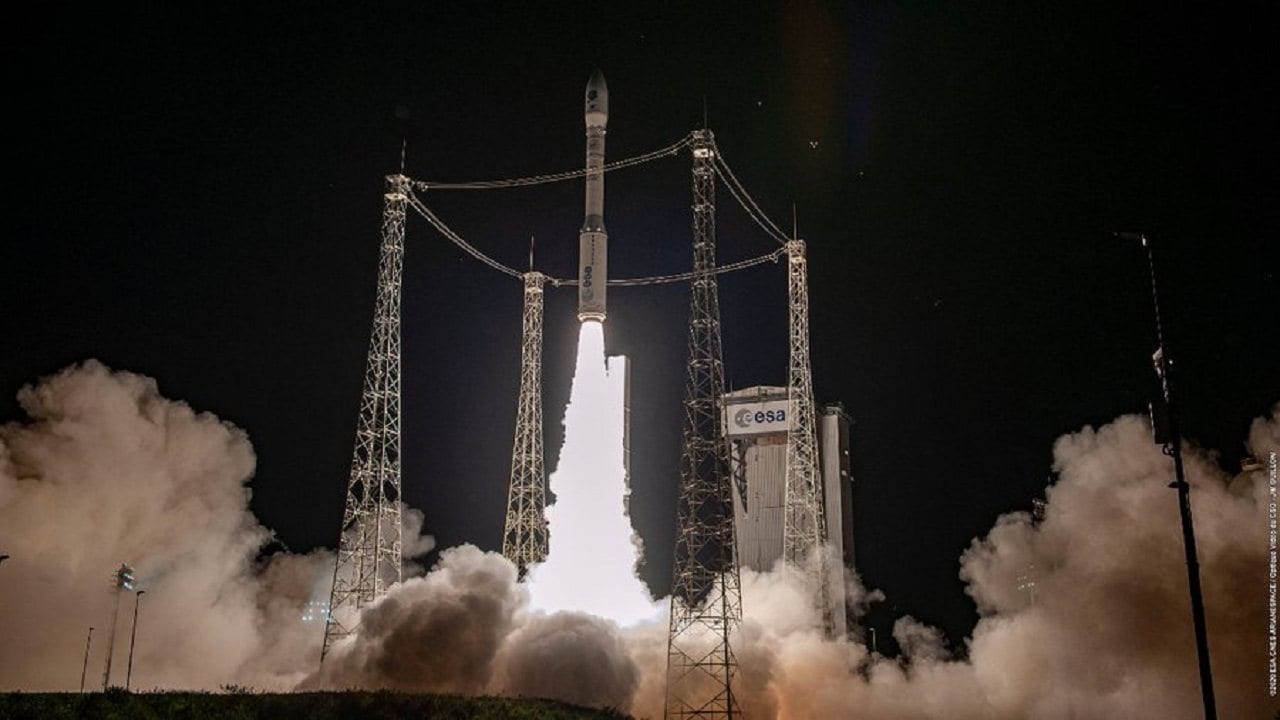
The ESA-Arianespace Vega rocket launched from French Guinea Image credit: ESA/Twitter[/caption]Vega successfully deployed 53 small satellites -- most weighing less than 15 kilogrammes (33 pounds) -- on behalf of clients from 13 countries."I hope these microsatellites enjoyed their ride on Europe's direct line to space!" Stephane Israel, chief executive of launch service provider Arianespace, wrote on Twitter.
The Vega rocket is a crucial component of Europe's ambitions to compete in the booming aerospace market, where it faces strong competition from rivals including Elon Musk's SpaceX.Its last mission in July 2019 failed around two minutes after take-off because of an apparent structural failure that caused the launcher to split in two.It was the first failed mission after 14 successful launches since it began operations in 2012.European Space Agency director general Jan Woerner said Wednesday's launch was an "extremely important project" that heralded the comeback of the Vega rocket class.First Published:Sep 04, 2020, 12:05:25 IST
Advertisement
Advertisement

Careless Whispers: Scientists discover that plants can 'talk' to each other using smells
Japanese scientists have recorded a video that shows plants, in certain conditions, communicate with each other using mists that carry smells. The discovery, reveals that plants release a fine mist of airborne compounds, to warn nearby plants of potential dangers
Life on Mars? European Space Agency’s Orbiter discovers ice water deposits at equator
European Space Agency's Mars Express Orbiter has identified massive ice and ice water deposits beneath the surface of Mars. The Mars Express orbiter was also the first to confirmed the presence of ice on Mars in 2004
Microsoft briefly overtakes Apple as the most valuable company, Apple back on top again
At its peak during the session, Microsoft's value reached $2.903 trillion, with a 2% surge. As of writing this article, Apple closed at $2.89 trillion, whereas Microsoft closed at $2.86 trillion
Even NASA is facing a tough time, starts layoffs following major budget cuts
NASA is facing some massive budget cuts, because of which, it has been forced to postpone some upcoming missions. NASA's Jet Propulsion Laboratory has been hit hard by recent federal budget cuts, resulting in the layoff of 100 contractors last week
ISRO, NASA's NISAR satellite to get ready by Jan-end, will monitor Earth's snow-covered regions
The NISAR satellite which has been developed jointly ISRO and NASA, should be ready for launch by the end of January 2024. The collaboration between NASA and ISRO on NISAR is the first time the two agencies have cooperated on hardware development for an Earth-observing mission
Advertisement
Advertisement