


Researchers develop breakthrough electronic devices that can dissolve in atmospheric water molecules
The lifespan of the devices can be controlled by varying the humidity level or by changing the polymer composition.

Scientists have developed a new electronic device that can be triggered to dissolve through exposure to water molecules in the atmosphere. The advance may lead to eco-friendly disposable personal electronics and biomedical devices that dissolve within the body, researchers said. There are also defence applications, including devices that can be programmed to dissolve in order to safeguard sensitive information, said Cunjiang Yu, Assistant Professor at the University of Houston in the US.[caption id="attachment_4032337" align="alignleft" width="380"]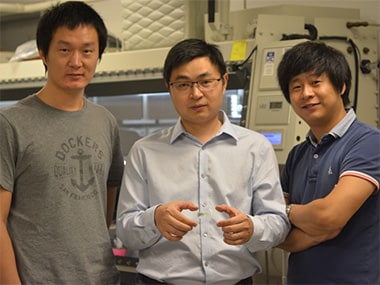 Cunjiang Yu, Bill D. Cook Assistant Professor of mechanical engineering, center, and co-first authors Xu Wang, left, and Kyoseung Sim, right. Image: University of Houston.[/caption]The field, known as physically transient electronics, currently requires immersion in aqueous corrosive solutions or biofluids. This work demonstrates a completely new working mechanism - the dissolution is triggered by ambient moisture, researchers said. "More importantly, the transient period of time can be precisely controlled," said Yu, lead author of the research paper published in the journal Science Advances.Using the technique, a biomedical implant could be programmed to disappear when its task - delivering medication, for example - is complete. Sensitive communications could be devised to literally vanish once the message was delivered. New versions of cell phones could be programmed to dissolve when they are no longer needed, researchers said. "We demonstrate that polymeric substrates with novel degradation kinetics and associated transience chemistry offer a feasible strategy to construct physically transient electronics," the researchers said."Through the manipulation of the polymer component and environmental humidity, the progress of hydrolysing polyanhydrides can be managed and thus the dissolution kinetics of functional device can be controlled," they said. The researchers said that the time period can range from days to weeks, or even longer. In the research, functional electronic components were built via additive processes onto a film made of the polymer polyanhydride.The device remained stable until ambient moisture triggered a chemical breakdown that digested the inorganic electronic materials and components. The researchers tested a number of compounds, including aluminium, copper, nickel indium-gallium, zinc oxide and magnesium oxide, and developed various electronic devices, including resistors, capacitors, antennas, transistors, diodes, photo sensors, to demonstrate the models versatility. The lifespan of the devices can be controlled by varying the humidity level or by changing the polymer composition, Yu added.

Why AI notetakers are raising serious privacy and security concerns
China's low-cost AI models are changing the global AI race. Here's why Silicon Valley is worried
China's Kimi K3 challenges US AI leaders with frontier-level performance at lower cost
How did Instagram run ads promoting child abuse in India?
Why has India halted WhatsApp’s username feature before launch?