
Advertisement


Sections
Researchers and musicians translate the TRAPPIST-1 planetary system into a musical instrument
The repeating pattern of transits used to discover the planets in the TRAPPIST-1 system has been translated into a melody.

In February 2017, NASA announced that its Spitzer space telescope had found seven Earth sized exoplanets in orbit around TRAPPIST-1, an ultracool dwarf star 40 light years away. A puzzling aspect about the system was how the planets were in a stable orbit, considering all of the seven planets are in orbit much closer to the host star than Mercury is to the Sun.[caption id="attachment_3918959" align="alignleft" width="380"]![trappist-1-music]() Image: System Sounds[/caption]Follow up observations from the Kepler space telescope allowed astronomers to figure out the mystery. The planets were locked in orbital resonance, with each planet giving a gravitational tug to the next planet and keeping it in place. This allows the seven planets to maintain their orbits so close to the star without colliding into each other. This is the only known system where seven planets are in orbital resonance.The orbital resonance is a difficult concept to understand, but researchers from Canada have collaborated to create a web-based interface that allows users to understand the intricate dance of the planets in the TRAPPIST-1 system. The interface is also a musical instrument, that allows users to generate music from the orbits of the planets.The repeating pattern of transits used to discover the planets was translated into a melody. The pitch of the sounds corresponds to the orbital frequency of the planets, which has been shifted to be audible to human ears. The gravitational tug of war in the system has resulted in the orbital frequencies of the planets not being whole number ratios, which means the notes are slightly out of tune, giving the TRAPPIST-1 system a unique sound signature.The gravitational tugs can be understood with the beats. Different parts of a drum kit are mapped to different sets of planetary conjugations. This is the point when an inner planet overtakes an outer planet. There is a crash cymbal, a ride cymbal, a closed high hat, a pedal high hat, a snare and a kick mapped to various pairs of conjugations. Every time you hear a beat, that is the sound of a planet tugging another into place. The variations of the brightness of the star was mapped to the volume of the sound.The same process can be used to generate music based on other star systems as well. However, these may just not sound as good as the TRAPPIST-1 system. The process is known as System Sounds, and there is a web interface where you can play around by generating sounds based on the TRAPPIST-1 system. The creators encourage users to capture the music on screen and share their creations online.According to researchers, three of the planets in the TRAPPIST-1 system are in the habitable zones of the host star. This means that there could be liquid water on the surface of the planets, a prerequisite for a planet to support life as we know it on Earth. With the right conditions, all seven planets in the system could have liquid water on the surface. The James Webb Space Telescope which NASA plans to launch in 2018, will investigate the possibility of the planets in the TRAPPIST-1 system harbouring life.
Image: System Sounds[/caption]Follow up observations from the Kepler space telescope allowed astronomers to figure out the mystery. The planets were locked in orbital resonance, with each planet giving a gravitational tug to the next planet and keeping it in place. This allows the seven planets to maintain their orbits so close to the star without colliding into each other. This is the only known system where seven planets are in orbital resonance.The orbital resonance is a difficult concept to understand, but researchers from Canada have collaborated to create a web-based interface that allows users to understand the intricate dance of the planets in the TRAPPIST-1 system. The interface is also a musical instrument, that allows users to generate music from the orbits of the planets.The repeating pattern of transits used to discover the planets was translated into a melody. The pitch of the sounds corresponds to the orbital frequency of the planets, which has been shifted to be audible to human ears. The gravitational tug of war in the system has resulted in the orbital frequencies of the planets not being whole number ratios, which means the notes are slightly out of tune, giving the TRAPPIST-1 system a unique sound signature.The gravitational tugs can be understood with the beats. Different parts of a drum kit are mapped to different sets of planetary conjugations. This is the point when an inner planet overtakes an outer planet. There is a crash cymbal, a ride cymbal, a closed high hat, a pedal high hat, a snare and a kick mapped to various pairs of conjugations. Every time you hear a beat, that is the sound of a planet tugging another into place. The variations of the brightness of the star was mapped to the volume of the sound.The same process can be used to generate music based on other star systems as well. However, these may just not sound as good as the TRAPPIST-1 system. The process is known as System Sounds, and there is a web interface where you can play around by generating sounds based on the TRAPPIST-1 system. The creators encourage users to capture the music on screen and share their creations online.According to researchers, three of the planets in the TRAPPIST-1 system are in the habitable zones of the host star. This means that there could be liquid water on the surface of the planets, a prerequisite for a planet to support life as we know it on Earth. With the right conditions, all seven planets in the system could have liquid water on the surface. The James Webb Space Telescope which NASA plans to launch in 2018, will investigate the possibility of the planets in the TRAPPIST-1 system harbouring life.
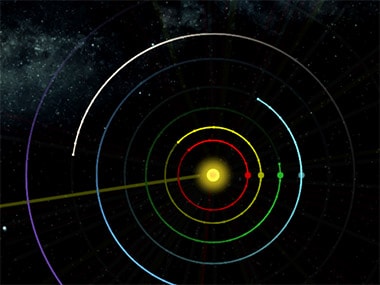 Image: System Sounds[/caption]Follow up observations from the Kepler space telescope allowed astronomers to figure out the mystery. The planets were locked in orbital resonance, with each planet giving a gravitational tug to the next planet and keeping it in place. This allows the seven planets to maintain their orbits so close to the star without colliding into each other. This is the only known system where seven planets are in orbital resonance.The orbital resonance is a difficult concept to understand, but researchers from Canada have collaborated to create a web-based interface that allows users to understand the intricate dance of the planets in the TRAPPIST-1 system. The interface is also a musical instrument, that allows users to generate music from the orbits of the planets.The repeating pattern of transits used to discover the planets was translated into a melody. The pitch of the sounds corresponds to the orbital frequency of the planets, which has been shifted to be audible to human ears. The gravitational tug of war in the system has resulted in the orbital frequencies of the planets not being whole number ratios, which means the notes are slightly out of tune, giving the TRAPPIST-1 system a unique sound signature.The gravitational tugs can be understood with the beats. Different parts of a drum kit are mapped to different sets of planetary conjugations. This is the point when an inner planet overtakes an outer planet. There is a crash cymbal, a ride cymbal, a closed high hat, a pedal high hat, a snare and a kick mapped to various pairs of conjugations. Every time you hear a beat, that is the sound of a planet tugging another into place. The variations of the brightness of the star was mapped to the volume of the sound.
First Published:Aug 11, 2017, 14:44:23 IST
Advertisement
Advertisement

Why AI notetakers are raising serious privacy and security concerns
AI notetakers promise effortless meeting summaries, but experts warn they could expose confidential conversations, corporate secrets and personal voiceprints. As businesses increasingly adopt AI-powered meeting assistants, questions over data storage, privacy, consent and legal risks are becoming impossible to ignore
5 min read
China's low-cost AI models are changing the global AI race. Here's why Silicon Valley is worried
As Chinese firms continue to improve performance while keeping prices low, the AI race is no longer just about building the smartest model—it is increasingly becoming a battle over who can deliver the best value
2 min read
China's Kimi K3 challenges US AI leaders with frontier-level performance at lower cost
Chinese artificial intelligence startup Moonshot AI has unveiled its latest open-weight AI model, Kimi K3, with early results suggesting it could compete with some of the world's most advanced AI systems developed by leading US companies
2 min read
How did Instagram run ads promoting child abuse in India?
India has issued a notice to Meta after an investigation alleged that Instagram displayed paid advertisements promoting child sexual abuse material. MeitY ordered Meta to remove such Instagram ads and explain within seven days how they were approved
8 min read
Why has India halted WhatsApp’s username feature before launch?
India has halted WhatsApp’s planned username feature, citing concerns about cybercrime, impersonation, and law enforcement challenges. As Meta races to address security concerns, here’s why MeitY has paused the rollout, what the feature does, and how it could influence privacy and online safety in India
3 min read
Advertisement
Advertisement