


Process of modern human populations absorbing Neanderthals was a stop and go phenomenon: Study
Researchers have found Neanderthals survived at least 3,000 years longer in the modern day Spain, long after they had died out everywhere else.

Researchers have found Neanderthals survived at least 3,000 years longer in the Southern Iberia region, modern day Spain, long after they had died out everywhere else. According to the findings, the process of modern human populations absorbing Neanderthal populations through interbreeding was not a regular or a gradual wave-of-advance phenomenon, rather a "stop-and-go, punctuated, geographically uneven history".[caption id="attachment_4217237" align="alignleft" width="380"]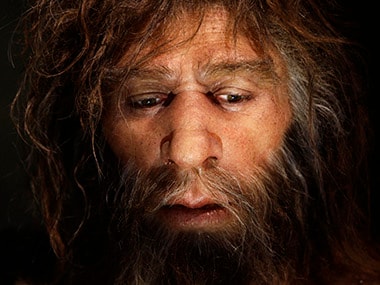 A hyperrealistic model of a Neanaderthal. Image: Reuters[/caption]"Technology from the Middle Paleolithic in Europe is exclusively associated with the Neanderthals," said João Zilhão, researcher at the University of Barcelona in Spain. After excavating three new sites in southern Spain, over more than 10 years, the researchers discovered evidence of distinct Neanderthal materials dating from 37,000 years ago. "In three new excavation sites, we found Neanderthal artefacts dated to thousands of years later than anywhere else in Western Europe. Even in the adjacent regions of northern Spain and southern France the latest Neanderthal sites are all significantly older," Zilhão added.The Middle Paleolithic, a part of the Stone Age spanning between 300,000 and 30,000 years ago, is widely acknowledged as a phase during which anatomically modern humans started to move out of Africa and assimilated with the Eurasian populations, including Neanderthals, through interbreeding. According to the research, published in the journal Heliyon, this process was not a straightforward, instead, it seems to have been punctuated with different evolutionary patterns in different geographical regions."We believe that the stop-and-go, punctuated, uneven mechanism we propose must have been the rule in human evolution, which helps explaining why Paleolithic material culture tends to form patterns of geographically extensive similarity while Paleolithic genomes tend to show complex ancestry patchworks," Zilhão noted. The key to understanding this pattern lies in discovering and analyzing new sites, not in revisiting old ones.

Why AI notetakers are raising serious privacy and security concerns
China's low-cost AI models are changing the global AI race. Here's why Silicon Valley is worried
China's Kimi K3 challenges US AI leaders with frontier-level performance at lower cost
How did Instagram run ads promoting child abuse in India?
Why has India halted WhatsApp’s username feature before launch?