


NASA's Kepler space telescope makes discovery using machine learning from Google
NASA will announce the discovery made by Kepler, which has been searching for alien worlds since 2009, on 14 December.

NASA's planet-hunting Kepler space telescope has made its latest discovery using machine learning from Google, the US space agency said.[caption id="attachment_4253589" align="alignleft" width="380"]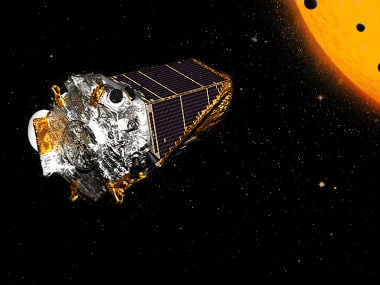 Kepler Space telescope. NASA.[/caption]NASA will announce the discovery made by Kepler, which has been searching for alien worlds since 2009, on 14 December."The discovery was made by researchers using machine learning from Google," NASA officials said."Machine learning is an approach to artificial intelligence, and demonstrates new ways of analysing Kepler data," they said.Kepler has gazed at more than 150,000 stars and continues to transmit back data that leads to important discoveries of celestial objects in our galaxy, including first-time observations of planets outside our solar system.When Kepler launched in March 2009, scientists did not know how common planets were beyond our solar system, according to NASA.Thanks to Kepler's treasure trove of discoveries, astronomers now believe there may be at least one planet orbiting every star in the sky, the US space agency said.Kepler completed its prime mission in 2012 and went on to collect data for an additional year in an extended mission.In 2014, the spacecraft began a new extended mission called K2, which continues the search for planets outside our solar system, known as exoplanets, while introducing new research opportunities to study young stars, supernovae and other cosmic phenomena.

Why AI notetakers are raising serious privacy and security concerns
China's low-cost AI models are changing the global AI race. Here's why Silicon Valley is worried
China's Kimi K3 challenges US AI leaders with frontier-level performance at lower cost
How did Instagram run ads promoting child abuse in India?
Why has India halted WhatsApp’s username feature before launch?