


NASA rocket mission to form artificial clouds at night to study their effect on communication systems
The artificial clouds will be visible for residents of the Republic of the Marshall Islands, NASA said.

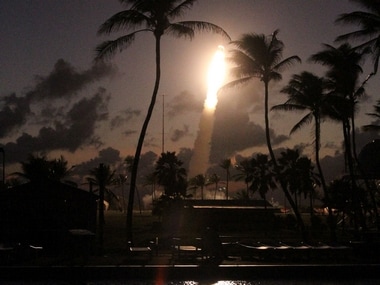
Image Courtesy: NASA[/caption]The artificial clouds will be visible for residents of the Republic of the Marshall Islands, NASA said. The Waves and Instabilities from a Neutral Dynamo, or WINDY, mission will study a phenomenon that occurs in the ionosphere a layer of charged particles in the upper atmosphere.Known as equatorial spread F, or ESF, these disturbances occur after sunset at latitudes near the equator in part of the ionosphere known as the F region. The disturbances interfere with radio communication, navigation and imaging systems and pose a hazard to technology and society that depends on it.The WINDY mission consists of two NASA suborbital sounding rockets that will be launched from Roi-Namur island in the north part of the Kwajalein Atoll in the Marshall Islands.The Kwajalein Atoll in the Marshall Islands is near the magnetic equator, where post-sunset ionosphere storms are more intense, making the site an ideal location for these studies.One rocket will carry a substance called tri-methyl aluminum, or TMA. This substance will form the white artificial clouds that glow in the night sky, the US space agency said.Scientists on the ground will photograph the movement of these clouds to measure the winds and energetic particles that are in motion in the upper atmosphere.The clouds are expected to be visible for about 30 minutes. The second rocket, a two-stage 36-foot long Terrier-Malemute, will be launched five minutes after the first rocket. The second rocket carries instruments to measure ionosphere densities and electric and magnetic fields present in these storms.The ionosphere is defined as the layer of Earth's atmosphere that is ionized by solar and cosmic radiation.

Why AI notetakers are raising serious privacy and security concerns
China's low-cost AI models are changing the global AI race. Here's why Silicon Valley is worried
China's Kimi K3 challenges US AI leaders with frontier-level performance at lower cost
How did Instagram run ads promoting child abuse in India?
Why has India halted WhatsApp’s username feature before launch?