
Advertisement


Sections
Instagram starts flagging fake posts but wrongly marks digital art image as 'False information'
The concerned Instagram image is of a man standing on rainbow coloured mountains.

There has been a lot of debate regarding how Facebook needs to handle fake news, misinformation on its platform, especially around the US 2020 elections. The company said that it will flag posts that have fake news or misinformation to avoid users from spreading misleading information. This was even implied in a case that occurred in Singapore. Here Facebook flagged a post as "False information".[caption id="attachment_7478291" align="alignnone" width="1024"]![Representational Image.]() Representational Image.[/caption]The same concept has been transferred to Instagram as well. The company announced that it will flag posts that contain false information but will not ban them from the platform.As per a new post by San Francisco-based photographer Toby Harriman, the company is marking "False photos/digital art" for photos which it deems have been photoshopped to change the context. According to him, an image where "a man is standing on rainbow-coloured mountains" on Instagram was marked as "False information". When you tap at "see why", it says, "The primary claims in this information are factually inaccurate."Harriman says, "Interesting to see this and curious if it’s a bit too far. As much as I do love it to help better associate real vs Photoshop. I also have huge respect for digital art and don’t want to have to click through barriers to see it.”[caption id="attachment_7903291" align="alignnone" width="444"]
Representational Image.[/caption]The same concept has been transferred to Instagram as well. The company announced that it will flag posts that contain false information but will not ban them from the platform.As per a new post by San Francisco-based photographer Toby Harriman, the company is marking "False photos/digital art" for photos which it deems have been photoshopped to change the context. According to him, an image where "a man is standing on rainbow-coloured mountains" on Instagram was marked as "False information". When you tap at "see why", it says, "The primary claims in this information are factually inaccurate."Harriman says, "Interesting to see this and curious if it’s a bit too far. As much as I do love it to help better associate real vs Photoshop. I also have huge respect for digital art and don’t want to have to click through barriers to see it.”[caption id="attachment_7903291" align="alignnone" width="444"]![Instagram flagged this post as]() Instagram flagged this post as "False information".[/caption]Flagging a post on Instagram also removes it from the Explore tab and hashtag pages, in short, the post won't be seen by many, hence limiting the reach of the concerned artist.Although, at the time of rolling out this feature, the company had mentioned that it has employed 54 fact-checkers working in 42 languages, but it looks like it still isn't enough.Applying fact-checking algorithms to regular digital art images is taking things a bit too far. Instagram is a platform where apart from photographers, a lot of digital artists showcase their work as well. If you apply fact-checking algorithms without a nuanced understanding of what comprises digital art, then a lot of digital artists are in for a rude shock.
Instagram flagged this post as "False information".[/caption]Flagging a post on Instagram also removes it from the Explore tab and hashtag pages, in short, the post won't be seen by many, hence limiting the reach of the concerned artist.Although, at the time of rolling out this feature, the company had mentioned that it has employed 54 fact-checkers working in 42 languages, but it looks like it still isn't enough.Applying fact-checking algorithms to regular digital art images is taking things a bit too far. Instagram is a platform where apart from photographers, a lot of digital artists showcase their work as well. If you apply fact-checking algorithms without a nuanced understanding of what comprises digital art, then a lot of digital artists are in for a rude shock.
 Representational Image.[/caption]The same concept has been transferred to Instagram as well. The company announced that it will flag posts that contain false information but will not ban them from the platform.As per a new post by San Francisco-based photographer Toby Harriman, the company is marking "False photos/digital art" for photos which it deems have been photoshopped to change the context. According to him, an image where "a man is standing on rainbow-coloured mountains" on Instagram was marked as "False information". When you tap at "see why", it says, "The primary claims in this information are factually inaccurate."Harriman says, "Interesting to see this and curious if it’s a bit too far. As much as I do love it to help better associate real vs Photoshop. I also have huge respect for digital art and don’t want to have to click through barriers to see it.”[caption id="attachment_7903291" align="alignnone" width="444"]
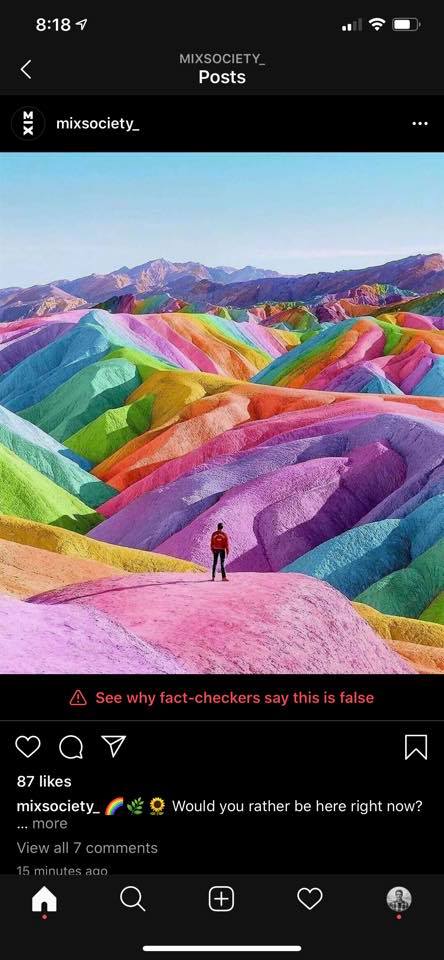 Instagram flagged this post as "False information".[/caption]Flagging a post on Instagram also removes it from the Explore tab and hashtag pages, in short, the post won't be seen by many, hence limiting the reach of the concerned artist.Although, at the time of rolling out this feature, the company had mentioned that it has employed 54 fact-checkers working in 42 languages, but it looks like it still isn't enough.Applying fact-checking algorithms to regular digital art images is taking things a bit too far. Instagram is a platform where apart from photographers, a lot of digital artists showcase their work as well. If you apply fact-checking algorithms without a nuanced understanding of what comprises digital art, then a lot of digital artists are in for a rude shock.
First Published:Jan 14, 2020, 12:21:16 IST
Advertisement
Advertisement

Why AI notetakers are raising serious privacy and security concerns
AI notetakers promise effortless meeting summaries, but experts warn they could expose confidential conversations, corporate secrets and personal voiceprints. As businesses increasingly adopt AI-powered meeting assistants, questions over data storage, privacy, consent and legal risks are becoming impossible to ignore
5 min read
China's low-cost AI models are changing the global AI race. Here's why Silicon Valley is worried
As Chinese firms continue to improve performance while keeping prices low, the AI race is no longer just about building the smartest model—it is increasingly becoming a battle over who can deliver the best value
2 min read
China's Kimi K3 challenges US AI leaders with frontier-level performance at lower cost
Chinese artificial intelligence startup Moonshot AI has unveiled its latest open-weight AI model, Kimi K3, with early results suggesting it could compete with some of the world's most advanced AI systems developed by leading US companies
2 min read
How did Instagram run ads promoting child abuse in India?
India has issued a notice to Meta after an investigation alleged that Instagram displayed paid advertisements promoting child sexual abuse material. MeitY ordered Meta to remove such Instagram ads and explain within seven days how they were approved
8 min read
Why has India halted WhatsApp’s username feature before launch?
India has halted WhatsApp’s planned username feature, citing concerns about cybercrime, impersonation, and law enforcement challenges. As Meta races to address security concerns, here’s why MeitY has paused the rollout, what the feature does, and how it could influence privacy and online safety in India
3 min read
Advertisement
Advertisement