
Advertisement


Sections
Grindr, the world's largest gay dating app, will now send users notifications to get regular HIV tests
Grindr will send men who opt into the service a reminder every three to six months and simultaneously point them to the nearest testing site

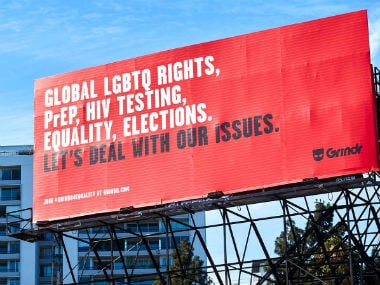
Grindr, the world's largest gay dating app, is set to change its software this week to urge millions of users to get frequent HIV tests, in an an effort to shrink the global epidemic, the media reported.[caption id="attachment_4407465" align="alignleft" width="380"]![Grindr is introducing a notifiocation which will set reminders for people. Grindr.]() Grindr will send reminders for users to get HIV tests. Grindr.[/caption]Grindr, which claims to have 3.3 million daily users from every country in the world, will send men who opt into the service a reminder every three to six months, and simultaneously point them to the nearest testing site, The New York Times reported.It will also let clinics, gay community centres, and other testing sites advertise for free.The company is making the move to "reduce HIV transmission and support our whole community - regardless of HIV status - in living long and fulfilling lives", Jack Harrison-Quintana, Grindr's director for equality, said on 26 March.HIV experts greeted the announcement enthusiastically."Wow, that's great! For a company of this magnitude to do this is groundbreaking," said Jeffrey D. Klausner, a former chief of sexually transmitted disease prevention in San Francisco who has used Grindr to promote testing.Perry N Halkitis, dean of the Rutgers School of Public Health and an expert in gay male behaviour, called the decision "excellent".Jonathan Mermin, chief of AIDS and sexually transmitted diseases at the Centres for Disease Control and Prevention, said many men who use location-based phone apps to find other men nearby are considered at high risk of getting infected.Therefore, "all effective efforts to increase testing are welcome", The New York Times quoted Mermin as saying.The Centre recommends that sexually active gay men get tested at least once a year and those at highest risk get tested every three to six months.More than 1,07,000 gay and bisexual men in the US have HIV but do not know it, according to Mermin.
Grindr will send reminders for users to get HIV tests. Grindr.[/caption]Grindr, which claims to have 3.3 million daily users from every country in the world, will send men who opt into the service a reminder every three to six months, and simultaneously point them to the nearest testing site, The New York Times reported.It will also let clinics, gay community centres, and other testing sites advertise for free.The company is making the move to "reduce HIV transmission and support our whole community - regardless of HIV status - in living long and fulfilling lives", Jack Harrison-Quintana, Grindr's director for equality, said on 26 March.HIV experts greeted the announcement enthusiastically."Wow, that's great! For a company of this magnitude to do this is groundbreaking," said Jeffrey D. Klausner, a former chief of sexually transmitted disease prevention in San Francisco who has used Grindr to promote testing.Perry N Halkitis, dean of the Rutgers School of Public Health and an expert in gay male behaviour, called the decision "excellent".Jonathan Mermin, chief of AIDS and sexually transmitted diseases at the Centres for Disease Control and Prevention, said many men who use location-based phone apps to find other men nearby are considered at high risk of getting infected.Therefore, "all effective efforts to increase testing are welcome", The New York Times quoted Mermin as saying.The Centre recommends that sexually active gay men get tested at least once a year and those at highest risk get tested every three to six months.More than 1,07,000 gay and bisexual men in the US have HIV but do not know it, according to Mermin.
 Grindr will send reminders for users to get HIV tests. Grindr.[/caption]Grindr, which claims to have 3.3 million daily users from every country in the world, will send men who opt into the service a reminder every three to six months, and simultaneously point them to the nearest testing site, The New York Times reported.It will also let clinics, gay community centres, and other testing sites advertise for free.The company is making the move to "reduce HIV transmission and support our whole community - regardless of HIV status - in living long and fulfilling lives", Jack Harrison-Quintana, Grindr's director for equality, said on 26 March.HIV experts greeted the announcement enthusiastically."Wow, that's great! For a company of this magnitude to do this is groundbreaking," said Jeffrey D. Klausner, a former chief of sexually transmitted disease prevention in San Francisco who has used Grindr to promote testing.Perry N Halkitis, dean of the Rutgers School of Public Health and an expert in gay male behaviour, called the decision "excellent".Jonathan Mermin, chief of AIDS and sexually transmitted diseases at the Centres for Disease Control and Prevention, said many men who use location-based phone apps to find other men nearby are considered at high risk of getting infected.Therefore, "all effective efforts to increase testing are welcome", The New York Times quoted Mermin as saying.The Centre recommends that sexually active gay men get tested at least once a year and those at highest risk get tested every three to six months.More than 1,07,000 gay and bisexual men in the US have HIV but do not know it, according to Mermin.
First Published:Mar 27, 2018, 15:15:02 IST
Advertisement
Advertisement

Why AI notetakers are raising serious privacy and security concerns
AI notetakers promise effortless meeting summaries, but experts warn they could expose confidential conversations, corporate secrets and personal voiceprints. As businesses increasingly adopt AI-powered meeting assistants, questions over data storage, privacy, consent and legal risks are becoming impossible to ignore
5 min read
China's low-cost AI models are changing the global AI race. Here's why Silicon Valley is worried
As Chinese firms continue to improve performance while keeping prices low, the AI race is no longer just about building the smartest model—it is increasingly becoming a battle over who can deliver the best value
2 min read
China's Kimi K3 challenges US AI leaders with frontier-level performance at lower cost
Chinese artificial intelligence startup Moonshot AI has unveiled its latest open-weight AI model, Kimi K3, with early results suggesting it could compete with some of the world's most advanced AI systems developed by leading US companies
2 min read
How did Instagram run ads promoting child abuse in India?
India has issued a notice to Meta after an investigation alleged that Instagram displayed paid advertisements promoting child sexual abuse material. MeitY ordered Meta to remove such Instagram ads and explain within seven days how they were approved
8 min read
Why has India halted WhatsApp’s username feature before launch?
India has halted WhatsApp’s planned username feature, citing concerns about cybercrime, impersonation, and law enforcement challenges. As Meta races to address security concerns, here’s why MeitY has paused the rollout, what the feature does, and how it could influence privacy and online safety in India
3 min read
Advertisement
Advertisement