
Advertisement


Sections
Facebook's white supremacy policy is too narrow, say external auditors
In 2018, Facebook appointed a team of auditors to oversee its goals of “advancing civil rights".

Last weekend, Facebook released its second Civil Rights Audit report, in which, company COO Sheryl Sandberg talks about dealing with white supremacist content on the platform, that broadly bans content that use the term 'white nationalism' or ‘white separatism’. But external auditors have found this policy "too narrow".According to external auditors, who were appointed by Facebook in 2018 to oversee its goals of “advancing civil rights on our platform”, Facebook’s overly narrow implementation of its own rules was hampering moderation.“Facebook’s current white nationalism policy is too narrow, because it prohibits only explicit praise, support or representation of the terms ‘white nationalism’ or ‘white separatism’”, the report says. “The narrow scope of the policy leaves up content that expressly espouses white nationalist ideology without using the term ‘white nationalist’. As a result, content that would cause the same harm is permitted to remain on the platform.”[caption id="attachment_6341991" align="alignnone" width="1024"]![Members of the National Socialist Movement. Reuters]() Members of the National Socialist Movement. Reuters[/caption]Till earlier this year, terms like 'White nationalism' and 'white separatism' were allowed on Facebook as the company only considered white “supremacy” breaching its hate speech policies.However, in March 2019, Facebook updated its rules to ban the explicit praise, support or representation of the former two ideologies as well. The rule applies to both the core Facebook app and Instagram.On the suggested narrow scope of the policy, The Guardian reported Sandberg as saying:
Members of the National Socialist Movement. Reuters[/caption]Till earlier this year, terms like 'White nationalism' and 'white separatism' were allowed on Facebook as the company only considered white “supremacy” breaching its hate speech policies.However, in March 2019, Facebook updated its rules to ban the explicit praise, support or representation of the former two ideologies as well. The rule applies to both the core Facebook app and Instagram.On the suggested narrow scope of the policy, The Guardian reported Sandberg as saying:
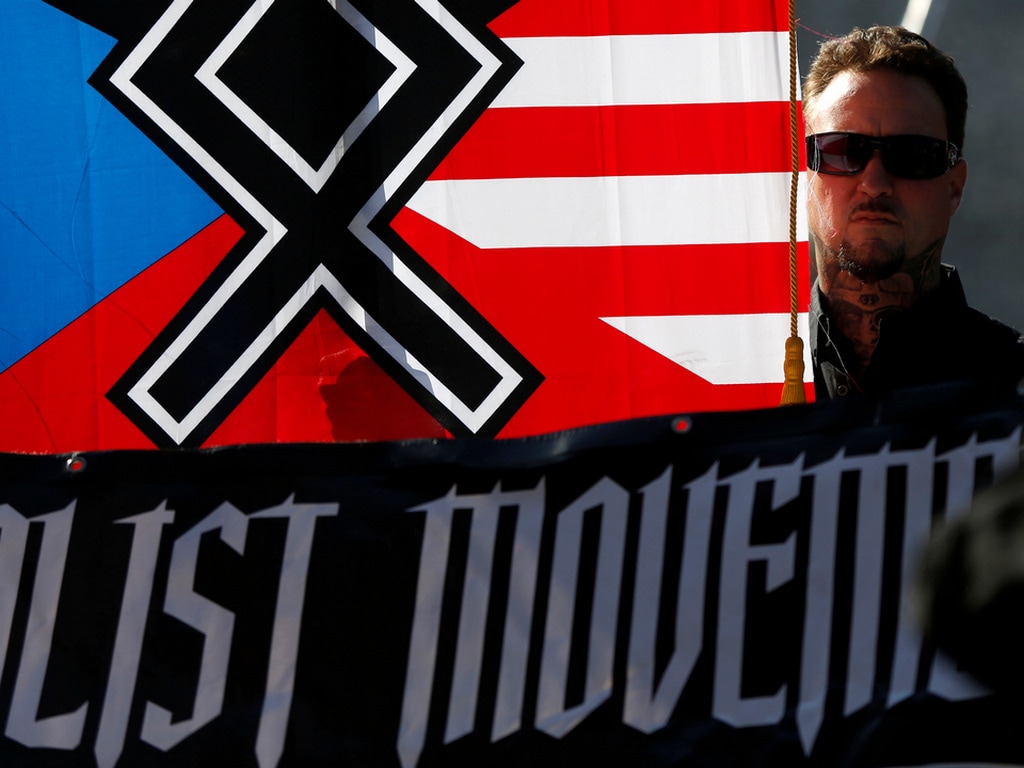 Members of the National Socialist Movement. Reuters[/caption]Till earlier this year, terms like 'White nationalism' and 'white separatism' were allowed on Facebook as the company only considered white “supremacy” breaching its hate speech policies.However, in March 2019, Facebook updated its rules to ban the explicit praise, support or representation of the former two ideologies as well. The rule applies to both the core Facebook app and Instagram.On the suggested narrow scope of the policy, The Guardian reported Sandberg as saying:
“We’re addressing this by identifying hate slogans and symbols connected to white nationalism and white separatism to better enforce our policy. We also recently updated our policies so Facebook isn’t used to organise events that intimidate or harass people based on their race, religion or other parts of their identity. We now ban posts from people who intend to bring weapons anywhere to intimidate or harass others, or who encourage people to do the same. Civil rights leaders first flagged this trend to us, and it’s exactly the type of content our policies are meant to protect against."In the Civil Rights Audit report 2019, Facebook has also pledged to put its new “don’t vote” policy prohibition into effect ahead of the 2020 US elections. The new “don’t vote” policy is in its developmental stages and the company is seeking advice from voting organisations. Facebook said the policy is likely to only apply in the United States in its initial release and will not include the policing of organic posts from users.
First Published:Jul 02, 2019, 11:32:58 IST
Advertisement
Advertisement

Why AI notetakers are raising serious privacy and security concerns
AI notetakers promise effortless meeting summaries, but experts warn they could expose confidential conversations, corporate secrets and personal voiceprints. As businesses increasingly adopt AI-powered meeting assistants, questions over data storage, privacy, consent and legal risks are becoming impossible to ignore
5 min read
China's low-cost AI models are changing the global AI race. Here's why Silicon Valley is worried
As Chinese firms continue to improve performance while keeping prices low, the AI race is no longer just about building the smartest model—it is increasingly becoming a battle over who can deliver the best value
2 min read
China's Kimi K3 challenges US AI leaders with frontier-level performance at lower cost
Chinese artificial intelligence startup Moonshot AI has unveiled its latest open-weight AI model, Kimi K3, with early results suggesting it could compete with some of the world's most advanced AI systems developed by leading US companies
2 min read
How did Instagram run ads promoting child abuse in India?
India has issued a notice to Meta after an investigation alleged that Instagram displayed paid advertisements promoting child sexual abuse material. MeitY ordered Meta to remove such Instagram ads and explain within seven days how they were approved
8 min read
Why has India halted WhatsApp’s username feature before launch?
India has halted WhatsApp’s planned username feature, citing concerns about cybercrime, impersonation, and law enforcement challenges. As Meta races to address security concerns, here’s why MeitY has paused the rollout, what the feature does, and how it could influence privacy and online safety in India
3 min read
Advertisement
Advertisement