
Advertisement


Sections
Facebook updates Group privacy policies to make it easier to understand
Facebook Groups were either Public, Closed or Secret. These will now change to simply Public and Private

Facebook is revamping the naming conventions for its Groups to make it simpler for people to understand them. The idea behind this change of names is to avoid malicious actors for using groups for negative purposes such as spreading hatred online or fake news among other things.So far, Facebook Groups were either Public, Closed or Secret. These will now change to simply Public and Private, with the Private Group having two options.[caption id="attachment_6621011" align="alignnone" width="1280"]![Stickers bearing the Facebook logo are pictured at Facebook Inc's F8 developers conference in San Jose, California. REUTERS/Stephen]() Stickers bearing the Facebook logo are pictured at Facebook Inc's F8 developers conference in San Jose, California. REUTERS/Stephen[/caption]"Having two privacy settings — public and private — will help make it clearer about who can find the group and see the members and posts that are part of it. We’ve also heard that most people prefer to use the terms “public” and “private” to describe the privacy settings of groups they belong to," said Jordan Davis, product manager for Facebook Groups on the Facebook newsroom blog.Here are the major takeaways:
Stickers bearing the Facebook logo are pictured at Facebook Inc's F8 developers conference in San Jose, California. REUTERS/Stephen[/caption]"Having two privacy settings — public and private — will help make it clearer about who can find the group and see the members and posts that are part of it. We’ve also heard that most people prefer to use the terms “public” and “private” to describe the privacy settings of groups they belong to," said Jordan Davis, product manager for Facebook Groups on the Facebook newsroom blog.Here are the major takeaways:![Facebook Groups changes]() Facebook Groups changes[/caption]According to Facebook, this change in Groups privacy policy is part of its Safe Communities Initiative. Facebook claims to have hired more than 30,000 people in its safety and security division. As part of the initiative, the safety teams have a goal of protecting people using Facebook Groups from harm. To this effect, these resources are meant to proactively identify and remove harmful content from Groups."Increasingly, we can use AI and machine learning to proactively detect bad content before anyone reports it, and sometimes before people even see it. As content is flagged by our systems or reported by people, trained reviewers consider context and determine whether the content violates our Community Standards," said Davis.
Facebook Groups changes[/caption]According to Facebook, this change in Groups privacy policy is part of its Safe Communities Initiative. Facebook claims to have hired more than 30,000 people in its safety and security division. As part of the initiative, the safety teams have a goal of protecting people using Facebook Groups from harm. To this effect, these resources are meant to proactively identify and remove harmful content from Groups."Increasingly, we can use AI and machine learning to proactively detect bad content before anyone reports it, and sometimes before people even see it. As content is flagged by our systems or reported by people, trained reviewers consider context and determine whether the content violates our Community Standards," said Davis.
 Stickers bearing the Facebook logo are pictured at Facebook Inc's F8 developers conference in San Jose, California. REUTERS/Stephen[/caption]"Having two privacy settings — public and private — will help make it clearer about who can find the group and see the members and posts that are part of it. We’ve also heard that most people prefer to use the terms “public” and “private” to describe the privacy settings of groups they belong to," said Jordan Davis, product manager for Facebook Groups on the Facebook newsroom blog.Here are the major takeaways:
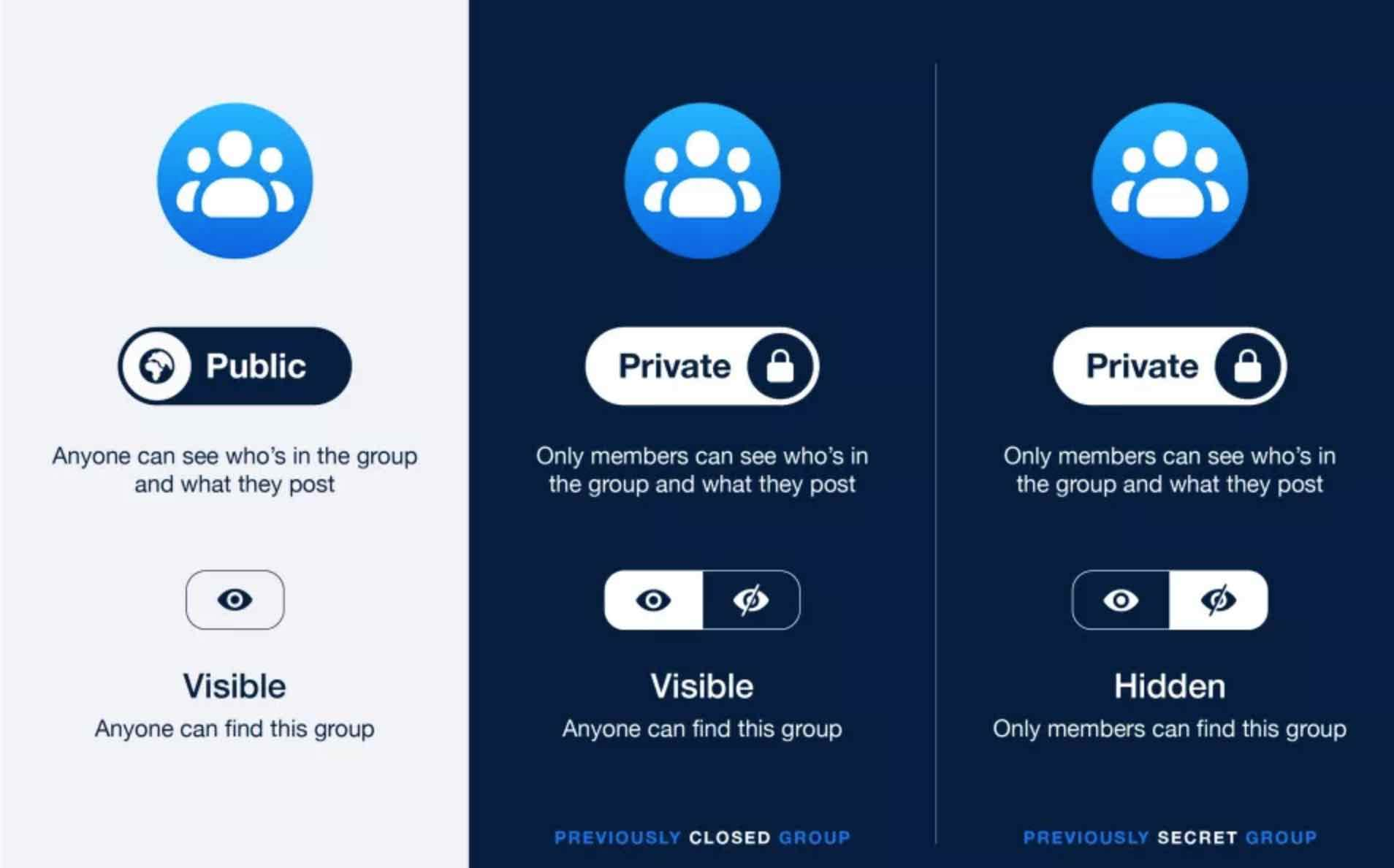
- Public Group: Will be visible to everyone and you can search these groups and find its members.
- Private Group (Visible): Anyone can find this group, but only members can see who is in the group and what they post.
- Private Group (Hidden): Only members of the group can find this group. And only members can see who is in the group and what they post.
 Facebook Groups changes[/caption]According to Facebook, this change in Groups privacy policy is part of its Safe Communities Initiative. Facebook claims to have hired more than 30,000 people in its safety and security division. As part of the initiative, the safety teams have a goal of protecting people using Facebook Groups from harm. To this effect, these resources are meant to proactively identify and remove harmful content from Groups."Increasingly, we can use AI and machine learning to proactively detect bad content before anyone reports it, and sometimes before people even see it. As content is flagged by our systems or reported by people, trained reviewers consider context and determine whether the content violates our Community Standards," said Davis.
First Published:Aug 15, 2019, 10:23:42 IST
Advertisement
Advertisement

Why AI notetakers are raising serious privacy and security concerns
AI notetakers promise effortless meeting summaries, but experts warn they could expose confidential conversations, corporate secrets and personal voiceprints. As businesses increasingly adopt AI-powered meeting assistants, questions over data storage, privacy, consent and legal risks are becoming impossible to ignore
5 min read
China's low-cost AI models are changing the global AI race. Here's why Silicon Valley is worried
As Chinese firms continue to improve performance while keeping prices low, the AI race is no longer just about building the smartest model—it is increasingly becoming a battle over who can deliver the best value
2 min read
China's Kimi K3 challenges US AI leaders with frontier-level performance at lower cost
Chinese artificial intelligence startup Moonshot AI has unveiled its latest open-weight AI model, Kimi K3, with early results suggesting it could compete with some of the world's most advanced AI systems developed by leading US companies
2 min read
How did Instagram run ads promoting child abuse in India?
India has issued a notice to Meta after an investigation alleged that Instagram displayed paid advertisements promoting child sexual abuse material. MeitY ordered Meta to remove such Instagram ads and explain within seven days how they were approved
8 min read
Why has India halted WhatsApp’s username feature before launch?
India has halted WhatsApp’s planned username feature, citing concerns about cybercrime, impersonation, and law enforcement challenges. As Meta races to address security concerns, here’s why MeitY has paused the rollout, what the feature does, and how it could influence privacy and online safety in India
3 min read
Advertisement
Advertisement