
Advertisement


Sections
Bye bye iPad, Qualcomm's 'always-connected PC' is the future and it's here today
“The devices are thin & light, instantly on, always connected, & I haven’t charged mine all week!” - Terry Myerson

Qualcomm and Microsoft today announced what is possibly the most transformative upgrade to the PC as we know it. Dubbed the ‘Always-Connected PC’, this Snapdragon-powered Windows platform will meld the best of the mobile and PC worlds into one.At a time when the world is going increasingly mobile and the PC is increasingly losing relevance, the always-connected PC might just be the transformative nudge that the market is in such desperate need of.So what is an ‘Always-Connected PC’?We’ll just quote Microsoft’s Terry Myerson here, “The devices are thin & light, instantly on, always connected, & I haven’t charged mine all week!” How is this possible? These PCs will be powered by what was until now a purely mobile platform, the Snapdragon 835. And rather than running Android or some other such limited OS, these devices will be running a fully functional desktop OS, i.e., Windows 10 S. The 835 can be found in flagship mobile devices like the Samsung Galaxy S8 or the OnePlus 5T.[caption id="attachment_4244361" align="alignnone" width="1024"]![Qualcomm introduces the Always-Connected PC. Image: tech2/Anirudh Regidi]() Qualcomm introduces the Always-Connected PC. Image: tech2/Anirudh Regidi[/caption]Even from a hypothetical standpoint, this setup is very promising. The 835 is a powerful mobile platform and Microsoft has worked with Qualcomm to optimise Windows 10 S for this platform. All the more impressive is the fact that architecturally, the 835 is based on the RISC (reduced instruction set computing) architecture vs CISC (complex instruction set computing) architecture that the likes of Intel and AMD have offered to the PC.Without delving too deeply into what RISC and CISC are, RISC is essentially a very power-efficient architecture designed for performing very specific tasks. CISC is far more flexible, but comparatively inefficient, which is probably why Intel has so far struggled to develop a comparably low-power chip for PC users. Most desktop apps are developed for CISC and mobile apps for RISC.With Qualcomm’s Snapdragon 835 and Microsoft’s RISC-optimised Windows 10 S, Qualcomm and Microsoft think that they have a platform that can deliver on the promise of the always-connected PC. Those familiar with the PC scene might remember Microsoft’s failed Window RT, the company’s first attempt at Windows on RISC. The OS had debuted with the Nvidia Tegra-powered Surface RT and had failed miserably owing to the poor app ecosystem surrounding that platform.For a more detailed look at Windows 10 S, head here.Windows 10 S already has a richer ecosystem, and with the promise of more apps, is already addressing the shortcomings of RT. RT also launched at a time when the cloud and web app ecosystem wasn’t as well developed.And this isn’t just a pipe dream. Asus and HP both unveiled Snapdragon 835-powered devices, with Lenovo expected to announce some more designs at CES next year.[caption id="attachment_4244387" align="alignnone" width="1280"]
Qualcomm introduces the Always-Connected PC. Image: tech2/Anirudh Regidi[/caption]Even from a hypothetical standpoint, this setup is very promising. The 835 is a powerful mobile platform and Microsoft has worked with Qualcomm to optimise Windows 10 S for this platform. All the more impressive is the fact that architecturally, the 835 is based on the RISC (reduced instruction set computing) architecture vs CISC (complex instruction set computing) architecture that the likes of Intel and AMD have offered to the PC.Without delving too deeply into what RISC and CISC are, RISC is essentially a very power-efficient architecture designed for performing very specific tasks. CISC is far more flexible, but comparatively inefficient, which is probably why Intel has so far struggled to develop a comparably low-power chip for PC users. Most desktop apps are developed for CISC and mobile apps for RISC.With Qualcomm’s Snapdragon 835 and Microsoft’s RISC-optimised Windows 10 S, Qualcomm and Microsoft think that they have a platform that can deliver on the promise of the always-connected PC. Those familiar with the PC scene might remember Microsoft’s failed Window RT, the company’s first attempt at Windows on RISC. The OS had debuted with the Nvidia Tegra-powered Surface RT and had failed miserably owing to the poor app ecosystem surrounding that platform.For a more detailed look at Windows 10 S, head here.Windows 10 S already has a richer ecosystem, and with the promise of more apps, is already addressing the shortcomings of RT. RT also launched at a time when the cloud and web app ecosystem wasn’t as well developed.And this isn’t just a pipe dream. Asus and HP both unveiled Snapdragon 835-powered devices, with Lenovo expected to announce some more designs at CES next year.[caption id="attachment_4244387" align="alignnone" width="1280"]![]() "Expect more from a PC," says Qualcomm. Image: tech2/Anirudh Regidi[/caption]ASUS showed off its NovaGo PC, a 2-in-1 tablet/PC with a 360-degree hinge, and HP showed off the ENVY x2, a detachable tablet PC similar to Microsoft’s Surface Pro lineup. To look at the spec sheet, you’d think that you were looking at a mobile phone. Both devices offer variants powered by the Snapdagon 835 platform, feature up to 8 GB of RAM and up to 256 GB of storage. Both use an integrated Qualcomm x16 LTE modem and both offer 20+ hours of battery life.[caption id="attachment_4244379" align="alignnone" width="1280"]
"Expect more from a PC," says Qualcomm. Image: tech2/Anirudh Regidi[/caption]ASUS showed off its NovaGo PC, a 2-in-1 tablet/PC with a 360-degree hinge, and HP showed off the ENVY x2, a detachable tablet PC similar to Microsoft’s Surface Pro lineup. To look at the spec sheet, you’d think that you were looking at a mobile phone. Both devices offer variants powered by the Snapdagon 835 platform, feature up to 8 GB of RAM and up to 256 GB of storage. Both use an integrated Qualcomm x16 LTE modem and both offer 20+ hours of battery life.[caption id="attachment_4244379" align="alignnone" width="1280"]![The NovaGo is a $599 device featuring a 360-degree hinge. Image: tech2/Anirudh Regidi]() The NovaGo is a $599 device featuring a 360-degree hinge. Image: tech2/Anirudh Regidi[/caption]From our limited hands-on time with the device (do check out our hands-on videos on our YouTube channel), we found the experience to be surprisingly good. Windows functions responded quickly and fluidly and Windows Ink-enabled apps like Paint 3D and Powerpoint worked great. Better yet, manipulating 3D objects in, say, Powerpoint, was easy, with the response being near instantaneous. For most Windows users, this performance should be adequate.Enabling 20-hours of battery lifeConsidering that your smartphone and tablet struggles to get you 10 hours of continuous screen-on time, how did Microsoft and Qualcomm enable this on a laptop-style device which has an even larger, more power-hungry screen? The secret, as far as we can make out, is a massive battery.We’ve been told, unofficially, that the chip in these always-on PCs is tiny. That chip won’t be much larger than the one in your smartphone, in fact. The rest of the real-estate is simply filled with battery, a battery that is larger than that found in most laptops today. That large battery, when coupled with the power-saving benefits of a RISC-style mobile architecture, enables such ridiculous battery life.Microsoft’s Terry Myerson mentioned that he charged his alway-connected PC once a week.Once a week, let that sink in for a bit.Imagine how your Windows experience will change once this happens. Imagine not having to worry about a carrying a charger or whether you have enough charge left to finish that movie you were watching. Imagine sitting on a 15-hour flight to the US and not needing to worry about battery life. Even your phone couldn't do that. That's the promise of the always-connected PC.This also brings us to another game-changer that this always-connected PC brings, and that is standby time. Qualcomm promises that one can easily expect something in the range of 5x to 10x improvement in standby time.Continuous connectivityThe integrated Qualcomm x16 modem can also enable a new computing experience. An integrated modem means that you can be persistently connected to the cloud. Potentially, we’re looking at working directly off the cloud while on the move, taking better advantage of cloud-computing and cloud storage options and moving beyond the hardware limitations of your device.This technology can make internal storage obsolete.Does it run Photoshop?Why do you use a tablet? Because it’s convenient, offers great battery life and it’s more portable than a laptop.An always-connected PC offers better battery life (double that of an iPad), a similar form factor, similar convenience and the added benefit of a full-fledged desktop experience.Now Windows 10 S is not Windows 10. You still don’t have Photoshop on the platform, but you get everything else, including a proper file explorer, multitasking, the desktop web, etc. The pricing also can’t possibly be an issue either. For $799, you get a Wi-Fi-only 12.9-inch iPad Pro with 64 GB of storage and up to 10 hours of video playback. The keyboard and Pencil are optional extras that add another $300 to the price tag. For $799, you’ll get the Asus NovaGo with 8 GB RAM, 256 GB of storage, a 13.3-inch display, 2x USB ports, an HDMI port, a microSD port, a fingerprint sensor, an integrated keyboard and around 20 hours of battery life, and you’re getting Windows.In a world that’s increasingly turning mobile, and cloud-based, we can't think of a more ideal time to introduce such a device.Disclaimer: The correspondent was invited by Qualcomm India for the Snapdragon Summit at Hawaii, USA. All travel and accommodation expenses were taken care of by Qualcomm.
The NovaGo is a $599 device featuring a 360-degree hinge. Image: tech2/Anirudh Regidi[/caption]From our limited hands-on time with the device (do check out our hands-on videos on our YouTube channel), we found the experience to be surprisingly good. Windows functions responded quickly and fluidly and Windows Ink-enabled apps like Paint 3D and Powerpoint worked great. Better yet, manipulating 3D objects in, say, Powerpoint, was easy, with the response being near instantaneous. For most Windows users, this performance should be adequate.Enabling 20-hours of battery lifeConsidering that your smartphone and tablet struggles to get you 10 hours of continuous screen-on time, how did Microsoft and Qualcomm enable this on a laptop-style device which has an even larger, more power-hungry screen? The secret, as far as we can make out, is a massive battery.We’ve been told, unofficially, that the chip in these always-on PCs is tiny. That chip won’t be much larger than the one in your smartphone, in fact. The rest of the real-estate is simply filled with battery, a battery that is larger than that found in most laptops today. That large battery, when coupled with the power-saving benefits of a RISC-style mobile architecture, enables such ridiculous battery life.Microsoft’s Terry Myerson mentioned that he charged his alway-connected PC once a week.Once a week, let that sink in for a bit.Imagine how your Windows experience will change once this happens. Imagine not having to worry about a carrying a charger or whether you have enough charge left to finish that movie you were watching. Imagine sitting on a 15-hour flight to the US and not needing to worry about battery life. Even your phone couldn't do that. That's the promise of the always-connected PC.This also brings us to another game-changer that this always-connected PC brings, and that is standby time. Qualcomm promises that one can easily expect something in the range of 5x to 10x improvement in standby time.Continuous connectivityThe integrated Qualcomm x16 modem can also enable a new computing experience. An integrated modem means that you can be persistently connected to the cloud. Potentially, we’re looking at working directly off the cloud while on the move, taking better advantage of cloud-computing and cloud storage options and moving beyond the hardware limitations of your device.This technology can make internal storage obsolete.Does it run Photoshop?Why do you use a tablet? Because it’s convenient, offers great battery life and it’s more portable than a laptop.An always-connected PC offers better battery life (double that of an iPad), a similar form factor, similar convenience and the added benefit of a full-fledged desktop experience.Now Windows 10 S is not Windows 10. You still don’t have Photoshop on the platform, but you get everything else, including a proper file explorer, multitasking, the desktop web, etc. The pricing also can’t possibly be an issue either. For $799, you get a Wi-Fi-only 12.9-inch iPad Pro with 64 GB of storage and up to 10 hours of video playback. The keyboard and Pencil are optional extras that add another $300 to the price tag. For $799, you’ll get the Asus NovaGo with 8 GB RAM, 256 GB of storage, a 13.3-inch display, 2x USB ports, an HDMI port, a microSD port, a fingerprint sensor, an integrated keyboard and around 20 hours of battery life, and you’re getting Windows.In a world that’s increasingly turning mobile, and cloud-based, we can't think of a more ideal time to introduce such a device.Disclaimer: The correspondent was invited by Qualcomm India for the Snapdragon Summit at Hawaii, USA. All travel and accommodation expenses were taken care of by Qualcomm.
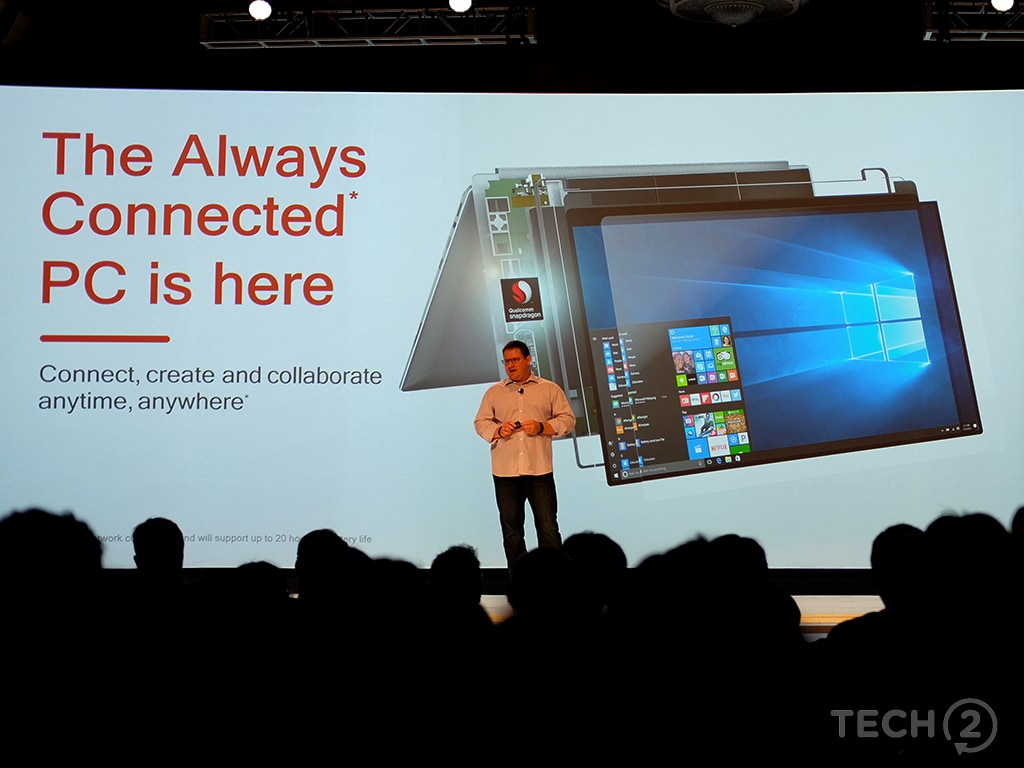 Qualcomm introduces the Always-Connected PC. Image: tech2/Anirudh Regidi[/caption]Even from a hypothetical standpoint, this setup is very promising. The 835 is a powerful mobile platform and Microsoft has worked with Qualcomm to optimise Windows 10 S for this platform. All the more impressive is the fact that architecturally, the 835 is based on the RISC (reduced instruction set computing) architecture vs CISC (complex instruction set computing) architecture that the likes of Intel and AMD have offered to the PC.Without delving too deeply into what RISC and CISC are, RISC is essentially a very power-efficient architecture designed for performing very specific tasks. CISC is far more flexible, but comparatively inefficient, which is probably why Intel has so far struggled to develop a comparably low-power chip for PC users. Most desktop apps are developed for CISC and mobile apps for RISC.
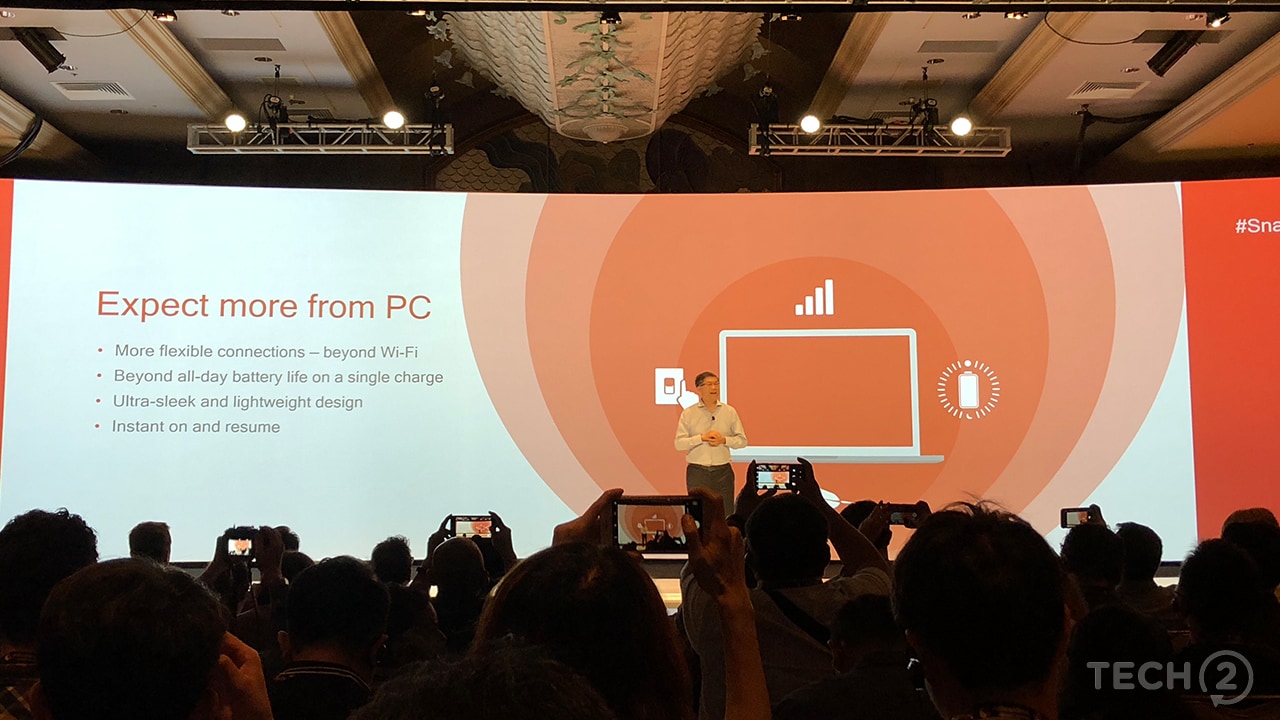 "Expect more from a PC," says Qualcomm. Image: tech2/Anirudh Regidi[/caption]ASUS showed off its NovaGo PC, a 2-in-1 tablet/PC with a 360-degree hinge, and HP showed off the ENVY x2, a detachable tablet PC similar to Microsoft’s Surface Pro lineup. To look at the spec sheet, you’d think that you were looking at a mobile phone. Both devices offer variants powered by the Snapdagon 835 platform, feature up to 8 GB of RAM and up to 256 GB of storage. Both use an integrated Qualcomm x16 LTE modem and both offer 20+ hours of battery life.[caption id="attachment_4244379" align="alignnone" width="1280"]
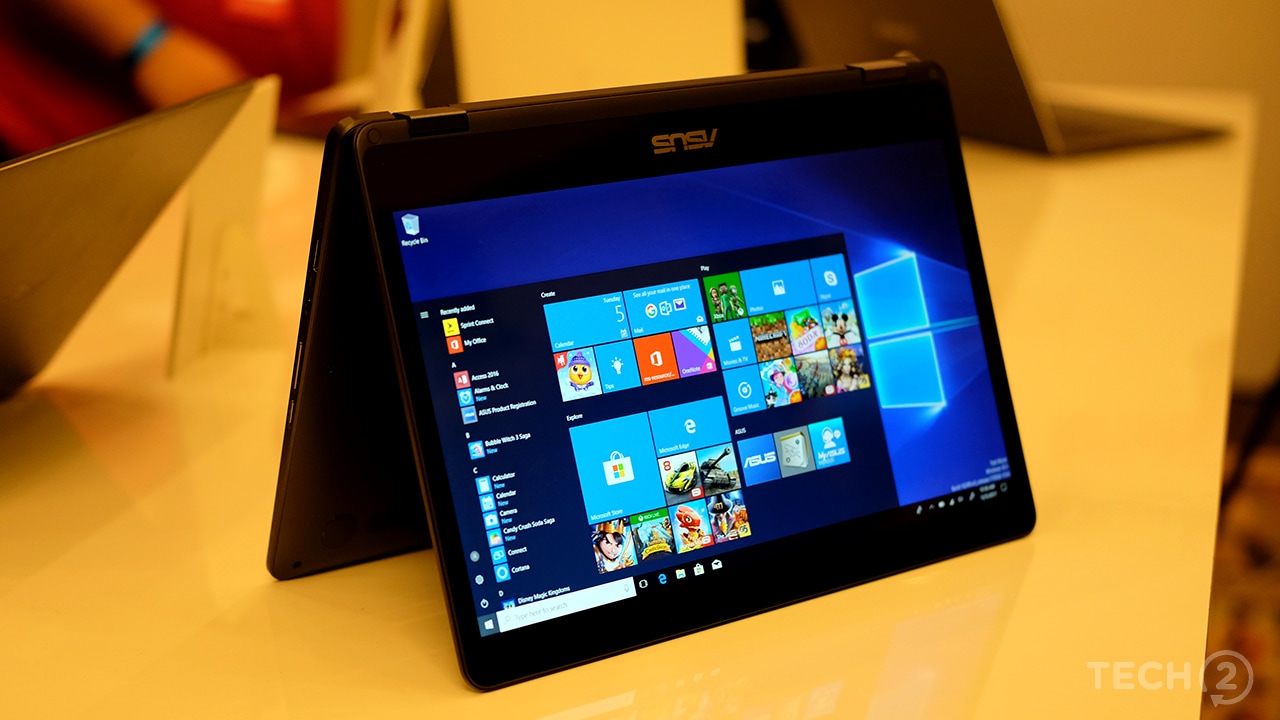 The NovaGo is a $599 device featuring a 360-degree hinge. Image: tech2/Anirudh Regidi[/caption]From our limited hands-on time with the device (do check out our hands-on videos on our YouTube channel), we found the experience to be surprisingly good. Windows functions responded quickly and fluidly and Windows Ink-enabled apps like Paint 3D and Powerpoint worked great. Better yet, manipulating 3D objects in, say, Powerpoint, was easy, with the response being near instantaneous. For most Windows users, this performance should be adequate.Enabling 20-hours of battery lifeConsidering that your smartphone and tablet struggles to get you 10 hours of continuous screen-on time, how did Microsoft and Qualcomm enable this on a laptop-style device which has an even larger, more power-hungry screen? The secret, as far as we can make out, is a massive battery.We’ve been told, unofficially, that the chip in these always-on PCs is tiny. That chip won’t be much larger than the one in your smartphone, in fact. The rest of the real-estate is simply filled with battery, a battery that is larger than that found in most laptops today. That large battery, when coupled with the power-saving benefits of a RISC-style mobile architecture, enables such ridiculous battery life.Microsoft’s Terry Myerson mentioned that he charged his alway-connected PC once a week.Once a week, let that sink in for a bit.Imagine how your Windows experience will change once this happens. Imagine not having to worry about a carrying a charger or whether you have enough charge left to finish that movie you were watching. Imagine sitting on a 15-hour flight to the US and not needing to worry about battery life. Even your phone couldn't do that. That's the promise of the always-connected PC.This also brings us to another game-changer that this always-connected PC brings, and that is standby time. Qualcomm promises that one can easily expect something in the range of 5x to 10x improvement in standby time.Continuous connectivityThe integrated Qualcomm x16 modem can also enable a new computing experience. An integrated modem means that you can be persistently connected to the cloud. Potentially, we’re looking at working directly off the cloud while on the move, taking better advantage of cloud-computing and cloud storage options and moving beyond the hardware limitations of your device.This technology can make internal storage obsolete.Does it run Photoshop?Why do you use a tablet? Because it’s convenient, offers great battery life and it’s more portable than a laptop.An always-connected PC offers better battery life (double that of an iPad), a similar form factor, similar convenience and the added benefit of a full-fledged desktop experience.Now Windows 10 S is not Windows 10. You still don’t have Photoshop on the platform, but you get everything else, including a proper file explorer, multitasking, the desktop web, etc. The pricing also can’t possibly be an issue either. For $799, you get a Wi-Fi-only 12.9-inch iPad Pro with 64 GB of storage and up to 10 hours of video playback. The keyboard and Pencil are optional extras that add another $300 to the price tag. For $799, you’ll get the Asus NovaGo with 8 GB RAM, 256 GB of storage, a 13.3-inch display, 2x USB ports, an HDMI port, a microSD port, a fingerprint sensor, an integrated keyboard and around 20 hours of battery life, and you’re getting Windows.In a world that’s increasingly turning mobile, and cloud-based, we can't think of a more ideal time to introduce such a device.Disclaimer: The correspondent was invited by Qualcomm India for the Snapdragon Summit at Hawaii, USA. All travel and accommodation expenses were taken care of by Qualcomm.
First Published:Dec 06, 2017, 09:09:28 IST
Advertisement
Advertisement

Why AI notetakers are raising serious privacy and security concerns
AI notetakers promise effortless meeting summaries, but experts warn they could expose confidential conversations, corporate secrets and personal voiceprints. As businesses increasingly adopt AI-powered meeting assistants, questions over data storage, privacy, consent and legal risks are becoming impossible to ignore
5 min read
China's low-cost AI models are changing the global AI race. Here's why Silicon Valley is worried
As Chinese firms continue to improve performance while keeping prices low, the AI race is no longer just about building the smartest model—it is increasingly becoming a battle over who can deliver the best value
2 min read
China's Kimi K3 challenges US AI leaders with frontier-level performance at lower cost
Chinese artificial intelligence startup Moonshot AI has unveiled its latest open-weight AI model, Kimi K3, with early results suggesting it could compete with some of the world's most advanced AI systems developed by leading US companies
2 min read
How did Instagram run ads promoting child abuse in India?
India has issued a notice to Meta after an investigation alleged that Instagram displayed paid advertisements promoting child sexual abuse material. MeitY ordered Meta to remove such Instagram ads and explain within seven days how they were approved
8 min read
Why has India halted WhatsApp’s username feature before launch?
India has halted WhatsApp’s planned username feature, citing concerns about cybercrime, impersonation, and law enforcement challenges. As Meta races to address security concerns, here’s why MeitY has paused the rollout, what the feature does, and how it could influence privacy and online safety in India
3 min read
Advertisement
Advertisement