


Automated control system caused Ethiopia Boeing 737 crash, flight data suggests
Malfunctioning automatic control systems overwhelmed the crew and doomed the flight.

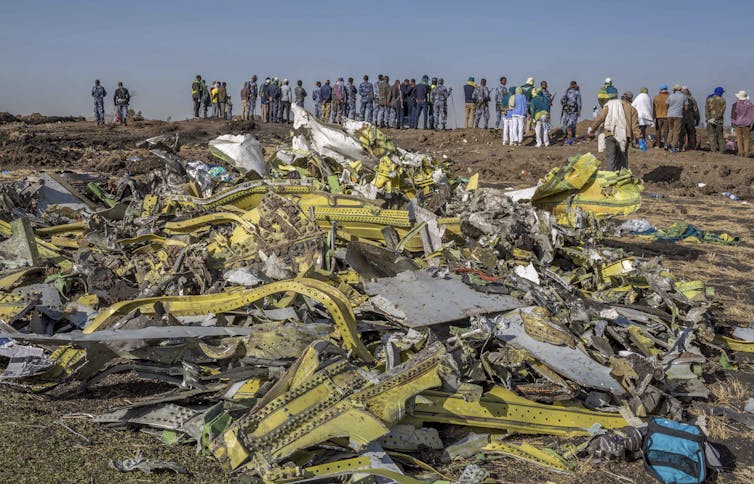
Wreckage from Ethiopia Airlines Flight 302 lies near the crash site outside Addis Ababa. AP[/caption]A typical flight starts with manual control of the plane. The pilot and co-pilot will personally steer the aircraft onto the taxiway, configure the flaps for takeoff, actively control the aircraft as it accelerates down the runway, and smoothly pull back on the control yoke to lift the plane off the ground and into flight. The flight’s altitude and speed data, transmitted from the plane in real time and made available to the public by FlightRadar24.com, shows that happened normally as Ethiopian Airlines Flight 302 left the runway.Everything appears to have gone as usual on the initial climb away from the takeoff, too. Normally, the pilot will retract the landing gear and maintain a relatively steady speed as the aircraft climbs. The plane might accelerate slightly until it’s going fast enough that the flaps – extended to increase lift at lower speeds – can be safely retracted, letting the wings themselves generate the necessary lift. This process usually takes place in the first minute after takeoff. Once the aircraft has climbed to 1,000 feet above the ground, the pilot will engage the autopilot system.That’s the point at which the computer takes over – and where, my analysis of the data suggests, things went wrong for Ethiopian Airlines Flight 302. A modern autopilot system gives the computer command of the engine throttles, rudder, elevators and ailerons – basically full control over the aircraft.
Simulating the expected flight

How long on the ground?
More than 300 Boeing 737 Max aircraft have been flying since 2017, with thousands of safe takeoffs and landings. That suggests the problem for Ethiopian Airlines – and possibly the 2018 Lion Air crash too – is one of the difficult sort of engineering troubles that happen intermittently, or even seemingly randomly, in very complex systems.Boeing has already said it will update the aircraft’s software. Any fixes will have to be checked not only to ensure that they handle whatever the exact problem is that’s identified by crash investigators, but also to make sure they don’t cause other unexpected errors. That will take its own amount of time. In the meantime, all the Boeing 737 Max aircraft in the world are on the ground, waiting. Timothy Takahashi, Professor of Practice for Aerospace EngineeringThis article is republished from The Conversation under a Creative Commons license. Read the original article.

Why AI notetakers are raising serious privacy and security concerns
China's low-cost AI models are changing the global AI race. Here's why Silicon Valley is worried
China's Kimi K3 challenges US AI leaders with frontier-level performance at lower cost
How did Instagram run ads promoting child abuse in India?
Why has India halted WhatsApp’s username feature before launch?