


Astronomers discover three small super-Earth planets 100 light years away from our solar system
All of them are categorised as super-Earths, that is, with masses that are larger than Earth's but less than Neptune's, the study said

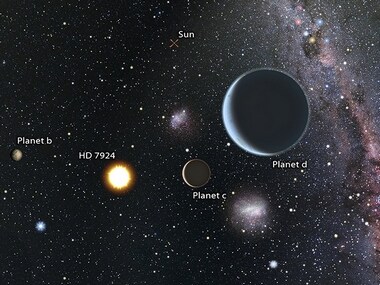
Artist’s impression of a view from the HD 7924 planetary system. Karen Teramura & BJ Fulton, UH IfA[/caption]The star, GJ9827, is one of the few known stars to have multiple transiting terrestrial-sized exoplanets that are suited for atmospheric characterisation, according to the study published in The Astronomical Journal.All of them are categorised as super-Earths, that is, with masses that are larger than Earth's but less than Neptune's, the study said. In fact, the researchers said, the three exoplanets are particularly interesting because two of them have radii between 1.5 and 2.0 Earth-radii.Across this range in radii, the composition of planets is expected to change from rocky to gaseous. Moreover, there are relatively few such candidates for study. These planets orbit very close to the star, with periods of 1.2, 3.6 and 6.2 days respectively, and at these close distances they have fairly hot temperatures, estimated at 1172, 811 and 680 degrees kelvin, the study said.Space scientists typically measure the distances in planetary space environments in terms of planetary radii. One Earth radius equals 6,378 kilometres.

Why AI notetakers are raising serious privacy and security concerns
China's low-cost AI models are changing the global AI race. Here's why Silicon Valley is worried
China's Kimi K3 challenges US AI leaders with frontier-level performance at lower cost
How did Instagram run ads promoting child abuse in India?
Why has India halted WhatsApp’s username feature before launch?