
Advertisement


Sections
Intel’s Honeycomb Glacier is a gaming laptop concept with adjustable dual screens
Not only gamers but the secondary screen on the prototype can be beneficial to creators as well.

Intel had a few important announcements at the Computex 2019 expo including the launch of its 10th Gen Intel Core Ice Lake processors and the Intel Core i9-9900KS special edition CPU. At its Open House event, the company showcased several partner devices under Project Athena and a few prototypes that included the Honeycomb Glacier.[caption id="attachment_6721241" align="alignnone" width="1280"]![Intel Honeycomb Glacier gaming prototype laptop.]() Intel Honeycomb Glacier gaming prototype laptop.[/caption]The dual screen concept design is Intel’s take on how a secondary screen can be useful for the appropriate use-cases. However, the primary focus here is for gaming. While playing games, I usually tend to Alt-tab out of games to use a chat client like Discord or OBS Studio when I’m streaming. To overcome this problem, I had to either use an additional monitor or play the game in the windowed mode. A secondary screen right on the laptop makes a lot of sense so that the less important apps can be locked onto them while continuing to play the game.On the Honeycomb Glacier, we find a 15.6-inch 1920 x 1080-pixel display and a 12.3-inch 1920 x 720-pixel secondary display right above the keyboard. ASUS already announced a similar design at Computex 2019 with the ZenBook Pro Duo. It also has a secondary display called the ScreenPad Plus. The biggest difference between the two, however, is ergonomics.[caption id="attachment_6721231" align="alignnone" width="1280"]
Intel Honeycomb Glacier gaming prototype laptop.[/caption]The dual screen concept design is Intel’s take on how a secondary screen can be useful for the appropriate use-cases. However, the primary focus here is for gaming. While playing games, I usually tend to Alt-tab out of games to use a chat client like Discord or OBS Studio when I’m streaming. To overcome this problem, I had to either use an additional monitor or play the game in the windowed mode. A secondary screen right on the laptop makes a lot of sense so that the less important apps can be locked onto them while continuing to play the game.On the Honeycomb Glacier, we find a 15.6-inch 1920 x 1080-pixel display and a 12.3-inch 1920 x 720-pixel secondary display right above the keyboard. ASUS already announced a similar design at Computex 2019 with the ZenBook Pro Duo. It also has a secondary display called the ScreenPad Plus. The biggest difference between the two, however, is ergonomics.[caption id="attachment_6721231" align="alignnone" width="1280"]![Secondary screen on the Intel Honeycomb Glacier gaming prototype laptop.]() The secondary screen on the Intel Honeycomb Glacier gaming prototype laptop.[/caption]Dual screens sound great but are annoying if one must constantly switch between looking at the different screens placed at two different locations. The Honeycomb Glacier has an interesting dual-hinge design that allows users to have both the displays in their field of view. In its closed state, the primary screen opens like a regular laptop and then the secondary screen can be tilted up with a button on the hinge. The angle of the tilt can then be adjusted accordingly.Since this is still a prototype, it’s far from a finished product. A report from The Verge mentions that the laptop packs an eight-core Intel CPU and an NVIDIA GeForce 1060 graphics card. The Honeycomb Glacier comes with a Tobii eye-tracking camera that’s placed on the central hinge of the primary display. This camera is used to track the eye movements of esports players during professional matches to improve and monitor their gameplay.[caption id="attachment_6721221" align="alignnone" width="1280"]
The secondary screen on the Intel Honeycomb Glacier gaming prototype laptop.[/caption]Dual screens sound great but are annoying if one must constantly switch between looking at the different screens placed at two different locations. The Honeycomb Glacier has an interesting dual-hinge design that allows users to have both the displays in their field of view. In its closed state, the primary screen opens like a regular laptop and then the secondary screen can be tilted up with a button on the hinge. The angle of the tilt can then be adjusted accordingly.Since this is still a prototype, it’s far from a finished product. A report from The Verge mentions that the laptop packs an eight-core Intel CPU and an NVIDIA GeForce 1060 graphics card. The Honeycomb Glacier comes with a Tobii eye-tracking camera that’s placed on the central hinge of the primary display. This camera is used to track the eye movements of esports players during professional matches to improve and monitor their gameplay.[caption id="attachment_6721221" align="alignnone" width="1280"]![Game streaming use-case on the Intel Honeycomb Glacier gaming prototype laptop.]() Game streaming use-case on the Intel Honeycomb Glacier gaming prototype laptop.[/caption]If you’re wondering how the secondary display can be used for other than gaming, content creators will find it useful as well. Editing videos can be much easier to manage with the timeline tab locked to the secondary screen while the preview tab is displayed on the primary display. Because of the bigger size of the secondary screen compared to the ZenBook Pro Duo, more apps can be displayed in it.Honeycomb Glacier isn’t meant to be a final product but more of an inspiration or concept for other PC manufacturers to create a commercial device out of it. While the ZenBook Pro Duo and HP’s Omen X 2S already have laptops with secondary displays, we can expect more vendors to adopt this concept.
Game streaming use-case on the Intel Honeycomb Glacier gaming prototype laptop.[/caption]If you’re wondering how the secondary display can be used for other than gaming, content creators will find it useful as well. Editing videos can be much easier to manage with the timeline tab locked to the secondary screen while the preview tab is displayed on the primary display. Because of the bigger size of the secondary screen compared to the ZenBook Pro Duo, more apps can be displayed in it.Honeycomb Glacier isn’t meant to be a final product but more of an inspiration or concept for other PC manufacturers to create a commercial device out of it. While the ZenBook Pro Duo and HP’s Omen X 2S already have laptops with secondary displays, we can expect more vendors to adopt this concept.
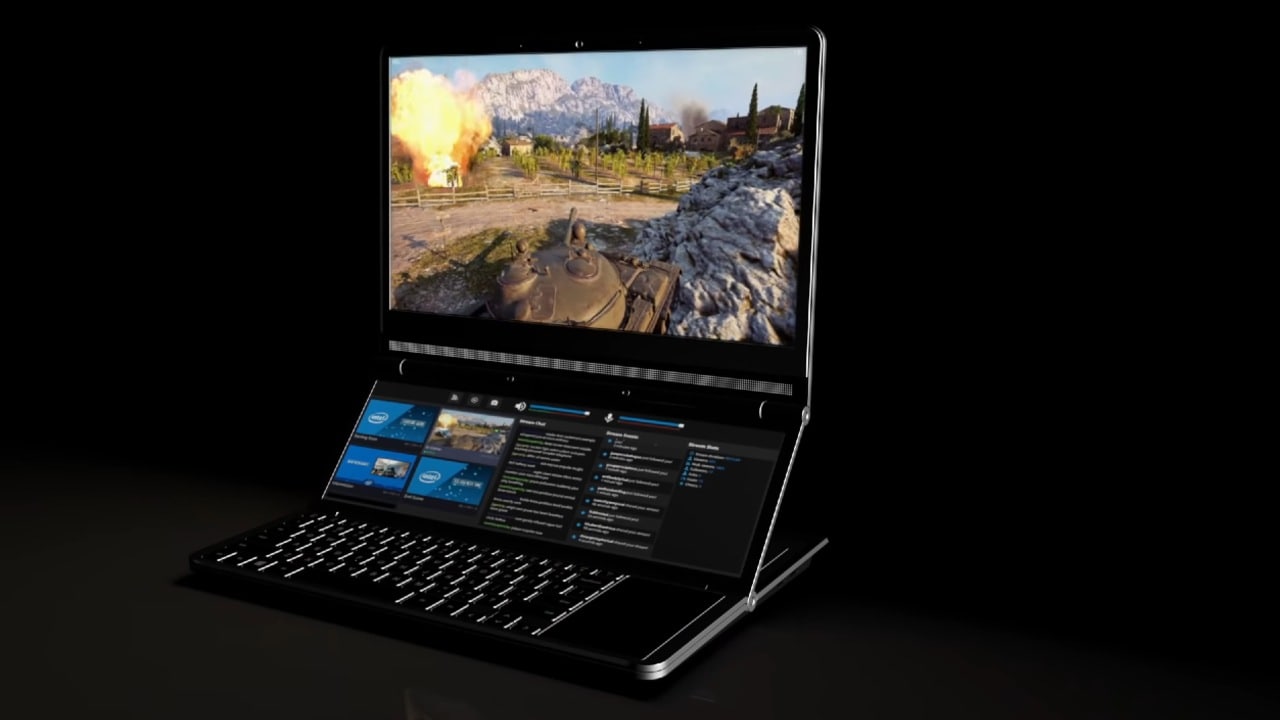 Intel Honeycomb Glacier gaming prototype laptop.[/caption]The dual screen concept design is Intel’s take on how a secondary screen can be useful for the appropriate use-cases. However, the primary focus here is for gaming. While playing games, I usually tend to Alt-tab out of games to use a chat client like Discord or OBS Studio when I’m streaming. To overcome this problem, I had to either use an additional monitor or play the game in the windowed mode. A secondary screen right on the laptop makes a lot of sense so that the less important apps can be locked onto them while continuing to play the game.On the Honeycomb Glacier, we find a 15.6-inch 1920 x 1080-pixel display and a 12.3-inch 1920 x 720-pixel secondary display right above the keyboard. ASUS already announced a similar design at Computex 2019 with the ZenBook Pro Duo. It also has a secondary display called the ScreenPad Plus. The biggest difference between the two, however, is ergonomics.[caption id="attachment_6721231" align="alignnone" width="1280"]
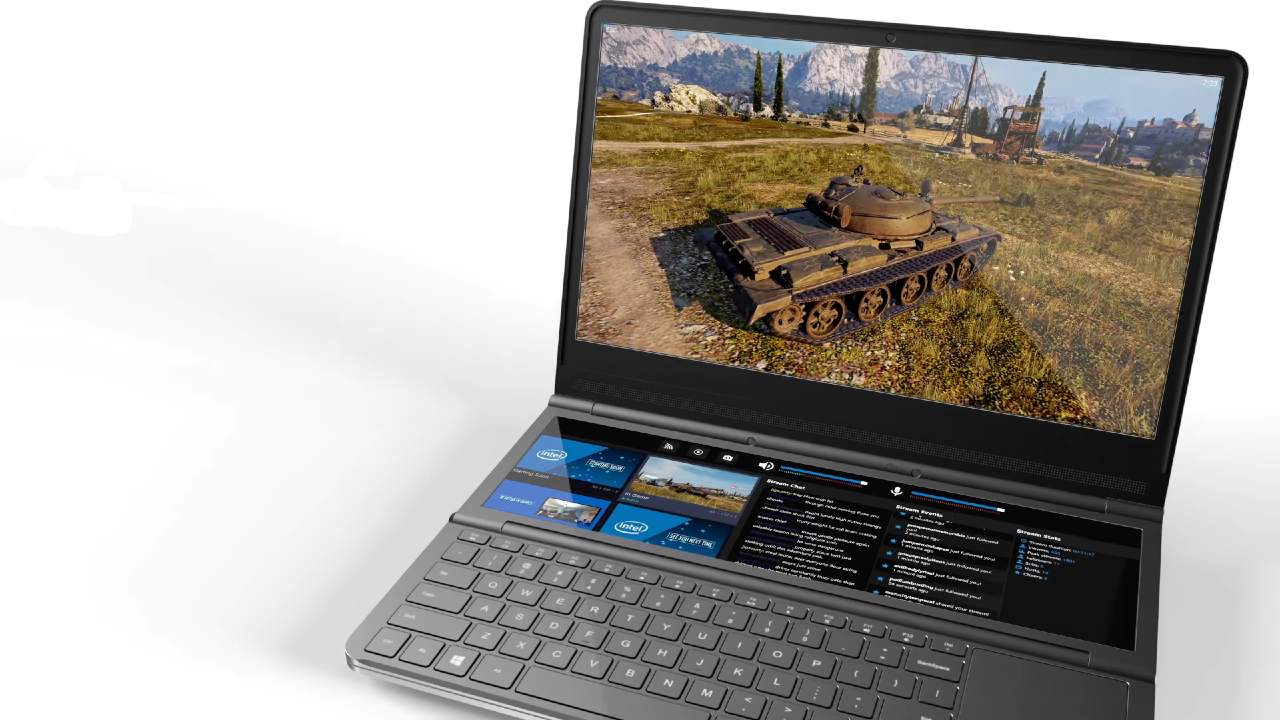 The secondary screen on the Intel Honeycomb Glacier gaming prototype laptop.[/caption]Dual screens sound great but are annoying if one must constantly switch between looking at the different screens placed at two different locations. The Honeycomb Glacier has an interesting dual-hinge design that allows users to have both the displays in their field of view. In its closed state, the primary screen opens like a regular laptop and then the secondary screen can be tilted up with a button on the hinge. The angle of the tilt can then be adjusted accordingly.Since this is still a prototype, it’s far from a finished product. A report from The Verge mentions that the laptop packs an eight-core Intel CPU and an NVIDIA GeForce 1060 graphics card. The Honeycomb Glacier comes with a Tobii eye-tracking camera that’s placed on the central hinge of the primary display. This camera is used to track the eye movements of esports players during professional matches to improve and monitor their gameplay.[caption id="attachment_6721221" align="alignnone" width="1280"]
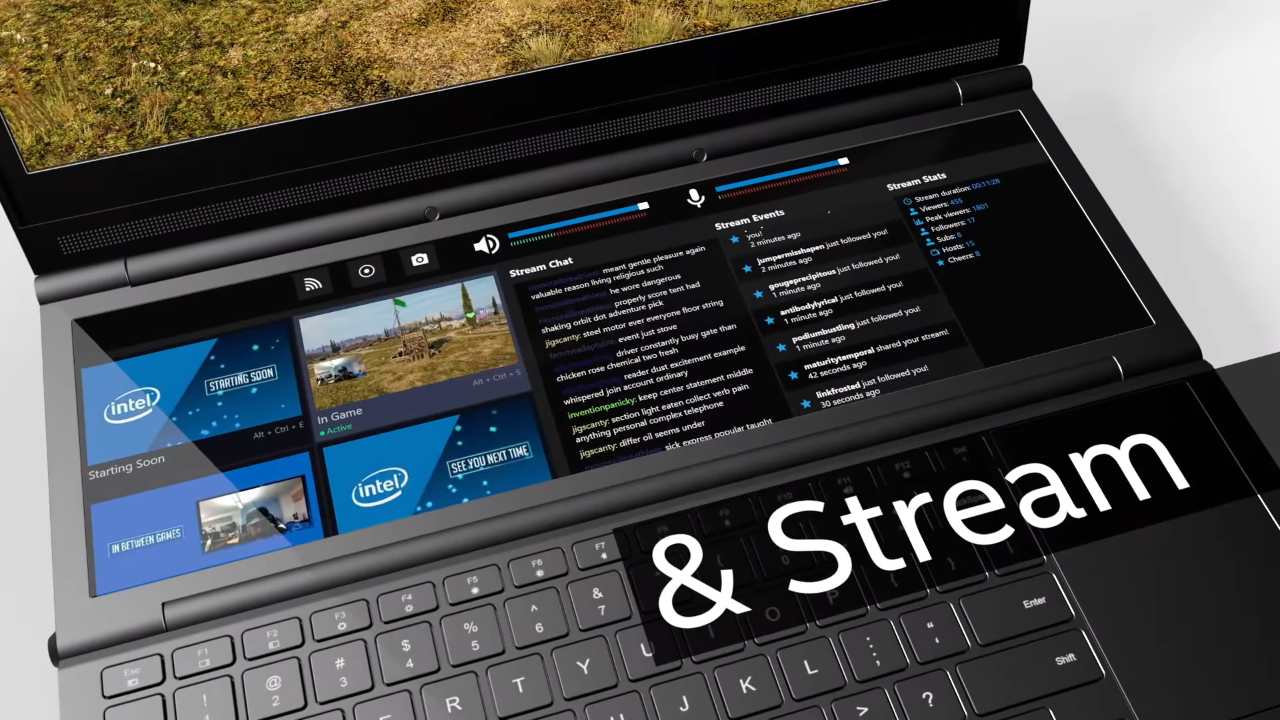 Game streaming use-case on the Intel Honeycomb Glacier gaming prototype laptop.[/caption]If you’re wondering how the secondary display can be used for other than gaming, content creators will find it useful as well. Editing videos can be much easier to manage with the timeline tab locked to the secondary screen while the preview tab is displayed on the primary display. Because of the bigger size of the secondary screen compared to the ZenBook Pro Duo, more apps can be displayed in it.Honeycomb Glacier isn’t meant to be a final product but more of an inspiration or concept for other PC manufacturers to create a commercial device out of it. While the ZenBook Pro Duo and HP’s Omen X 2S already have laptops with secondary displays, we can expect more vendors to adopt this concept.
First Published:May 29, 2019, 17:32:37 IST
Advertisement
Advertisement

High Stakes Game: Steam’s Best of 2023 highlights which games had gamers all excited last year
Valve has revealed its 'Best of 2023' list on Steam, categorising top-selling PC games into tiers such as Platinum, Gold, Silver, and Bronze, offering insights into the gaming landscape throughout the year
Netflix subscribers can now finally play GTA trilogy on Android, iOS devices. Here’s how to download
The Grand Theft Auto: The Trilogy – The Definitive Edition for iOS and Android mobile platforms with greatly improved visual and gameplay enhancements, promising an elevated gaming experience.
Grand Theft Auto VI Trailer launch: Here’s all the major easter eggs you missed
Hours before Rockstar was supposed to launch the GTA VI trailer, someone already leaked it online. As a result, Rockstar couldn’t go for the big reveal as they had planned. Nevertheless, the trailer had some major easter eggs throughout, which revealed a ton of details about the upcoming game
GTA 6 may launch in Oct 2024, reveals leaked voice message from Take-Two Interactive CEO Strauss Zelnick
While the launch is scheduled for October 2024, the game may be announced officially as early as October 2023, a new leaked voice memo from Take-Two Interactive's CEO Strauss Zelnick has revealed. This should be taken with a pinch of salt though
Ready Player One: Esports is India’s sunrise sector, set to become a Rs 1,100 crore industry by 2025
According to an EY report, Esports, a subset of digital gaming is estimated to become a Rs 1,100 crore industry by 2025 at a CAGR of 46 per cent. Statista released a report, saying the number of users in Esports is expected to amount to 122.10m users by 2027
Advertisement
Advertisement