
Advertisement


Sections
From Sydney to Delhi: Tracing Indian Test cricket team's evolution since 2000
Firstpost traces the evolution of India's performance in Test cricket over the last 15 years.

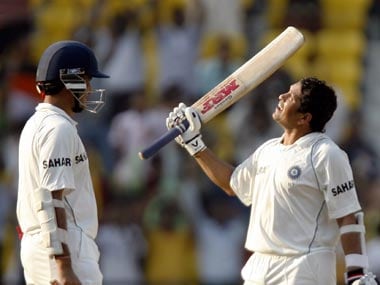 Ganguly's ascent to captaincy was the beginning of several memorable victories, which continued under the leadership of Rahul Dravid, Anil Kumble and MS Dhoni. Reuters[/caption]At the turn of this century, Indian cricket was at one of its lowest points, battling a match-fixing scandal, poor form and an inexperienced captain in the form of Tendulkar. The whitewash in Australia was followed by a 0-2 Test defeat to South Africa at home and Tendulkar’s resignation as captain. The then deputy, Sourav Ganguly, assumed command of the floundering ship, and soon India had the services of its first foreign coach, New Zealand’s John Wright. It wouldn't be wrong to say that the unorthodox captain-coach pair ushered Indian cricket into a new era.Wright's description of Ganguly in his book Indian Summers, a chronicle of his experiences as the Indian coach, is indicative of the latter's impact on the team, "His high-handedness often annoyed me but I secretly admired his rebellious streak because it gave the team some pepper and got up opposition noses, most famously Steve Waugh's.”Another development that gave an impetus to Indian cricket from the background was the election of the late Jagmohan Dalmiya as the President of the BCCI in 2001. He had gained quite a reputation during his tenure as ICC chief, but it cannot be denied that Dalmiya’s time at the helm of Indian cricket administration yielded results as well.Here’s a brief glimpse into how Dalmiya worked, from an excerpt of Wright’s book:Six days after the election I got a fax from Dalmiya who wanted to know why the team was inconsistent, why our batsmen couldn't turn ones into twos, and why they lost their wickets by getting "caught in the dilemmas of yes and no". Then he got to the point: "Are these a result of natural disability or a lack of proper training programmes?" He went on to talk about India's passion for the game, the BCCI's moral responsibility to the public and the fact that, despite cricket being a game of "glorious uncertainties", India needed professionalism "instead of always putting the onus on the whims of uncertainties". He wanted Andrew (Leipus, the physio) and I to spell out the factors that were hindering the team's performance and the problems we faced and put forward suggestions for addressing them....The early 2000s was also the time that saw the start and rise of several stars of Indian cricket. Harbhajan Singh, Virender Sehwag, Zaheer Khan were all breaking into the team, the likes of Rahul Dravid, VVS Laxman, Anil Kumble were shouldering more and more responsibility, and this combination of youth and experience proved to be the key for the Indian team of early 2000s.Victories to rememberGanguly's ascent to captaincy was the beginning of several memorable victories, which continued under the leadership of Rahul Dravid, Anil Kumble and MS Dhoni. Starting with the famous 2001 ‘Final Frontier’ win against Australia (I will refrain from elaborating on the Kolkata Test because that is an article in itself) and followed by winning Test matches abroad, from Zimbabwe, Sri Lanka, West Indies, Pakistan (the much-heralded Friendship Cup in 2004) to England (another masterpiece of a match at Headingley) and Australia (the empathic win at Adelaide.) From not winning a single Test outside the subcontinent for 15 years, India went on to nearly complete a series win over Australia on their turf.Ganguly’s captaincy ended in 2005 and he retired in 2008, but by then the team was well and truly on the path to notching up some more famous wins — a drawn series in West Indies and South Africa, a series win in New Zealand after 41 years, a memorable win at Perth under Kumble, a Test series win in England in 2007 lead by Dravid and the climb to the top of the ICC Rankings in 2010 under Dhoni. Through all this, there was another coach-captain combination to credit. South Africa’s Gary Kirsten was the perfect foil to Dhoni and together they were responsible for boosting India’s winning momentum.These wins were the stepping stones that turned the Indian Test team from a bunch of ragtag players to a truly formidable team that could win on foreign soil; and even though today they may seem more like a bunch of formidable players with ragtag performances, the journey over the last 15 years has been satisfying and successful — though anything but smooth.[caption id="attachment_2566492" align="alignright" width="380"]
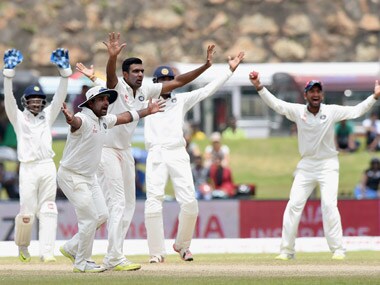 Finally, there seemed to be a resurgence of the fighting spirit that characterised the Indian team at the start of the century. AFP[/caption]Fluctuating fortunesThe year 2011 saw the Indian Test team whitewashed 4–0 in away Test series by England, displacing them from the top of the table. This series was followed by another disastrous 4–0 whitewash in Australia, which ended the careers of Dravid and Laxman in 2012. Kumble had exited with Ganguly in 2008, handing over the reins to Dhoni, and with Tendulkar’s retirement in 2013, the legendary Indian line-up was completely revamped. Dhoni himself passed on the mantle of the longer-form to Virat Kohli in 2014 and the former fabled stars like Zaheer and Sehwag called it a day off-field.At the same time, India saw the emergence of the next generation of Test-worthy performers. Kohli was the only silver lining in India’s 2011-12 tour Down Under with a century in last Test at Adelaide. The likes of Ajinkya Rahane and Cheteshwar Pujara slipped into the position left vacant by the retirements with moderate ease. In the bowling department, Ravichandra Ashwin’s toiling craft and Ishant Sharma’s erratic accuracy made for some crucial, if inconsistent, Test success in the last few years.The best example of this new, unpredictable phase of Indian Test cricket would be the 2014 England series. Poor travellers once again, India drew the first Test and went on to register a historic win at Lords in the second Test studded by Ishant and Rahane's excellent performances. Yet, they lost the series 3-1 after England decimated them in the next three Tests, the last two being innings defeats.In contrast, was the Test series in Australia later that year. While Virat Kohli’s first series as captain saw India lose 0-2, the four-match series was keenly contested. With the captain leading from the front, India drew the final two matches, after the losing the first one with a close of margin of 48-runs and the second by four wickets. This performance, despite being in a losing cause, gave hope to Indian fans.Finally, there seemed to be a resurgence of the fighting spirit that characterised the Indian team at the start of the century.The ranking graph
If India’s Test performance is seen, purely statistically, through the lens of the International Cricket Council’s (ICC) point-based ranking system, the team’s fortunes have been inconsistent as India’s fast bowlers in the 12 years since it was introduced.India started at the fifth position in 2003, moved up to the top three by 2005 but then plummeted back to five again in 2007. In 2008, they climbed up to the second spot, but slipped to four in 2009. From the fourth position, India leapfrogged to No one in 2010 and held on to the position for little over a year. However, in the coming year, they fell as low as 5 once again in 2012 and 2014.Since the calculation of ICC Rankings appear to be give the Duckworth-Lewis method a tough competition in complication, here’s a breakdown of India’s test performance in every year of the new millennium:
 From 2000 to 2015, India has played 165 Test matches and won 66 of them, losing 48 and 51 ending in a draw.The way forwardIn the 15 years of this century, India has progressed as a nation. From technology to entertainment, all fields saw this change. Indian cricket was no different. In the words of Sanjay Manjrekar: “As India changed, Indian cricket started to change too. The body language of the players when they are in a foreign country now is not as it used to be in my day, and that is a big plus”In his column for ESPNCricinfo, Manjrekar surmises the turn of Indian fortunes at the turn of the century as follows:"As Indian cricket evolved, and started producing some truly world-class players, Indian fans and media went to matches mainly to watch these players perform, to see an Indian stand up to the mighty West Indians or the Australians or English. If an Indian win came along on the way, it was a big bonus. Expectations from the team were low. After 2000, as the self-confidence of Indians grew on the world stage, their expectations from their national team in their favourite sport swelled too. They now want their team to make them proud there, not here.”As he rightly points out, expectations from the team have risen and from what we have seen of Kohli’s still fairly new team under the tutelage of Ravi Shastri, the expectations are justified. There are several similarities between this team and the one from the early 2000s and they certainly can replicate their surprising success. There is a passionate, talismanic captain in Kohli, there is the mentorship of Ravi Shastri as team director, there is mix of enthusiasm and experience and most importantly, there is untapped potential that can spring a surprise when needed. (Remember Ravindra Jadeja vs South Africa?)So here’s to the next phase of this century and the best hope I can have for this team is that 15 years later, there will be another tribute celebrating new achievements.Check out Firstpost's collection on how the past 15 years transformed sports, entertainment, technology and more in F.Rewind.
First Published:Jan 13, 2016, 15:37:40 IST
Advertisement
Advertisement

Why India may not witness a medal rush at 2026 Commonwealth Games
A 125-strong Indian contingent is in Glasgow for the 2026 Commonwealth Games, starting today (July 23), chasing international glory. However, with a roster of sports such as badminton and wrestling being cut from the event, the country’s medal chances have been drastically reduced
4 min read
MLS probes Inter Miami over Casemiro move despite confirmed signing
Inter Miami have signed Brazil midfielder Casemiro as a free agent, but Major League Soccer has launched an investigation into an alleged tampering issue linked to his move
1 min read
'It's not over yet': PV Sindhu makes bold declaration following historic Japan Open title victory
Two‑time Olympic medalist PV Sindhu reaffirmed her belief in herself with a landmark triumph at the Japan Open Super 750, defeating local favourite Akane Yamaguchi in straight sets.
1 min read
The Luis de la Fuente effect: Spain’s secret weapon in their 2026 World Cup victory
Spain’s 2026 FIFA World Cup triumph was not about a single superstar but about a collective force shaped by Luis de la Fuente’s leadership. His ability to value every player created a family‑oriented squad that thrived under pressure.
4 min read
Rodri beats Messi to win Golden Boot award; Check out full list of 2026 World Cup award winners
The 2026 World Cup wrapped up in thrilling fashion, with Spain clinching a 1-0 victory over defending champions Argentina to become world champions. La Roja will add a second star above their crest, joining the list of teams that became multi-time World Cup winners.
Substitute Ferran Torres struck in extra time to help Spain secure a 1-0 lead. The Spanish side looked utterly dominant with their playmaking, while Argentina was lacklustre. Even Messi, who carried the team to the summit clash, failed to display his magic.
Following the tournament, check out the full list of the FIFA 2026 World Cup award winners.
1 min read
Advertisement
Advertisement