


After Uttarakhand, will Rahul recall ‘murder of democracy’ by his own party?
The recent failed attempt in Uttarakhand to use Article 356 for partisan gains was a clear case to highlight the ‘murder of democracy’. But then, Rahul should have remembered that Modi was not the only culprit in this abuse of the provision of Article 356 in the Constitution

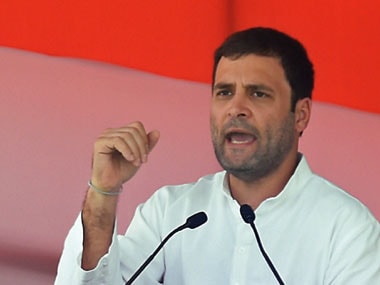
File image of Congress vice-president Rahul Gandhi. AFP[/caption]It was a draconian provision (Section 93) that the colonial government had incorporated in the Government of India Act 1935 to keep the provincial governments on a leash. That provision remained intact and unchanged in our Constitution; only Section 93 of the GOI Act became Article 356 of the Indian Constitution. When apprehensions were raised in the Constituent Assembly, Dr BR Ambedkar justified its inclusion to deal with the emergency situations but expressed the hope that “such articles will never be called into operation and they would remain a dead letter”.But Ambedkar’s hopes were misplaced.Barely a year after the promulgation of the Constitution, the Punjab government headed by Gopichand Bhargava was dismissed under Article 356. Another three years later, in 1954, the Andhra Pradesh government was sacked as apparently the Centre feared the possibility of a Communist takeover there. But then these dismissals did not earn much reproach because the Congress party was in power in both the Centre and the states, and the dismissals had more to do with internal party squabbles.The real misuse of Article 356 became evident when the Nehru cabinet moved against the democratically-elected Communist government in Kerala. EMS Namboodiripad had a clear majority. True, his policies involving radical land reforms and educational reforms angered the vested interest groups; and so, the Catholic Church, the Nair Service Society and the Indian Union of Muslim League joined hands to protest against the government measures. The Congress party, smarting over the loss to the Communists in the 1957 election in Kerala, backed the violent stir.The protesters attacked government property in different parts of the state. It was a serious law and order situation. But then the grave internal disturbance was not ground enough for invoking Article 356. (The Centre owed a duty under Article 355 to protect every state against internal aggression.) Nehru admitted as much when he said on the floor of the Lok Sabha on 10 June, 1959: “I am opposed to unconstitutional means at any time, anyhow, because once you adopt them, they would be justified in another context. You cannot judge things minus means.”Despite all his good intentions, Nehru finally resorted to the ‘unconstitutional means’ of dismissing the CPI government on 31 July, 1959. Though some historians tell us that he could not resist the pressure by many party colleagues — mainly his own daughter, Indira Gandhi, who was the Congress president then — the burden of the crime must squarely rest with the prime minister who took the final call.During the Kerala imbroglio, Indira had made an ominous statement, indirectly attacking her father who was emphasising constitutional means. She had said: “The Constitution is for the people, not the people for the Constitution. And if the Constitution stands in the way of meeting the people’s grievances in Kerala, it should be changed.”Such a cavalier attitude to the constitutional provisions was on ample display when Indira became prime minister. All niceties were thrown to the wind and she brazenly went about dismantling the non-Congress governments elected to rule in several states. It is a terrible commentary on our democracy at work that she used Article 356 to dismiss as many as 48 opposition-ruled state governments during her tenure as prime minister.Unlike what Rahul Gandhi tells us, “people of this country and the institutions built by our founding fathers” did — rather, had to — tolerate this “murder of democracy” being perpetrated by his grandmother, Indira Gandhi. His father, Rajiv Gandhi, did not have to act with impunity as Indira did, as the opposition had been decimated in 1984, in the aftermath of the Indira assassination, (remember, the BJP had won just two seats in the Lok Sabha and even its iconic leader Vajpayee had lost the election). Rajiv was in a position just as his grandfather, Nehru. Both, unlike Indira, did not have to face formidable opposition in the states. So their track record looks comparatively better.But then the misuse of Article 356 was not a monopoly of the Nehru-Gandhi family alone. Other Congress prime ministers like PV Narasimha Rao and Manmohan Singh have been equally unscrupulous in resorting to this diabolical provision. Even the small-time prime ministers like VP Singh, Chandra Shekhar, IK Gujral and HD Deve Gowda have been complicit in this constitutional crime.Rahul Gandhi will do Indian democracy a lot of good if, while rightly attacking Modi, he assures the countrymen that the Congress governments under his watch will not resort to Article 356 in the future. If he does so, that will go a long way in putting a brake on the ‘murder of democracy’ that he bemoans.But does Rahul have the courage of conviction to make that pledge?

Rahul Gandhi, Kharge lead protest near PM residence; Centre says Parliament discussion was offered
Parliament's Monsoon Session from July 20: Key bills, numbers game to dominate agenda
Major blow to Uddhav Thackeray as six Lok Sabha MPs join Shinde camp
12 years and counting: NDA leaders felicitate PM Modi as he trumps Nehru's tenure record
‘Trust, progress and welfare’: PM Modi celebrates 12 years in office, highlights big policy moves