
Advertisement


Sections
Narendra Modi's second term in office: From job creation, tax rates to agrarian crisis, to-do list for next five years is ready
The Narendra Modi government should work on getting state finances in order

Giving suggestions to the new government on what should be done to keep the economy going may sound pompous given that there are experienced experts working on the same in various ministries and advisory bodies. Therefore, any thoughts on what should be done are more in the form of expectations from the new government rather than suggestions.It is quite clear that the economy is definitely going through odd times. Odd, because while we still take pride in claiming to be the fastest growing economy in the world for the last few years, there are several zones of discomfort which call for some policy action. In fact, the recent controversy on the economic data releases has cast elements of a shadow on some economic variables. Whichever way one looks at the performance of the economy, there are definitely areas of improvement that should be on the priority list.The first pressing issue in the country today is employment. It is evident that the pace of jobs creation has not kept up with gross domestic product (GDP) growth that has been in the region of 7 percent per annum. While it is true that most jobs are created in the private sector which is dependent on growth which makes the reasoning circular, the government can focus on areas which increase the demand for labour. To begin with, the empty posts in the government offices have to be filled up so that there is optimal capacity utilisation here.At the broader level, the government has to focus on the small and medium-sized enterprises (SME) segment and start-ups where individuals can find employment by partly becoming entrepreneurs. Even today there are schemes which have been started for start-ups. The way forward is to have an end-to-end solution where the Centre works with the states to ensure that starting a business becomes easy from registration, property acquisition, tax compliance, labour rules, etc. Maybe a single window clearance should be in place.[caption id="attachment_6485871" align="alignleft" width="380"]![File photo of Prime Minister Narendra Modi addressing a rally. Reuters]() File photo of Prime Minister Narendra Modi. Reuters[/caption]The second pressing issue today relates to consumption which is down. It can partly be attributed to a lower number of jobs that have been created. Can the government do anything here?In the USA we have seen that the government has gone in for tax cuts to kick-start the economy while here in India a tough call has to be taken. Tax cuts are needed in the middle and higher ends of income because this is where there is spending power.GST rates need to be reviewed and here too, any rationalisation can mean a loss of revenue. Therefore, the tax rates need to be changed effectively to ensure that spending power improves without seriously distorting the collections. It has to be done in a calibrated manner so that as tax rates are cut, consumption leads to higher growth which generates more revenue—the classical case of supply-side economics working a la Laffer curve theory.At the corporate level, the corporate tax rate has to be lowered for sure or can be linked with investments so that the issue of capital formation can also be addressed. This is the investment push that can be provided as presently the government appears to be more focused on the capex which gets restricted to roads, housing and to an extent, urban development. For it to be more encompassing, corporates have to be encouraged to invest more. Investment can be the third main focus area and the private sector being the trigger.The fourth sector that has to be targeted is agriculture. There has been a tendency for a piecemeal approach to be followed for farming as there are multiple entities involved as agriculture is a state subject. This is one reason as to why an end-to-end solution does not exist. The problems start from land, seeds, irrigation, yields, credit, sale, logistics (transport and warehousing), marketing and packaging. As states also get involved, there are varied interest groups which have made the system cumbersome and not free-flowing.The Green Revolution worked in the late 60s and 70s in enhancing yields because there was a clear agenda focused on wheat which had a frontend procurement process. But farming is more complex given the scale and hence just creating an electronic national agricultural market without APMC laws being effectively repealed does not work. Some states have abolished them but others haven’t. Also, road connectivity is absent in rural areas as the centre has focused mainly on highways and left the rural connectivity to states. There is hence a need to have this integrated approach to make the system resilient.A project that must be taken up is the channelling of the rivers down the sub-continent to ensure that access to irrigation is available in the regions that are susceptible to monsoon inconsistencies. This has to again get the acceptance of states because in drought-prone areas it would be good if perennial rivers like the Ganges are channelled to these segments.Fifth, the financial system has to be made more robust and the approach to banks and NPAs has to be made clear. The resolution process has been fairly uneven with different strictures being in force. A concerted action plan drawn with the Reserve Bank of India (RBI) has to be in place in the short-term so that there is a clear direction for the banks as well as borrowers and the path to resolution is transparent.
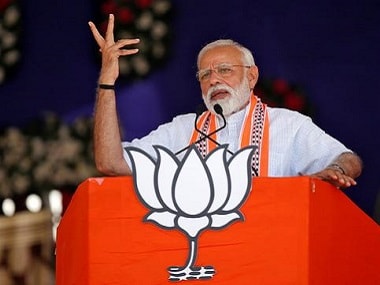
File photo of Prime Minister Narendra Modi. Reuters[/caption]The second pressing issue today relates to consumption which is down. It can partly be attributed to a lower number of jobs that have been created. Can the government do anything here?In the USA we have seen that the government has gone in for tax cuts to kick-start the economy while here in India a tough call has to be taken. Tax cuts are needed in the middle and higher ends of income because this is where there is spending power.GST rates need to be reviewed and here too, any rationalisation can mean a loss of revenue. Therefore, the tax rates need to be changed effectively to ensure that spending power improves without seriously distorting the collections. It has to be done in a calibrated manner so that as tax rates are cut, consumption leads to higher growth which generates more revenue—the classical case of supply-side economics working a la Laffer curve theory.At the corporate level, the corporate tax rate has to be lowered for sure or can be linked with investments so that the issue of capital formation can also be addressed. This is the investment push that can be provided as presently the government appears to be more focused on the capex which gets restricted to roads, housing and to an extent, urban development. For it to be more encompassing, corporates have to be encouraged to invest more. Investment can be the third main focus area and the private sector being the trigger.The fourth sector that has to be targeted is agriculture. There has been a tendency for a piecemeal approach to be followed for farming as there are multiple entities involved as agriculture is a state subject. This is one reason as to why an end-to-end solution does not exist. The problems start from land, seeds, irrigation, yields, credit, sale, logistics (transport and warehousing), marketing and packaging. As states also get involved, there are varied interest groups which have made the system cumbersome and not free-flowing.The Green Revolution worked in the late 60s and 70s in enhancing yields because there was a clear agenda focused on wheat which had a frontend procurement process. But farming is more complex given the scale and hence just creating an electronic national agricultural market without APMC laws being effectively repealed does not work. Some states have abolished them but others haven’t. Also, road connectivity is absent in rural areas as the centre has focused mainly on highways and left the rural connectivity to states. There is hence a need to have this integrated approach to make the system resilient.A project that must be taken up is the channelling of the rivers down the sub-continent to ensure that access to irrigation is available in the regions that are susceptible to monsoon inconsistencies. This has to again get the acceptance of states because in drought-prone areas it would be good if perennial rivers like the Ganges are channelled to these segments.Fifth, the financial system has to be made more robust and the approach to banks and NPAs has to be made clear. The resolution process has been fairly uneven with different strictures being in force. A concerted action plan drawn with the Reserve Bank of India (RBI) has to be in place in the short-term so that there is a clear direction for the banks as well as borrowers and the path to resolution is transparent.
 File photo of Prime Minister Narendra Modi. Reuters[/caption]The second pressing issue today relates to consumption which is down. It can partly be attributed to a lower number of jobs that have been created. Can the government do anything here?In the USA we have seen that the government has gone in for tax cuts to kick-start the economy while here in India a tough call has to be taken. Tax cuts are needed in the middle and higher ends of income because this is where there is spending power.GST rates need to be reviewed and here too, any rationalisation can mean a loss of revenue. Therefore, the tax rates need to be changed effectively to ensure that spending power improves without seriously distorting the collections. It has to be done in a calibrated manner so that as tax rates are cut, consumption leads to higher growth which generates more revenue—the classical case of supply-side economics working a la Laffer curve theory.At the corporate level, the corporate tax rate has to be lowered for sure or can be linked with investments so that the issue of capital formation can also be addressed. This is the investment push that can be provided as presently the government appears to be more focused on the capex which gets restricted to roads, housing and to an extent, urban development. For it to be more encompassing, corporates have to be encouraged to invest more. Investment can be the third main focus area and the private sector being the trigger.The fourth sector that has to be targeted is agriculture. There has been a tendency for a piecemeal approach to be followed for farming as there are multiple entities involved as agriculture is a state subject. This is one reason as to why an end-to-end solution does not exist. The problems start from land, seeds, irrigation, yields, credit, sale, logistics (transport and warehousing), marketing and packaging. As states also get involved, there are varied interest groups which have made the system cumbersome and not free-flowing.The Green Revolution worked in the late 60s and 70s in enhancing yields because there was a clear agenda focused on wheat which had a frontend procurement process. But farming is more complex given the scale and hence just creating an electronic national agricultural market without APMC laws being effectively repealed does not work. Some states have abolished them but others haven’t. Also, road connectivity is absent in rural areas as the centre has focused mainly on highways and left the rural connectivity to states. There is hence a need to have this integrated approach to make the system resilient.A project that must be taken up is the channelling of the rivers down the sub-continent to ensure that access to irrigation is available in the regions that are susceptible to monsoon inconsistencies. This has to again get the acceptance of states because in drought-prone areas it would be good if perennial rivers like the Ganges are channelled to these segments.Fifth, the financial system has to be made more robust and the approach to banks and NPAs has to be made clear. The resolution process has been fairly uneven with different strictures being in force. A concerted action plan drawn with the Reserve Bank of India (RBI) has to be in place in the short-term so that there is a clear direction for the banks as well as borrowers and the path to resolution is transparent.
It has also been seen that while the central government manages the fiscal situation quite well, it is not the same with all the states. The government should work in getting state finances in order and leave it to a high-level committee to actually recommend certain limits that can be put for states finances in order to have more discipline. This is necessary as getting higher growth cannot be done by the Centre on its own and requires a lot of support from states as the structure is federal in scope.The above-mentioned five to six points can be the focus for the government for the first 365 days so as to strengthen the foundations of the economy.(The writer is Chief Economist, CARE Ratings)
Madan Sabnavis is Chief Economist at CARE Ratings.
First Published:May 24, 2019, 15:03:44 IST
Advertisement
Advertisement

Rahul Gandhi, Kharge lead protest near PM residence; Centre says Parliament discussion was offered
The developments come amid the continuing CJP-led agitation at Jantar Mantar, where protesters have vowed to continue their sit-in despite recent clashes with Delhi Police
2 min read
Parliament's Monsoon Session from July 20: Key bills, numbers game to dominate agenda
The Monsoon Session of Parliament will begin on July 20 and continue till August 13, with the government expected to push several key legislations, including constitutional amendment bills
2 min read
Major blow to Uddhav Thackeray as six Lok Sabha MPs join Shinde camp
In a major political setback for Shiv Sena (UBT) chief Uddhav Thackeray, six of the party's nine Lok Sabha MPs joined the Eknath Shinde-led Shiv Sena in Mumbai on Monday
2 min read
12 years and counting: NDA leaders felicitate PM Modi as he trumps Nehru's tenure record
Leaders of the National Democratic Alliance (NDA) on Wednesday felicitated Prime Minister Narendra Modi on completing 12 years in office and becoming India's longest-serving continuously elected Prime Minister
3 min read
‘Trust, progress and welfare’: PM Modi celebrates 12 years in office, highlights big policy moves
Prime Minister Narendra Modi on Tuesday marked 12 years in office. He described the period as one dedicated to "trust, development and public welfare" while highlighting key achievements of his government
3 min read
Advertisement
Advertisement