
Advertisement


Sections
Mamata Banerjee sidesteps demand for separate Gorkhaland, hints at revised arrangement for region
Obliquely rejecting, yet again, the demand for a separate 'Gorkhaland', West Bengal chief minister Mamata Banerjee hinted on Tuesday of the possibility of a new administrative arrangement for the districts of Darjeeling and Kalimpong.

Obliquely rejecting, yet again, the demand for a separate 'Gorkhaland', West Bengal chief minister Mamata Banerjee hinted on Tuesday at the possibility of a new administrative arrangement for the districts of Darjeeling and Kalimpong. Banerjee assured the region of “trying to meet its requirements”, but on the condition that “we shall all have to remain together” even as she underscored the need for peace. Though she made no specific mention of the statehood issue, the allusion was clear.[caption id="attachment_4338663" align="alignleft" width="380"]![File image of West Bengal chief minister Mamata Banerjee. PTI]() File image of West Bengal chief minister Mamata Banerjee. PTI[/caption]Banerjee was on her way to Darjeeling, nearly eight months after her previous visit to the hill town evoked a backlash of popular resentment which took the form of a 104-day shutdown in the Hills and a protracted period of unrest. It was her subsequent manoeuvrings which led to a tectonic shift in the local political topography and the emergence of a new ruling dispensation propped up by her government.“I used to come (to the Hills) every two to three months earlier, but you are all aware that there had come a time when none from elsewhere could visit (the region). There were some problems”, she told a gathering at Simulbari on her way up the hills from Siliguri. “We all know that Darjeeling is a beautiful part of our country... but it is very easy to create trouble. It (could) last a second but reduce everything to bits”.Banerjee was referring to the past months of political turbulence in the Hills which wrecked the local economy. “When the Hills and the plains, Bengalis, Nepalis and Gorkhas... work in tandem, progress is greater”, she maintained, making an effort to bridge the hill-plains dichotomy that colours local perceptions.
File image of West Bengal chief minister Mamata Banerjee. PTI[/caption]Banerjee was on her way to Darjeeling, nearly eight months after her previous visit to the hill town evoked a backlash of popular resentment which took the form of a 104-day shutdown in the Hills and a protracted period of unrest. It was her subsequent manoeuvrings which led to a tectonic shift in the local political topography and the emergence of a new ruling dispensation propped up by her government.“I used to come (to the Hills) every two to three months earlier, but you are all aware that there had come a time when none from elsewhere could visit (the region). There were some problems”, she told a gathering at Simulbari on her way up the hills from Siliguri. “We all know that Darjeeling is a beautiful part of our country... but it is very easy to create trouble. It (could) last a second but reduce everything to bits”.Banerjee was referring to the past months of political turbulence in the Hills which wrecked the local economy. “When the Hills and the plains, Bengalis, Nepalis and Gorkhas... work in tandem, progress is greater”, she maintained, making an effort to bridge the hill-plains dichotomy that colours local perceptions.
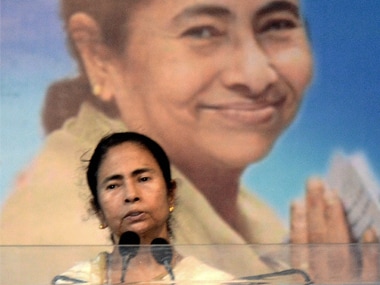 File image of West Bengal chief minister Mamata Banerjee. PTI[/caption]Banerjee was on her way to Darjeeling, nearly eight months after her previous visit to the hill town evoked a backlash of popular resentment which took the form of a 104-day shutdown in the Hills and a protracted period of unrest. It was her subsequent manoeuvrings which led to a tectonic shift in the local political topography and the emergence of a new ruling dispensation propped up by her government.“I used to come (to the Hills) every two to three months earlier, but you are all aware that there had come a time when none from elsewhere could visit (the region). There were some problems”, she told a gathering at Simulbari on her way up the hills from Siliguri. “We all know that Darjeeling is a beautiful part of our country... but it is very easy to create trouble. It (could) last a second but reduce everything to bits”.Banerjee was referring to the past months of political turbulence in the Hills which wrecked the local economy. “When the Hills and the plains, Bengalis, Nepalis and Gorkhas... work in tandem, progress is greater”, she maintained, making an effort to bridge the hill-plains dichotomy that colours local perceptions.
Banerjee’s visit after all these months is indication enough that her government is finally on top of the situation. Whether it helps facilitate clearing up the uncertainty over the political future of the Hills and can assuage the lingering disquiet underlying the apparently brittle calm and stability is another question.It is significant that her assurance of working towards meeting the region’s requirements in peaceful conditions comes at a time when the possibility of a “new arrangement” has been dominating local political discourse ever since Binay Tamang, chairman of the board of administrators her government set up to oversee the functioning of the Gorkhaland Territorial Administration (GTA), articulated such a likelihood at a rally on 21 January: His first public rally after assuming office.Tamang, who leads a faction of the Gorkha Janmukti Morcha (GJM), after having parted ways with Bimal Gurung, owes much of his rising political fortunes to Banerjee. At the rally, Tamang spoke of an arrangement which could help settle critical questions of Gorkha “identity” and “security”: Issues which have been propellers of the statehood campaign over the years.He declined to elaborate on the matter, but had thrown into the public domain the question of whether the state government is looking at revising the administrative and financial powers of the GTA, which itself came into being after replacing the Darjeeling Gorkha Hill Council, the first quasi-autonomous regional body set up in 1988.
Banerjee might have red-lined the statehood demand, but it would be naive not to recognise that it remains a powerful force multiplier. A divided GJM which, even in its fractious condition, continues to be the dominant political force in the region even though Gurung, long the leading figure behind the party and presently in some sort of political limbo, clearly remains a thorn in the flesh for Banerjee.Besides the rivalry within the two camps in the GJM, overhanging the chief minister’s visit to the Hills is the anticipation that is building up over a hearing pending in the Supreme Court: The government’s plea to recall an order restraining it from taking “any coercive action” against Gurung, who was slapped by the state police with a look-out notice as well as, among other charges, those under the Unlawful Activities (Prevention) Act for alleged criminal offences in the course of the June-September strike in the Hills last year.Cut-off from his support base, Gurung continues to occasionally send out audio clips with the assurance that he will soon be back with them. This remains a source of worry for not just his political opponents — many of whom swore by him until fissures within the GJM appeared — but also the state government.In a recent such clip, Gurung denounced all talk of agreeing to a new arrangement for the Hills (even though he earlier expressed his willingness to sit for talks with the West Bengal government). It is a widely accepted fact that he enjoys the backing of the BJP, which is keen not just to retain the Darjeeling Lok Sabha seat in the next parliamentary elections, but also is aspiring to extend its influence in the rest of West Bengal by throwing a challenge to the hegemony of Banerjee’s Trinamool Congress.
First Published:Feb 06, 2018, 20:59:07 IST
Advertisement
Advertisement

Rahul Gandhi, Kharge lead protest near PM residence; Centre says Parliament discussion was offered
The developments come amid the continuing CJP-led agitation at Jantar Mantar, where protesters have vowed to continue their sit-in despite recent clashes with Delhi Police
2 min read
Parliament's Monsoon Session from July 20: Key bills, numbers game to dominate agenda
The Monsoon Session of Parliament will begin on July 20 and continue till August 13, with the government expected to push several key legislations, including constitutional amendment bills
2 min read
Major blow to Uddhav Thackeray as six Lok Sabha MPs join Shinde camp
In a major political setback for Shiv Sena (UBT) chief Uddhav Thackeray, six of the party's nine Lok Sabha MPs joined the Eknath Shinde-led Shiv Sena in Mumbai on Monday
2 min read
12 years and counting: NDA leaders felicitate PM Modi as he trumps Nehru's tenure record
Leaders of the National Democratic Alliance (NDA) on Wednesday felicitated Prime Minister Narendra Modi on completing 12 years in office and becoming India's longest-serving continuously elected Prime Minister
3 min read
‘Trust, progress and welfare’: PM Modi celebrates 12 years in office, highlights big policy moves
Prime Minister Narendra Modi on Tuesday marked 12 years in office. He described the period as one dedicated to "trust, development and public welfare" while highlighting key achievements of his government
3 min read
Advertisement
Advertisement