


Karnataka results analysis: BJP's mistake was removing Yeddy from Delhi
Did the BJP make a mistake in not keeping back Yeddyurappa? The problem is he was sacked by Delhi, and not his own MLAs in Karnataka.

The real issue thrown up by the Karnataka election results is one of leadership and governance. The Congress won because the BJP could not solve the issue of its state leadership.Let’s be clear: this is not about whether BS Yeddyurappa should have been kept back or if the party was right in removing him. The issue is who decides this? Did the Karnataka BJP legislative party decide this or the BJP High Command sitting in the rarefied atmosphere of Delhi?Obviously, it was the latter. Leaders who would be unable to get themselves elected from anywhere got rid of an elected leader and key power centre in the Karnataka party through an executive coup.[caption id="attachment_766455" align="alignleft" width="380"]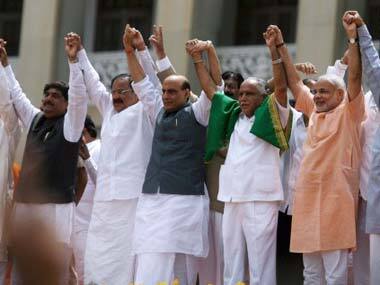 PTI[/caption]It is possible to rationalise the BJP High Command’s decision to remove Yeddyurappa on moral terms: the BJP, which was fighting the Congress on corruption, did not want to be embarrassed by a Chief Minister who was himself facing corruption charges.The problem, though, is in the process: how can leadership be decided by anyone other than the legislators themselves? If the legislators had seen Yeddyurappa as a liability and dethroned him, that would have been that.This problem surfaces less in dynastic parties like the Congress, where the Gandhi family will take the final call on everything. It does not make for empowered state leadership, and is a major reason why the Congress has lost control of many states. It could lose Andhra Pradesh next. But that comes with the acceptance of dynastic politics.However, in parties such as the BJP, which are federal in structure and where power is more diffused, leadership issues cannot really be decided in Delhi. The High Command simply does not have the power to do this. And this is the crux.As has been obvious for more than a decade now, India's real political power resides in the states. This gives regional parties an advantage since they tend to control their parties completely. Consider the tight hold of bosses in all regional parties – from Mayawati and Mulayam Singh to Navin Patnaik to Nitish Kumar to M Karunanidhi and J Jayalalithaa.The BJP is the oddball in the political arena for it is the only national party that encourages regional leadership. The rise of mass leaders like Narendra Modi, Vasundhara Raje, Shivraj Singh Chauhan and Raman Singh is evidence of this reality. Yeddyurappa too would have come under the same category but for the BJP’s central leadership misguided intervention.The point is not that the BJP would have won if it had retained Yeddyurappa. But since the party chose to remove him without consulting the state MLAs, both the local party and the central leadership can escape accountability. The BJP’s legislature party can wash its hands off saying it was Delhi’s decision. The Delhi chaps will say the local leadership was weak. We will never know what the people of Karnataka voted for or against in the election.For parties like the BJP, there is clearly a need to evolve a system for sorting out leadership issues through internal elections. This issue will come up time and again – both at the states and the centre.For example, it is obvious to everyone that Narendra Modi is the most popular leader in many states beyond Gujarat. But assuming his covert critics are right, how will the party ever know if it does not hold a contest for the leadership?The BJP removed its last president through an in-house coup, and the new man in – Rajnath Singh – came not through an election, but consensus. He was the least objectionable candidate to both the top leaders in Delhi and the RSS.Is this any way to elect a leader? What authority will he have, when no one knows if he has the support of the cadre in most states?In any democracy, power comes from below – the people, or the cadre – and not above. By pretending that consensus from above is always preferable to election, the BJP is hoping that competing ambitions can be brushed under the carpet.This problem will keep surfacing again and again even at the centre, where the BJP actually has lots of alleged leaders but few capable of winning an election. Consider the names: Sushma Swaraj, Arun Jaitley, LK Advani. Each one of them is hoping against hope that if (and when) Modi is found to be unacceptable to allies, they will get a look-in.Rajnath Singh presumably can at least win his own seat, but he too must be hoping for the same.It is most likely that Modi’s real challenge will come from other state CMs rather than the central leadership. But this issue can only be settled if the party decides to hold an election to select a Prime Ministerial candidate.Maybe, the party needs an internal system of primaries, like in the US, to settle leadership issues both in the states and centre.This is the only way to ensure that you have both strong regional leaders and strong central leaders. If the BJP wants a future, it must learn to embrace internal elections.
R Jagannathan is the Editor-in-Chief of Firstpost.

Rahul Gandhi, Kharge lead protest near PM residence; Centre says Parliament discussion was offered
Parliament's Monsoon Session from July 20: Key bills, numbers game to dominate agenda
Major blow to Uddhav Thackeray as six Lok Sabha MPs join Shinde camp
12 years and counting: NDA leaders felicitate PM Modi as he trumps Nehru's tenure record
‘Trust, progress and welfare’: PM Modi celebrates 12 years in office, highlights big policy moves