
Advertisement


Sections
How Modi has the professors of UPenn divided
Two interviews of UPenn professors published in New York Times India Ink suggests that the university is divided on the Modi issue.

Gujarat Chief Minister Narendra Modi, like it has now become evident, incites extreme opinions among Indians spread across the world. The latest proof of it: the furore over the cancellation of Modi's talk at Wharton by the university authorities. However, like everyone else who talks about him, University of Pennsylvania too seems to be divided over the Modi issue. New York Times India Ink recently did two interviews which the faculty of two different departments of the university which show that the politician is as contentious an issue overseas as he is in India.[caption id="attachment_658777" align="alignleft" width="380"]![Narendra Modi. Agencies.]() Narendra Modi. Agencies.[/caption]NYT first interviewed Ania Loomba, a professor in the Department of English at UPenn and one of the individuals who led the movement against Modi's address at the university.Loomba, explains that letting Modi address the Wharton economic conclave would amount to letting him 'sanitize' his government's records and erase the blots of the 2002 communal riots his government failed to control - and claimed over 1,000 lives.New York Times quotes Loomba:
Narendra Modi. Agencies.[/caption]NYT first interviewed Ania Loomba, a professor in the Department of English at UPenn and one of the individuals who led the movement against Modi's address at the university.Loomba, explains that letting Modi address the Wharton economic conclave would amount to letting him 'sanitize' his government's records and erase the blots of the 2002 communal riots his government failed to control - and claimed over 1,000 lives.New York Times quotes Loomba:
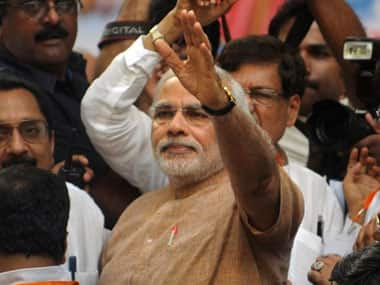 Narendra Modi. Agencies.[/caption]NYT first interviewed Ania Loomba, a professor in the Department of English at UPenn and one of the individuals who led the movement against Modi's address at the university.Loomba, explains that letting Modi address the Wharton economic conclave would amount to letting him 'sanitize' his government's records and erase the blots of the 2002 communal riots his government failed to control - and claimed over 1,000 lives.New York Times quotes Loomba:
"We are firmly opposed to any attempt to de-link development from human rights: the kinds of atrocities minority communities suffered and continue to suffer in Gujarat are not neatly separable from economic development."However, Loomba's fellow professor in the university, Aseem R. Shukla, an associate professor of surgery at The Perelman School of Medicine, found little merit in Loomba's argument in another NYT interview.Shukla said that the decision to cancel Modi's visit went against the liberal policies of the university. He cited the case of severely anti-Israel speakers being given a platform to talk at the university.According to Shukla, "The university insulted legions of Indians and Indian-Americans who, while not necessarily supporting Mr. Modi as a politician, have confidence in India’s democracy and judiciary."Seems like Modi has UPenn divided too.Read the interview with Loomba here and the interview with Shukla here.
First Published:Mar 13, 2013, 14:18:30 IST
Advertisement
Advertisement

Rahul Gandhi, Kharge lead protest near PM residence; Centre says Parliament discussion was offered
The developments come amid the continuing CJP-led agitation at Jantar Mantar, where protesters have vowed to continue their sit-in despite recent clashes with Delhi Police
2 min read
Parliament's Monsoon Session from July 20: Key bills, numbers game to dominate agenda
The Monsoon Session of Parliament will begin on July 20 and continue till August 13, with the government expected to push several key legislations, including constitutional amendment bills
2 min read
Major blow to Uddhav Thackeray as six Lok Sabha MPs join Shinde camp
In a major political setback for Shiv Sena (UBT) chief Uddhav Thackeray, six of the party's nine Lok Sabha MPs joined the Eknath Shinde-led Shiv Sena in Mumbai on Monday
2 min read
12 years and counting: NDA leaders felicitate PM Modi as he trumps Nehru's tenure record
Leaders of the National Democratic Alliance (NDA) on Wednesday felicitated Prime Minister Narendra Modi on completing 12 years in office and becoming India's longest-serving continuously elected Prime Minister
3 min read
‘Trust, progress and welfare’: PM Modi celebrates 12 years in office, highlights big policy moves
Prime Minister Narendra Modi on Tuesday marked 12 years in office. He described the period as one dedicated to "trust, development and public welfare" while highlighting key achievements of his government
3 min read
Advertisement
Advertisement