


Godse and RSS: What Justice Khosla and Dr Rajendra Prasad tell us about them
In a surprise statement on Wednesday, the Mahasabha not only owned up to Mahatma Gandhi's assassin Nathuram Godse, but also claimed he was part of what is now referred to as the saffron parivar.

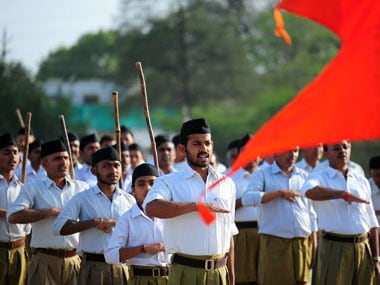
Representational image. AFP[/caption]Justice GD Khosla's accountGodse joined the RSS at the age of 22 and later on went on to join the Hindu Mahasabha. During the trial for murder, he resorted to filmy melodrama. And, before being hanged, Godse may have even regretted his violent act. These observations lie hidden in the work of Justice GD Khosla, a former judge of the Punjab high court, who was part of a three-member bench that heard an appeal filed by Godse and his accomplices after being found guilty of Gandhi's murder by a trial court.In The Murder of the Mahatma by Justice Khosla — whose words have often been quoted out of context by several Godse bhakts to build up Mahatma's murderer as a hero — he writes: "It was said afterwards that Godse had, during his last days in gaol, repented of his deed and declared that were he to be given another chance he would spend the rest of his life in the promotion of peace and the service of his country."On 10 February, 1949, a trial court found seven persons guilty of Gandhi's assassination. Godse and Narayan Apte — a philanderer who believed his stars would protect him from any punishment — were sentenced to death.Four days later the convicted criminals approached the high court to appeal the decision. Khosla writes: "Godse did not challenge his conviction upon the charge of murder, nor did he question the propriety of the death sentence. His appeal was confined to the finding that there was a conspiracy. "Justice Khosla is often portrayed as a man who had sympathy for Godse. But, this is a falsehood that was first perpetuated by Godse's followers and then, in deference to Goebbels' philosophy, acquired a life of its own. Justice Khosla was in fact in awe of the Mahatma and wrote glowingly of Gandhi after meeting him in Delhi just a few days before his assassination. "And as he went on talking, understanding came to me that this man had only one sentiment, one passion, one source of strength within him and that was a deep and pervading feeling of love. He loved Hindus and Muslims, Sikhs and Christians alike. He loved the British who had ruled over us for 150 years, he loved the Pakistanis who had hounded out millions of Hindus from their ancestral homes," he reminisced.Let's come to the statement that is credited to him to suggest the judge had empathy for Godse."I have, however, no doubt that had the audience of that day been constituted into a jury and entrusted with the task of deciding Godse's appeal, they would have brought in a verdict of 'not guilty' by an overwhelming majority," Khosla writes capturing the mood of the people in the court after Godse completed his argument with a speech.But this statement acquires a different — and the correct — meaning when read in the right context:
"It seemed to me that I was taking part in some kind of melodrama or in a scene out of a Hollywood feature film. Once or twice I had interrupted Godse and pointed out the irrelevance of what he was saying, but my colleagues seemed inclined to hear him and the audience most certainly thought that Godse's performance was the only worthwhile part of the lengthy proceedings. A writer's curiosity in watching the interplay of impact and response made me abstain from being too conscientious in the matter. Also I said to myself: 'The man is going to die soon. He is past doing any harm. He should be allowed to let off steam for the last time.' "Godse was the son of a village postmaster. During his childhood, to ward off evil influence, his mother dressed him up as a girl and made him wear a nose ring (nath), leading to the name Nathmal and then Nathuram. Since he failed to clear matriculation and find a stable job, Godse was forced to start a small tailor's shop.Justice Khosla writes: "At 22, he joined the Rashtriya Swayam Sewak Sangh — an organisation of which the avowed aim was to protect Hindu culture and solidarity. A few years later he shifted to Poona, and became Secretary of the local branch of the Hindu Mahasabha."But, the judge is silent on whether Godse was still an active member of the Sangh when he killed Gandhi.Dr Rajendra Prasad and the RSS challengeThe problem with proving the status of Godse's membership is complicated by the secrecy that shrouded the RSS during the 1940s. This is best captured in a letter written by Dr Rajendra Prasad — who later went on to become India's first president — to Sardar Patel on 12 December, 1948. (Dr Rajendra Prasad, Correspondence and Select Documents, Volume 10, page 182-183, Allied Publishers).In his missive to Patel, Prasad argues that the government must explain to the public the reasons behind the action it has taken against the RSS (it was banned after the Mahatma's murder). An annexure with the letter explains the RSS, its ideology and modus operandi:
-Through the RSS, the Maharashtrian Brahmins have been dreaming of establishing in India a Peshwa Raj after the withdrawal of the Britishers. The RSS flag is the Bhagwa flag of the Peshwas. The RSS people argue that the Peshwas — Maharashtrian rulers — were the last to be conquered by the British and, after the termination of the British rule in India, the Maharashtrians should be vested with political powers. -The RSS practises secret and violent methods that promote fascism. -There is no constitution of the organisation, its aims and objectives have never been clearly defined... Only the inner circle is taken into confidence. -There are no records of the proceedings of the RSS organisation, no registers are maintained... The RSS is thus strictly secret as regards to its organisation.Technically, it would be difficult to prove if Godse was a Sangh member. In fact, as Dr Prasad pointed out, since the RSS didn't maintain any record, not much about it can be proven legally.But, it is also a fact that the Hindu Mahasabha contributed both to the RSS and its political offshoot Jan Sangh (later BJP) by way of leadership. For a long time before Independence, it was common for politicians to be members of the Mahasabha, RSS as well as the Congress at the same time. Shyama Prasad Mukherjee, for instance, was an active member of the Mahasabha till he founded the Jan Sangh.It is true that the RSS was never indicted for its role in Gandhi's murder. Soon after Gandhi's death, home minister Sardar Patel banned the organisation, accused its members of celebrating Gandhi's murder and warned it against creating an atmosphere of hate.But none of its leaders were charged with the murder of hatching the conspiracy.Yet, Gopal Godse's statement, the Mahasabha's claims and the undisputed fact that Nathuram was indeed its member during his youth will make it difficult for the RSS to easily disown the man who killed Gandhi in January 1948.

Rahul Gandhi, Kharge lead protest near PM residence; Centre says Parliament discussion was offered
Parliament's Monsoon Session from July 20: Key bills, numbers game to dominate agenda
Major blow to Uddhav Thackeray as six Lok Sabha MPs join Shinde camp
12 years and counting: NDA leaders felicitate PM Modi as he trumps Nehru's tenure record
‘Trust, progress and welfare’: PM Modi celebrates 12 years in office, highlights big policy moves