


India’s underpriced fuel regime is a ticking debt bomb
A gradual restoration of daily fuel-price revisions may ultimately prove less disruptive than delaying adjustment until the economic pressures become far harder to manage

For several weeks now, Indian households have been shielded from the full force of a global oil shock.
Petrol and diesel prices at the pump have barely moved even as tensions in West Asia disrupted crude oil flows, raised shipping and insurance costs, and tightened global oil supplies. In many countries, fuel prices surged within days of the conflict. India chose a different approach by cushioning consumers while hoping the geopolitical disruption would ease before deeper economic damage spread through the system.
That initial strategy was understandable. Fuel prices affect almost every aspect of daily life, from vegetable prices and bus fares to logistics costs and household budgets. Sudden increases in petrol and diesel prices quickly travel through the broader economy and influence inflation expectations.
But prolonged suppression of fuel prices does not eliminate the impact of a global oil shock. It merely shifts the burden elsewhere.
 More from Opinion
That is the difficult reality India may now have to confront.
Hidden Costs
India imports more than 85 per cent of its crude oil requirement. Unlike countries with large domestic oil production, India cannot fully insulate itself from disruptions in global energy markets.
The current crisis is not merely about speculative spikes in oil futures. The Strait of Hormuz, through which a substantial share of global crude passes, has become a zone of uncertainty. Freight costs have risen. Insurance premiums have climbed. Physical cargoes are commanding higher premiums.
Indian refiners are therefore paying more not just for crude oil but also for ensuring that physical supplies continue reaching Indian ports reliably. Their import costs have also risen because of rupee depreciation in recent months.
Industry estimates suggest India’s oil import burden has increased sharply compared with average levels seen earlier this financial year. The under-recoveries are at ₹30,000 crore per month for diesel, petrol, and LPG alone. The public sector oil companies may have incurred a loss of ₹60,000 crore for these fuels in the last two months.
That burden does not remain confined to company balance sheets.
If oil marketing companies continue absorbing large losses for prolonged periods, borrowings rise, debt accumulates, and capital expenditure plans eventually come under pressure. Future investments in refining capacity, pipelines, storage infrastructure and cleaner-energy projects become harder to finance.
This matters more than many realise.
India’s energy demand is still growing rapidly. The country will require enormous investment in refining, storage, transportation and distribution infrastructure over the next decade. At the same time, oil marketing companies are also expected to invest heavily in sustainability initiatives, cleaner fuels, biofuels, hydrogen and the broader energy transition.
Oil marketing companies must therefore generate positive operating cash flows not only to sustain investments in the core refining sector, but also to finance the transition towards cleaner energy systems. These investments create direct and indirect employment, strengthen energy security, stimulate industrial activity and support broader economic growth.
India cannot simultaneously expect oil marketing companies to absorb large losses indefinitely, maintain uninterrupted fuel supplies during a geopolitical disruption, and continue investing heavily in the future.
Somewhere, eventually, the numbers stop adding up.
Restoring Pricing Discipline
These arguments are not a case for imposing a sudden and steep increase in fuel prices.
Some theoretical models based on import parity or full market-linked pricing suggest petrol and diesel prices should be significantly higher than current levels. Yet such calculations are academic benchmarks rather than realistic policy prescriptions.
The more practical option may be the restoration of daily fuel-price revisions. Such a framework would allow fuel prices to adjust gradually and transparently, rather than forcing either a prolonged freeze or a sudden one-shot correction later.
Industry observers increasingly believe that a phased increase of around ₹4-5 per litre may eventually become necessary if crude prices remain elevated and tensions in West Asia persist.
A calibrated increase of that nature would still leave Indian consumers significantly more protected than consumers in many other countries.
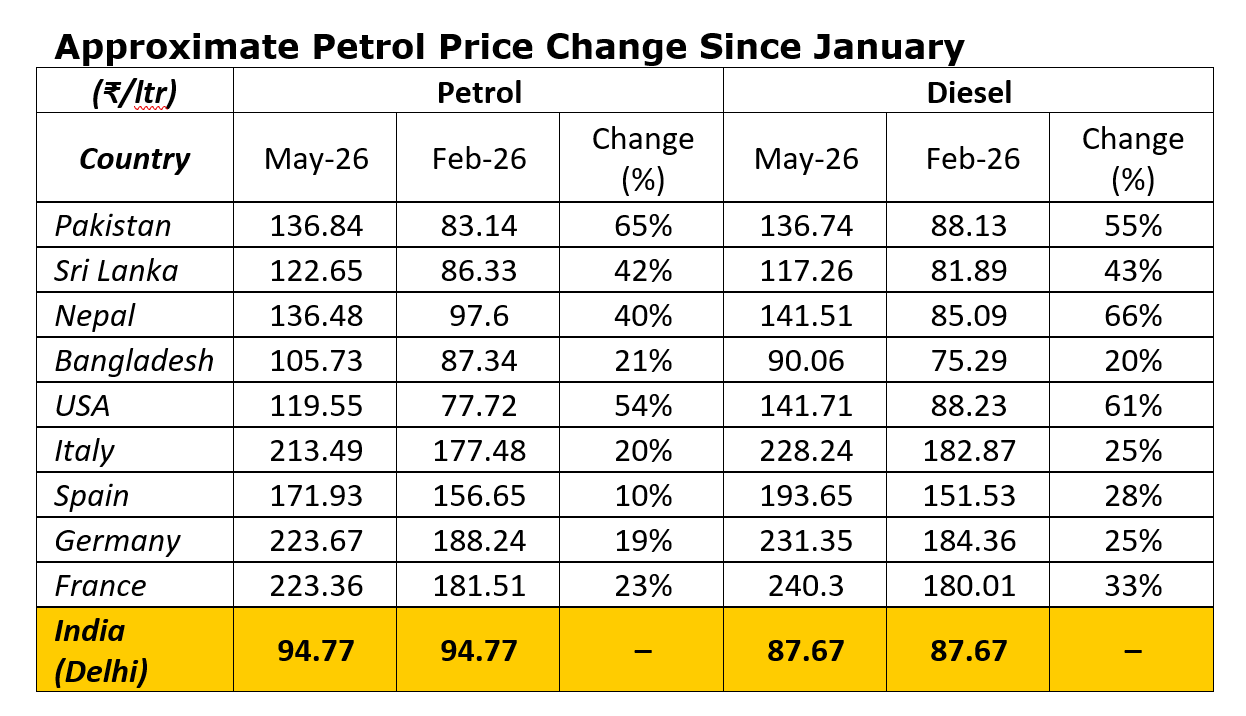
India has already shielded consumers more than most major economies. That protection bought valuable time during the initial phase of volatility.
But delaying all adjustment indefinitely carries risks of its own.
One-shot corrections tend to be economically harsher and more inflationary. They also create sharper downstream effects across transport, agriculture and logistics.
A daily-pricing mechanism may therefore offer a middle path between complete suppression and disruptive price shocks.
Shared Burden
The cushioning has already happened across the system. The Centre earlier reduced excise duties by ₹10 per litre, absorbing part of the burden fiscally. Domestic LPG price increases have remained relatively moderate compared with global benchmarks. Oil companies themselves have absorbed a substantial portion of the stress through sharply weaker marketing margins.
In effect, the pain has already been distributed across consumers, the government and oil marketing companies.
The question now is how long such an arrangement can continue if crude prices remain above $100 per barrel.
India’s own past offers a cautionary lesson. During previous oil shocks, prolonged suppression of fuel prices weakened the financial health of the sector, delayed investment decisions and increased hidden fiscal liabilities. Once uncertainty begins rising around pricing freedom, investor confidence in the sector also weakens.
That is not a path India should revisit casually.
India remains deeply dependent on imported energy. When global supply conditions deteriorate sharply, some part of that stress eventually reaches the domestic economy, either directly through prices or indirectly through fiscal and financial pressures elsewhere.
The challenge for policymakers is therefore not whether consumers should be protected during extraordinary shocks. The challenge is ensuring that temporary protection does not gradually evolve into larger instability underneath the system.
A gradual restoration of daily fuel-price revisions may ultimately prove less disruptive than delaying adjustment until the economic pressures become far harder to manage.
(The writer is former C&MD of BPCL. Views expressed in the above piece are personal and solely those of the writer. They do not necessarily reflect Firstpost’s views.)

The Russia-Ukraine war: Why peace remains so elusive
Head-on | Why President Trump is targeting India
When Manila and Tokyo draw a line, Beijing draws a red line
Bangladesh gets a new envoy to reset its India ties
Escalation trap to an exit strategy: How can the Iran war end?