


How French archives in Pondicherry are helping India recover stolen temple idols
The decades-old photographic archives from two French institutes documenting South Indian temples have become critical evidence in proving the provenance of stolen idols and helping India bring its lost antiquities home

Last week, when the Ashmolean Museum of the University of Oxford returned a stolen 16th-century bronze statue of the saint-poet Tirumangai Alvar to India, it swung the spotlight on a 70-year-old organisation based in the quaint seaside town of Pondicherry.
The Institut Francais de Pondichery, or the French Institute of Pondicherry (IFP), and the Ecole Francaise d’Extreme-Orient (EFEO) have been quietly researching and documenting Indian heritage since the mid-1950s. But the role of the French Institute in particular has, of late, expanded way beyond academic research. This French organisation—under the joint supervision of the French Ministry of Foreign Affairs and the National Centre for Scientific Research—has been actively helping the CID’s idol wing to establish the provenance of stolen antiquities from South India.
Its detailed archival evidence, for instance, was the key factor that helped the Indian authorities to not only connect the bronze statue of Tirumangai Alvar at the Ashmolean to the murti that was once housed in the temple of Shri Soundararaja Perumal in Tamil Nadu but, more importantly, legally prove that provenance through documentation conducted over a period of several years.
 More from Opinion
IFP director Renaud Colson says: “Since 1955, our photo collection has been an effort to academically document the richness of South Indian heritage, but now they have found a new purpose in fighting antiquities trafficking.” The institute’s 1.6 lakh physical images and more than 40,000 digital images are now an important weapon in the arsenal of the idol wing of the CID. Adds K Rameshkumar, head of photo archives, IFP: “We get on average 150-200 requests from the idol wing, and along with our own research work, helping the CID back up their claims on stolen heritage is now 50% of our work.”
To that end, the IFP has been developing an AI app to track stolen antiquities in collaboration with the Chennai Mathematical Institute. “The app matches the images in our archives with the picture of a stolen artefact to see if there’s a fit,” says Rameshkumar. This can be an important help to offer tip-offs to the idol wing, but proving the provenance still requires the expert eye. That’s because without before-after photographs and careful comparison, it becomes difficult to trace the tell-tale signs left by the smugglers to change the colour or alter the iconography of the stolen murtis. “Stolen images are often chemically treated to give them a greenish patina so they look older than they are,” adds Rameshkumar.
Worse, smugglers often vandalise inscriptions or alter parts of the image to make it look different and more difficult to trace. The Suthamalli Nataraja, smuggled by Subhash Kapoor and returned to India in 2014, is a case in point. Its base bore an inscription offering provenance, and it took the archives of the IFP and EFEO to back up the documentation of the original through careful comparison.
Dominic Goodall, head of the Pondicherry centre of the EFEO, says: “The photographs have been systematically archived with ledgers documenting which photographer went where, which temple in which district and village, along with dates and a numbered list of negatives. This detailed procedure makes it invaluable as evidence. That’s why the IFP/EFEO archives are so significant.”
The case of the Ardhanarishwarar murti, previously displayed at the Art Gallery of New South Wales before it was returned to India by the Australian government, is a case in point. Ledger index cards showed photographic evidence of the murti being housed and photographed at the Virudachalam temple on January 31, 1958, October 30, 1967, and March 4, 1974 – a continuous 15-year chain of photo evidence that was crucial to bringing this heritage home.
While tracking stolen antiquities is a huge part of their work, IFP and EFEO officials say that they now collaborate routinely with the ASI, National Archives and other academic and research institutes like the Tamil Nadu State Archives, Tamil Virtual Academy, Tamil Nadu State Department of Archaeology and Museum of Art & Photography in Bengaluru, among many others, on matters of heritage preservation and digitisation.
“Digital preservation is very important, and we are helping the ASI and state archaeology departments in creating methodology and a template for knowledge,” says Rameshkumar. Experts from the institute train local teams on how to digitise and preserve manuscripts and old photographs and make them easily accessible to researchers.
So when did it all begin, and why are these twin French organisations quietly working on documenting and researching Indian heritage? It all goes back to Jean Filliozat, who was a professor of Indian philology at the Ecole Pratique des Hautes Etudes and the College de France. It was he who founded the IFP in the mid-1950s and, along with NR Bhatt, kicked off an ambitious project to document the heritage of South India from 1956 to 1991.
Since then, dedicated researchers like RZ Pattabiraman and Francoise L'Hernault have ensured that the archival efforts continued with the same rigour. Today, IFP documents not just temple architecture and iconography but also murals, documents, jewellery, temple cars, old coins, copper plates, inscriptions and even prehistoric rock art.
As you walk down the airy corridors of the two 150-year-old buildings that house the IFP and EFEO, respectively, in Pondicherry’s serene heritage quarter, it is easy to think of their archival work as meant strictly for academic research.
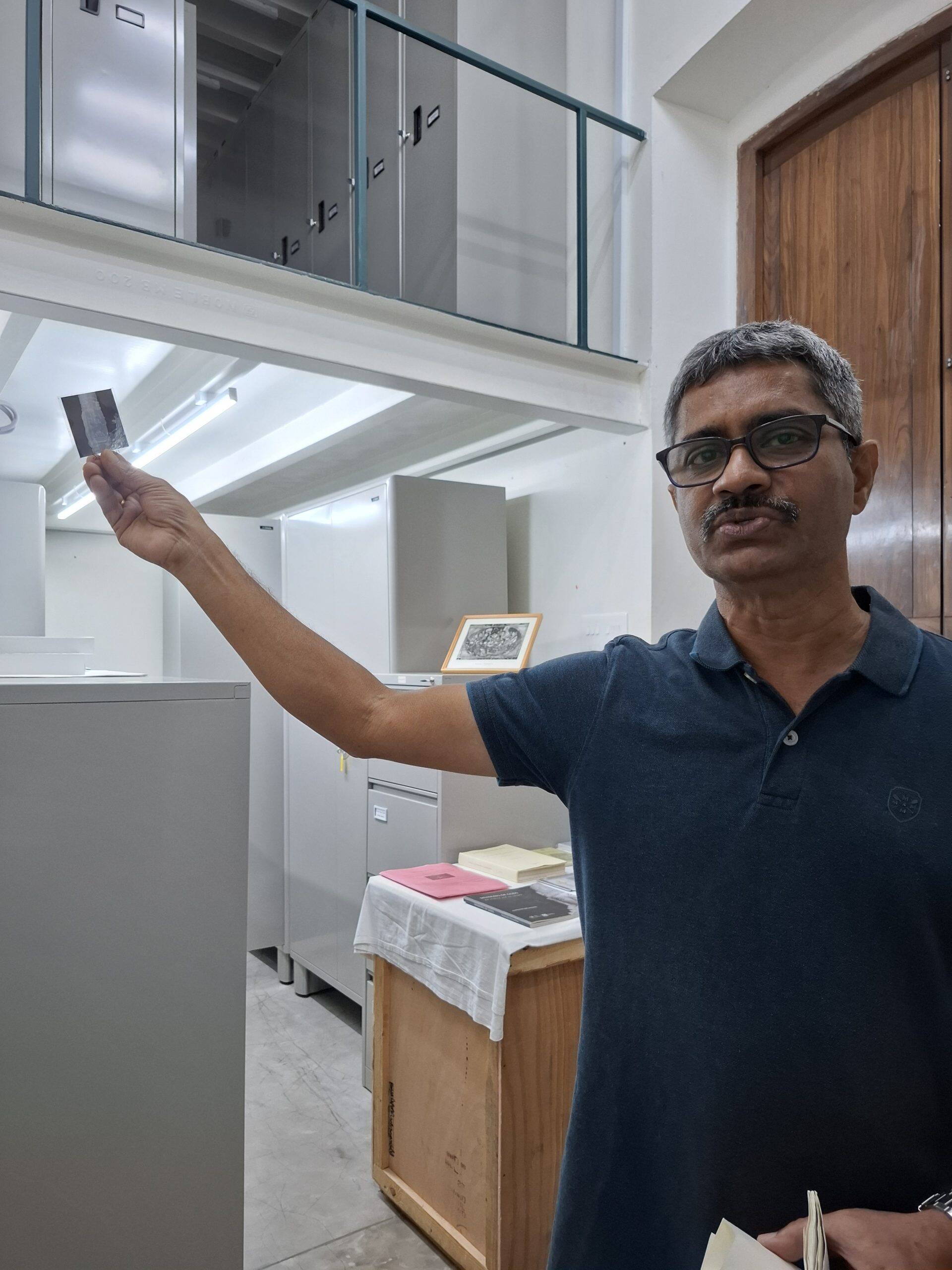
Step into the temperature-controlled photo archive of the IFP, though, and you see the rigour that goes into this work. The 70-year-old ledgers, their pages brittle with age, are carefully preserved. Every negative is wrapped in special archival paper – sourced from the Sri Aurobindo Ashram’s handmade paper factory – and secured without glue or any chemicals.
The index notes are carefully preserved. The images are all digitised. Given that there are instances of smugglers replacing temple murtis with fakes, this treasure trove of photographs taken over several decades becomes even more critical. The IFP and EFEO’s research is now India’s weapon in the battle to bring our lost antiquities home. Given how many of these smuggled antiquities are still untraced, this is a battle that has only just begun.
(Nandini Sen Gupta is a freelance writer and author of several books. Views expressed in the above piece are personal and solely those of the author. They do not necessarily reflect Firstpost’s views.)

The Russia-Ukraine war: Why peace remains so elusive
Head-on | Why President Trump is targeting India
When Manila and Tokyo draw a line, Beijing draws a red line
Bangladesh gets a new envoy to reset its India ties
Escalation trap to an exit strategy: How can the Iran war end?