


Amid frequent violent attacks on its citizens, what the future holds for China’s Balochistan plans
As the unfolding events demand continued attention, the manner in which the State responds will undoubtedly shape the trajectory of Baloch nationalist actions and exert far-reaching implications on Chinese investments and regional stability

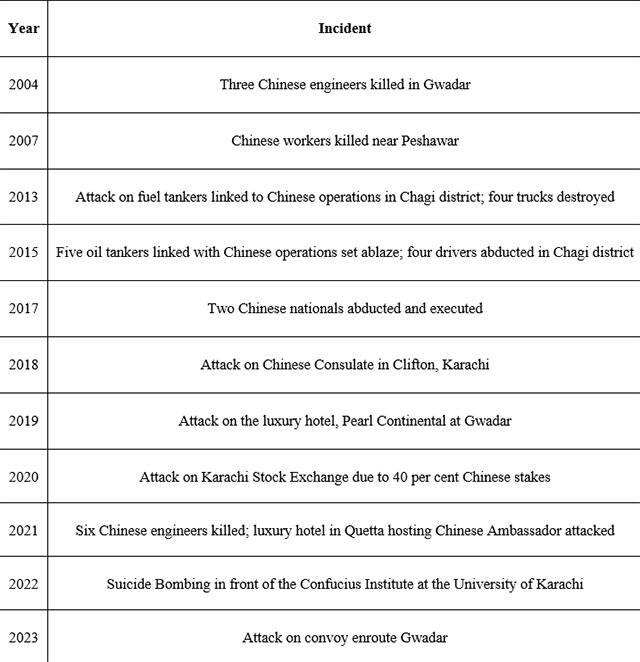
Author’s Compilation of prominent targeted attacks on Chinese investments and personnel since 2004[/caption]While there is a consistent pattern of attacks and occasional local demonstrations against evictions, the gravest concern continues to be the escalating instances of human rights violations, notably enforced disappearances. The displacement of Baloch residents to accommodate CPEC infrastructure has drawn widespread criticism. A closer examination of the Voice of Missing Baloch's database underscores a geographic shift in these disappearances, concentrated primarily in Baloch-speaking districts along the CPEC route.This intensification of violations extends beyond suppressing a longstanding anti-state movement. It is exacerbated by the complex intertwining of economic and geopolitical interests spurred by the Chinese presence. The rapid pace of CPEC construction, ostensibly addressing labour needs, has inadvertently brought about demographic changes by introducing non-Baloch-speaking populations. This phenomenon, coupled with a deterioration in human development indicators, poses a significant threat to the Baloch population and their nationalist aspirations. Following the series of dissatisfied, violent expressions of the Baloch people, over 15,000 troops of the Pakistan Army have been stationed, apart from the presence of Chinese Military Companies.In the midst of these dynamics, crucial questions emerge about the future of Chinese investments and the response of the Pakistani government. Political instability has further complicated matters, leading to project delays and impeding the full functionality of the Gwadar port. Moreover, the ineffectiveness within Pakistan's CPEC Authority has further undermined progress, with signs indicating its imminent dissolution. These developments follow the removal of the former CPEC Authority Chief, Lt Gen (Retd.) Aseem Bajwa, due to similar reasons. With the rising prominence of the Baloch nationalist movement, observers are keenly watching the government's strategies and the potential consequences.As the unfolding events demand continued attention, the manner in which the State responds will undoubtedly shape the trajectory of Baloch nationalist actions and exert far-reaching implications on Chinese investments and regional stability. The complexities of this situation warrant thorough analysis and a nuanced approach to mitigate tensions and foster progress.The author is an independent security analyst. She has previously served as a Research Assistant at Centre for Land Warfare Studies, New Delhi. Her areas of research include India’s Internal Security, especially in the Information Realm. Views expressed in the above piece are personal and solely that of the author. They do not necessarily reflect Firstpost’s views.Read all the Latest News, Trending News, Cricket News, Bollywood News,India News and Entertainment News here. Follow us on Facebook, Twitter and Instagram.
Tejusvi Shukla is a Research Associate at Chanakya University, Bengaluru, and is also serving as a Research Analyst for the Online Indian Journal of Peace and Conflict Studies. Previously, she has served with the Centre for Land Warfare Studies, a Think Tank of the Indian Army. Her areas of research include India’s internal security with a special focus on the information domain.
Tags

The Russia-Ukraine war: Why peace remains so elusive
Head-on | Why President Trump is targeting India
When Manila and Tokyo draw a line, Beijing draws a red line
Bangladesh gets a new envoy to reset its India ties
Escalation trap to an exit strategy: How can the Iran war end?