


Partitioned Freedom: Ram Madhav's new book triggers shift in popular perception of RSS’ view on Mahatma Gandhi
The book marks an important intervention in the study of India’s colonial struggle and eventual partition, and definitely forms a significant contribution to RSS’s historiography on partition

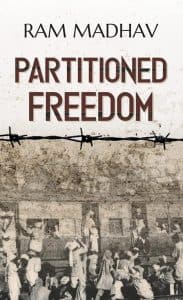
Book: Partitioned Freedom, written by Ram Madhav. Image courtesy: Amazon.in.[/caption]The book marks an important intervention in the study of India’s colonial struggle and eventual partition, and definitely forms a significant contribution to RSS’s historiography on partition. It may be positioned as a work which is not just an addition to the academic literature on the subject, but rather one which has the potential to influence the academic discourse through a re-assessment of the subject.It may also trigger a paradigm shift in the popular perception of RSS’s view of Mahatma Gandhi, as it emerges as a deeply scholarly engagement with his persona and has a conciliatory approach towards Gandhi by accepting his political leadership with all his failures.The book has been written as a story of colonial India’s journey through two partitions. Tracing our colonial history from a province’s partition that was annulled, to another that decisively vivisected India, the book maps the trajectory of changing political dynamics in the nation.As Madhav recently puts it in one of his lectures, it is also a story of Gandhi and Jinnah. While scrutinising India’s linear colonial history, the book offers us insights into a cyclical understanding of the temporal build-up to partition.Loaded with subtle messages, the book also serves as a respectful yet dispassionate appraisal of the freedom struggle’s leadership. The highly evocative titles of the book chapters aptly convey the essence of the arguments being made. It has well documented the monumental mistakes of the political stalwarts of Indian National Congress, which changed the very course of India’s history.The book begins with the argument that although the partition of Bengal on a religious basis was fought back through a display of cultural, and consequently, religious unity of Hindus and Muslims, it also sowed the seeds of India’s partition. The signs of Islamic separatism had been visible since the mid-nineteenth century, but they were given a fertile ground for assuming monstrous proportions 1905 onwards through British appeasement.The analysis that the book offers, of events such as the Lucknow Pact or the Khilafat movement, turns mainstream historical discourse on its head by arguing that these events were actually a sign of compromise, surrender and instances of pandering to separatism by the key actors of our freedom movement.Leaders such as Jawaharlal Nehru were never able to comprehend the nature of Islamic separatism. Mahatma Gandhi’s conviction in the early phases of the movement, that freedom could not be achieved without Hindu-Muslim unity, proved to be fatal for the future of colonial India.No doubt that Gandhi had the best of intentions regarding the preservation of our cultural ethos as well as Hindu-Muslim unity, but the extent of compromise that his idealism demanded later only led to fueling communal passions unfortunately.It was only in the years up to the partition that the common populace realised that the political narrative weaving around this ‘unity’ turned out to be farcical and disillusioning. Over time, the Indian National Congress displayed a lack of confidence to speak on behalf of all Indians, particularly the Muslim community, thus ceding ground to the separatist Islamic forces.As the authored has argued, it was too late to emerge out of the impending partition when Gandhi decided that securing freedom for India would have to be his top priority, and that Hindu-Muslim unity could wait.The Muslim League’s politics was a phenomenon that immensely benefitted from the loopholes created by the top echelons of the Congress. It punctured the myth of Indian syncretic culture and piggy-backed on the religious fundamentalism of radical sections of the Muslim society. The history of India’s partition also sends out an important message - that the idea of a nation and the discourse of nationalism built by the movement defines and decides the making and unmaking of a nation-state.Madhav has written that, “Revisiting horrors of the partition is needed not just as an academic exercise, nor to hate anybody, but to learn appropriate lessons and avoid another partition.” This observation sums up the driving force behind the academic endeavour taken up by him.A crucial takeaway from the book, as articulated by the author as well, is that a nation should never pander to separatist political and cultural forces. Another essential lesson to be learnt is the centrality of the idea of sacrifice in laying the foundation of a nation. A national movement demands sacrifice, and requires that cultural unity and national integrity needs to be upheld at all costs. The flag bearers of Indian nationalism need to build a civilizational discourse of Bharat, which celebrates its religious plurality while also emphasising on its cultural unity. The book has set the stage and context to rethink the present scenario of Indian politics and to also ponder over how to deal with fissiparous forces within Indian society.The author is an LL.M. graduate from Jindal Global Law School. Views expressed are personal. Read all the Latest News, Trending News, Cricket News, Bollywood News,India News and Entertainment News here. Follow us on Facebook, Twitter and Instagram.
